{"title":"河口湾淡水eDNA梯度下鱼类eDNA组成","authors":"Shota Homma, Shinya Hosokawa, Takashi Komuro","doi":"10.1002/edn3.70061","DOIUrl":null,"url":null,"abstract":"<p>Metabarcoding of environmental DNA (eDNA) is becoming practically applied to fish monitoring and conservation surveys in estuaries. However, estuarine bays may be an unsuitable zone to use eDNA metabarcoding because they are affected by eDNA originating from upstream rivers. In this study, the transition of eDNA composition from river to bay was examined to investigate the influence of freshwater sources on the eDNA composition of the downstream bay. Samples were collected in a bay spanning around 1 km and an upstream river under high and low tide within 1 day in November and in January. The samples were analyzed by using eDNA metabarcoding for fish species and species-specific quantitative analysis for the freshwater fish <i>Cyprinus carpio</i>. Our findings reveal that the eDNA of freshwater fishes was drastically diluted in the model estuarine bay. As a result, the relative-read-based composition clearly changed from riverine to marine environments, and the freshwater inflow had little effect on the relative-read-based composition at those sites. However, eDNA from freshwater fishes was widely detected in the bay by species-specific and metabarcoding analysis, suggesting that fresh water may have a more significant impact when focusing on presence/absence-based composition. Our study also found that the transition zone for the concentration of freshwater eDNA fluctuated spatiotemporally with tides, indicating that the degree of influence from the river varies with tide. Therefore, prior measurement of the distribution of freshwater fish eDNA at low tide would help to conservatively determine better sampling sites and design more reliable sampling in estuaries.</p>","PeriodicalId":52828,"journal":{"name":"Environmental DNA","volume":"7 1","pages":""},"PeriodicalIF":6.2000,"publicationDate":"2025-01-29","publicationTypes":"Journal Article","fieldsOfStudy":null,"isOpenAccess":false,"openAccessPdf":"https://onlinelibrary.wiley.com/doi/epdf/10.1002/edn3.70061","citationCount":"0","resultStr":"{\"title\":\"Fish eDNA Composition Along a Gradient of Freshwater eDNA in an Estuarine Bay\",\"authors\":\"Shota Homma, Shinya Hosokawa, Takashi Komuro\",\"doi\":\"10.1002/edn3.70061\",\"DOIUrl\":null,\"url\":null,\"abstract\":\"<p>Metabarcoding of environmental DNA (eDNA) is becoming practically applied to fish monitoring and conservation surveys in estuaries. However, estuarine bays may be an unsuitable zone to use eDNA metabarcoding because they are affected by eDNA originating from upstream rivers. In this study, the transition of eDNA composition from river to bay was examined to investigate the influence of freshwater sources on the eDNA composition of the downstream bay. Samples were collected in a bay spanning around 1 km and an upstream river under high and low tide within 1 day in November and in January. The samples were analyzed by using eDNA metabarcoding for fish species and species-specific quantitative analysis for the freshwater fish <i>Cyprinus carpio</i>. Our findings reveal that the eDNA of freshwater fishes was drastically diluted in the model estuarine bay. As a result, the relative-read-based composition clearly changed from riverine to marine environments, and the freshwater inflow had little effect on the relative-read-based composition at those sites. However, eDNA from freshwater fishes was widely detected in the bay by species-specific and metabarcoding analysis, suggesting that fresh water may have a more significant impact when focusing on presence/absence-based composition. Our study also found that the transition zone for the concentration of freshwater eDNA fluctuated spatiotemporally with tides, indicating that the degree of influence from the river varies with tide. Therefore, prior measurement of the distribution of freshwater fish eDNA at low tide would help to conservatively determine better sampling sites and design more reliable sampling in estuaries.</p>\",\"PeriodicalId\":52828,\"journal\":{\"name\":\"Environmental DNA\",\"volume\":\"7 1\",\"pages\":\"\"},\"PeriodicalIF\":6.2000,\"publicationDate\":\"2025-01-29\",\"publicationTypes\":\"Journal Article\",\"fieldsOfStudy\":null,\"isOpenAccess\":false,\"openAccessPdf\":\"https://onlinelibrary.wiley.com/doi/epdf/10.1002/edn3.70061\",\"citationCount\":\"0\",\"resultStr\":null,\"platform\":\"Semanticscholar\",\"paperid\":null,\"PeriodicalName\":\"Environmental DNA\",\"FirstCategoryId\":\"1085\",\"ListUrlMain\":\"https://onlinelibrary.wiley.com/doi/10.1002/edn3.70061\",\"RegionNum\":0,\"RegionCategory\":null,\"ArticlePicture\":[],\"TitleCN\":null,\"AbstractTextCN\":null,\"PMCID\":null,\"EPubDate\":\"\",\"PubModel\":\"\",\"JCR\":\"Q1\",\"JCRName\":\"Agricultural and Biological Sciences\",\"Score\":null,\"Total\":0}","platform":"Semanticscholar","paperid":null,"PeriodicalName":"Environmental DNA","FirstCategoryId":"1085","ListUrlMain":"https://onlinelibrary.wiley.com/doi/10.1002/edn3.70061","RegionNum":0,"RegionCategory":null,"ArticlePicture":[],"TitleCN":null,"AbstractTextCN":null,"PMCID":null,"EPubDate":"","PubModel":"","JCR":"Q1","JCRName":"Agricultural and Biological Sciences","Score":null,"Total":0}
Fish eDNA Composition Along a Gradient of Freshwater eDNA in an Estuarine Bay
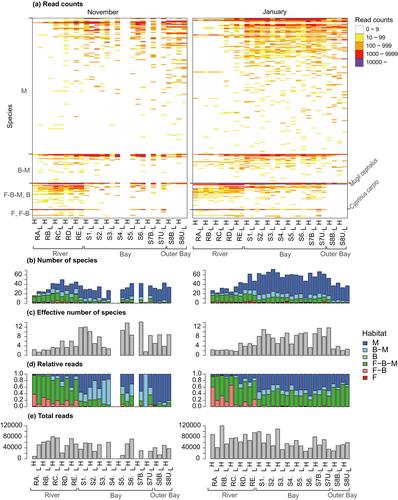
Metabarcoding of environmental DNA (eDNA) is becoming practically applied to fish monitoring and conservation surveys in estuaries. However, estuarine bays may be an unsuitable zone to use eDNA metabarcoding because they are affected by eDNA originating from upstream rivers. In this study, the transition of eDNA composition from river to bay was examined to investigate the influence of freshwater sources on the eDNA composition of the downstream bay. Samples were collected in a bay spanning around 1 km and an upstream river under high and low tide within 1 day in November and in January. The samples were analyzed by using eDNA metabarcoding for fish species and species-specific quantitative analysis for the freshwater fish Cyprinus carpio. Our findings reveal that the eDNA of freshwater fishes was drastically diluted in the model estuarine bay. As a result, the relative-read-based composition clearly changed from riverine to marine environments, and the freshwater inflow had little effect on the relative-read-based composition at those sites. However, eDNA from freshwater fishes was widely detected in the bay by species-specific and metabarcoding analysis, suggesting that fresh water may have a more significant impact when focusing on presence/absence-based composition. Our study also found that the transition zone for the concentration of freshwater eDNA fluctuated spatiotemporally with tides, indicating that the degree of influence from the river varies with tide. Therefore, prior measurement of the distribution of freshwater fish eDNA at low tide would help to conservatively determine better sampling sites and design more reliable sampling in estuaries.





 京公网安备 11010802042870号
京ICP备2023020795号-1
京公网安备 11010802042870号
京ICP备2023020795号-1

 分享
分享
 求助内容:
求助内容: 应助结果提醒方式:
 扫码关注我们
