Ezechiel B Tibiri, Palwende R Boua, Issiaka Soulama, Christine Dubreuil-Tranchant, Ndomassi Tando, Charlotte Tollenaere, Christophe Brugidou, Romaric K Nanema, Fidèle Tiendrebeogo
{"title":"非洲发展生物信息学平台的挑战与机遇:以布基纳法索Joseph Ki-Zerbo大学的BurkinaBioinfo为例。","authors":"Ezechiel B Tibiri, Palwende R Boua, Issiaka Soulama, Christine Dubreuil-Tranchant, Ndomassi Tando, Charlotte Tollenaere, Christophe Brugidou, Romaric K Nanema, Fidèle Tiendrebeogo","doi":"10.1093/bib/bbaf040","DOIUrl":null,"url":null,"abstract":"<p><p>Bioinformatics, an interdisciplinary field combining biology and computer science, enables meaningful information to be extracted from complex biological data. The exponential growth of biological data, driven by high-throughput omics technologies and advanced sequencing methods, requires robust computational resources. Worldwide, bioinformatics skills and computational clusters are essential for managing and analysing large-scale biological datasets across health, agriculture, and environmental science, which are crucial for the African continent. In Burkina Faso, the establishment of bioinformatics infrastructure has been a gradual process. Initial training initiatives between 2015-2016, including bioinformatics courses and the establishment of the BurkinaBioinfo (BBi) platform, marked significant progress. Over 250 scientists have been trained at diverse levels in bioinformatics, 105 user accounts have been created for high-performance computing access. Operational since 2019, this platform has significantly facilitated training programs for scientists and system administrators in west Africa, covering data production, introductory bioinformatics, phylogenetic analysis, and metagenomics. Financial and technical support from various sources has facilitated the rapid development of the platform to meet the growing need for bioinformatics analysis, particularly in conjunction with local 'wet labs'. Establishing a bioinformatics cluster in Burkina Faso involved identifying the needs of researchers, selecting appropriate hardware and installing the necessary bioinformatics tools. At present, the main challenges for the BBi platform include ongoing staff training in bioinformatics skills and high-level IT infrastructure management in the face of growing infrastructure demands. Despite these challenges, the establishment of a bioinformatics platform in Burkina Faso offers significant opportunities for scientific research and economic development in the country.</p>","PeriodicalId":9209,"journal":{"name":"Briefings in bioinformatics","volume":"26 1","pages":""},"PeriodicalIF":7.3000,"publicationDate":"2024-11-22","publicationTypes":"Journal Article","fieldsOfStudy":null,"isOpenAccess":false,"openAccessPdf":"https://www.ncbi.nlm.nih.gov/pmc/articles/PMC11789681/pdf/","citationCount":"0","resultStr":"{\"title\":\"Challenges and opportunities of developing bioinformatics platforms in Africa: the case of BurkinaBioinfo at Joseph Ki-Zerbo University, Burkina Faso.\",\"authors\":\"Ezechiel B Tibiri, Palwende R Boua, Issiaka Soulama, Christine Dubreuil-Tranchant, Ndomassi Tando, Charlotte Tollenaere, Christophe Brugidou, Romaric K Nanema, Fidèle Tiendrebeogo\",\"doi\":\"10.1093/bib/bbaf040\",\"DOIUrl\":null,\"url\":null,\"abstract\":\"<p><p>Bioinformatics, an interdisciplinary field combining biology and computer science, enables meaningful information to be extracted from complex biological data. The exponential growth of biological data, driven by high-throughput omics technologies and advanced sequencing methods, requires robust computational resources. Worldwide, bioinformatics skills and computational clusters are essential for managing and analysing large-scale biological datasets across health, agriculture, and environmental science, which are crucial for the African continent. In Burkina Faso, the establishment of bioinformatics infrastructure has been a gradual process. Initial training initiatives between 2015-2016, including bioinformatics courses and the establishment of the BurkinaBioinfo (BBi) platform, marked significant progress. Over 250 scientists have been trained at diverse levels in bioinformatics, 105 user accounts have been created for high-performance computing access. Operational since 2019, this platform has significantly facilitated training programs for scientists and system administrators in west Africa, covering data production, introductory bioinformatics, phylogenetic analysis, and metagenomics. Financial and technical support from various sources has facilitated the rapid development of the platform to meet the growing need for bioinformatics analysis, particularly in conjunction with local 'wet labs'. Establishing a bioinformatics cluster in Burkina Faso involved identifying the needs of researchers, selecting appropriate hardware and installing the necessary bioinformatics tools. At present, the main challenges for the BBi platform include ongoing staff training in bioinformatics skills and high-level IT infrastructure management in the face of growing infrastructure demands. Despite these challenges, the establishment of a bioinformatics platform in Burkina Faso offers significant opportunities for scientific research and economic development in the country.</p>\",\"PeriodicalId\":9209,\"journal\":{\"name\":\"Briefings in bioinformatics\",\"volume\":\"26 1\",\"pages\":\"\"},\"PeriodicalIF\":7.3000,\"publicationDate\":\"2024-11-22\",\"publicationTypes\":\"Journal Article\",\"fieldsOfStudy\":null,\"isOpenAccess\":false,\"openAccessPdf\":\"https://www.ncbi.nlm.nih.gov/pmc/articles/PMC11789681/pdf/\",\"citationCount\":\"0\",\"resultStr\":null,\"platform\":\"Semanticscholar\",\"paperid\":null,\"PeriodicalName\":\"Briefings in bioinformatics\",\"FirstCategoryId\":\"99\",\"ListUrlMain\":\"https://doi.org/10.1093/bib/bbaf040\",\"RegionNum\":2,\"RegionCategory\":\"生物学\",\"ArticlePicture\":[],\"TitleCN\":null,\"AbstractTextCN\":null,\"PMCID\":null,\"EPubDate\":\"\",\"PubModel\":\"\",\"JCR\":\"Q1\",\"JCRName\":\"BIOCHEMICAL RESEARCH METHODS\",\"Score\":null,\"Total\":0}","platform":"Semanticscholar","paperid":null,"PeriodicalName":"Briefings in bioinformatics","FirstCategoryId":"99","ListUrlMain":"https://doi.org/10.1093/bib/bbaf040","RegionNum":2,"RegionCategory":"生物学","ArticlePicture":[],"TitleCN":null,"AbstractTextCN":null,"PMCID":null,"EPubDate":"","PubModel":"","JCR":"Q1","JCRName":"BIOCHEMICAL RESEARCH METHODS","Score":null,"Total":0}
Challenges and opportunities of developing bioinformatics platforms in Africa: the case of BurkinaBioinfo at Joseph Ki-Zerbo University, Burkina Faso.
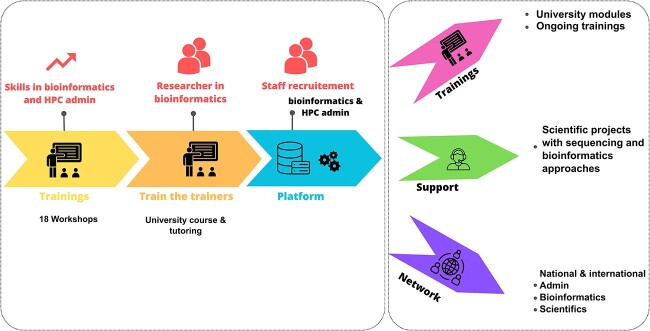
Bioinformatics, an interdisciplinary field combining biology and computer science, enables meaningful information to be extracted from complex biological data. The exponential growth of biological data, driven by high-throughput omics technologies and advanced sequencing methods, requires robust computational resources. Worldwide, bioinformatics skills and computational clusters are essential for managing and analysing large-scale biological datasets across health, agriculture, and environmental science, which are crucial for the African continent. In Burkina Faso, the establishment of bioinformatics infrastructure has been a gradual process. Initial training initiatives between 2015-2016, including bioinformatics courses and the establishment of the BurkinaBioinfo (BBi) platform, marked significant progress. Over 250 scientists have been trained at diverse levels in bioinformatics, 105 user accounts have been created for high-performance computing access. Operational since 2019, this platform has significantly facilitated training programs for scientists and system administrators in west Africa, covering data production, introductory bioinformatics, phylogenetic analysis, and metagenomics. Financial and technical support from various sources has facilitated the rapid development of the platform to meet the growing need for bioinformatics analysis, particularly in conjunction with local 'wet labs'. Establishing a bioinformatics cluster in Burkina Faso involved identifying the needs of researchers, selecting appropriate hardware and installing the necessary bioinformatics tools. At present, the main challenges for the BBi platform include ongoing staff training in bioinformatics skills and high-level IT infrastructure management in the face of growing infrastructure demands. Despite these challenges, the establishment of a bioinformatics platform in Burkina Faso offers significant opportunities for scientific research and economic development in the country.
期刊介绍:
Briefings in Bioinformatics is an international journal serving as a platform for researchers and educators in the life sciences. It also appeals to mathematicians, statisticians, and computer scientists applying their expertise to biological challenges. The journal focuses on reviews tailored for users of databases and analytical tools in contemporary genetics, molecular and systems biology. It stands out by offering practical assistance and guidance to non-specialists in computerized methodologies. Covering a wide range from introductory concepts to specific protocols and analyses, the papers address bacterial, plant, fungal, animal, and human data.
The journal's detailed subject areas include genetic studies of phenotypes and genotypes, mapping, DNA sequencing, expression profiling, gene expression studies, microarrays, alignment methods, protein profiles and HMMs, lipids, metabolic and signaling pathways, structure determination and function prediction, phylogenetic studies, and education and training.





 京公网安备 11010802042870号
京ICP备2023020795号-1
京公网安备 11010802042870号
京ICP备2023020795号-1

 分享
分享
 求助内容:
求助内容: 应助结果提醒方式:
 扫码关注我们
