Yongxue Li , Runuo Wang , Chunling Mao , Qian Hang , Longshan Zhao
{"title":"基于MoS2/N,S-CQDs/Bi2S3纳米复合光敏材料的双功能策略:前列腺抗原的超灵敏检测及便携式检测器的初步设计","authors":"Yongxue Li , Runuo Wang , Chunling Mao , Qian Hang , Longshan Zhao","doi":"10.1016/j.snb.2025.137305","DOIUrl":null,"url":null,"abstract":"<div><div>In this work, a novel photoelectrochemical (PEC) immunosensor based on molybdenum disulfide (MoS<sub>2</sub>)/nitrogen and sulfur co-doped carbon quantum dots (N,S-CQDs)/bismuth sulfide (Bi<sub>2</sub>S<sub>3</sub>) nanocomposites was designed for the quantitative detection of prostate-specific antigen (PSA) in human serum and urine. For the initial time, we used the synthesized N,S-CQDs as a Mo<sup>4</sup><sup>+</sup> and Bi<sup>3+</sup> sulfur source. A one-step hydrothermal process was used to create highly photoactive MoS<sub>2</sub>/N,S-CQDs/Bi<sub>2</sub>S<sub>3</sub> nanoheterojunctions. Compared to pure MoS<sub>2</sub> and Bi<sub>2</sub>S<sub>3</sub>, MoS<sub>2</sub>/N,S-CQDs/Bi<sub>2</sub>S<sub>3</sub> exhibited better photoelectric activity and electron transfer efficiency. By the layer-by-layer assembly method, the specificity between PSA and prostate-specific antibody (Anti-PSA) was used to form an immune complex, which increased the spatial site resistance of MoS<sub>2</sub>/N,S-CQDs/Bi<sub>2</sub>S<sub>3</sub>, leading to a decrease in photocurrent transmission efficiency, thus reaching the purpose of direct detection of PSA concentration. Under the optimized conditions, the photoelectric signal intensity of the MoS<sub>2</sub>/N,S-CQDs/Bi<sub>2</sub>S<sub>3</sub> PEC immunosensor showed a good linear relationship with the concentration of PSA in the range of 0.001 ng/mL to 50 ng/mL, and the limit of detection (LOD) was 0.35 pg/mL. Regarding quantitative PSA detection, the developed PEC immunosensor offers outstanding selectivity, sensitivity, and stability, which can provide an effective strategy for diagnosing and treating prostate cancer. In addition, to detect PSA and other biomarkers with speed and precision, a novel portable PEC detector model was proposed and designed in this study, and the construction of this model has great potential for application in clinical and other disease diagnosis.</div></div>","PeriodicalId":425,"journal":{"name":"Sensors and Actuators B: Chemical","volume":"430 ","pages":"Article 137305"},"PeriodicalIF":3.7000,"publicationDate":"2025-05-01","publicationTypes":"Journal Article","fieldsOfStudy":null,"isOpenAccess":false,"openAccessPdf":"","citationCount":"0","resultStr":"{\"title\":\"Bifunctional strategy based on MoS2/N,S-CQDs/Bi2S3 nanocomposite photosensitive materials: Ultrasensitive detection of prostate antigens and preliminary design of a portable detector\",\"authors\":\"Yongxue Li , Runuo Wang , Chunling Mao , Qian Hang , Longshan Zhao\",\"doi\":\"10.1016/j.snb.2025.137305\",\"DOIUrl\":null,\"url\":null,\"abstract\":\"<div><div>In this work, a novel photoelectrochemical (PEC) immunosensor based on molybdenum disulfide (MoS<sub>2</sub>)/nitrogen and sulfur co-doped carbon quantum dots (N,S-CQDs)/bismuth sulfide (Bi<sub>2</sub>S<sub>3</sub>) nanocomposites was designed for the quantitative detection of prostate-specific antigen (PSA) in human serum and urine. For the initial time, we used the synthesized N,S-CQDs as a Mo<sup>4</sup><sup>+</sup> and Bi<sup>3+</sup> sulfur source. A one-step hydrothermal process was used to create highly photoactive MoS<sub>2</sub>/N,S-CQDs/Bi<sub>2</sub>S<sub>3</sub> nanoheterojunctions. Compared to pure MoS<sub>2</sub> and Bi<sub>2</sub>S<sub>3</sub>, MoS<sub>2</sub>/N,S-CQDs/Bi<sub>2</sub>S<sub>3</sub> exhibited better photoelectric activity and electron transfer efficiency. By the layer-by-layer assembly method, the specificity between PSA and prostate-specific antibody (Anti-PSA) was used to form an immune complex, which increased the spatial site resistance of MoS<sub>2</sub>/N,S-CQDs/Bi<sub>2</sub>S<sub>3</sub>, leading to a decrease in photocurrent transmission efficiency, thus reaching the purpose of direct detection of PSA concentration. Under the optimized conditions, the photoelectric signal intensity of the MoS<sub>2</sub>/N,S-CQDs/Bi<sub>2</sub>S<sub>3</sub> PEC immunosensor showed a good linear relationship with the concentration of PSA in the range of 0.001 ng/mL to 50 ng/mL, and the limit of detection (LOD) was 0.35 pg/mL. Regarding quantitative PSA detection, the developed PEC immunosensor offers outstanding selectivity, sensitivity, and stability, which can provide an effective strategy for diagnosing and treating prostate cancer. In addition, to detect PSA and other biomarkers with speed and precision, a novel portable PEC detector model was proposed and designed in this study, and the construction of this model has great potential for application in clinical and other disease diagnosis.</div></div>\",\"PeriodicalId\":425,\"journal\":{\"name\":\"Sensors and Actuators B: Chemical\",\"volume\":\"430 \",\"pages\":\"Article 137305\"},\"PeriodicalIF\":3.7000,\"publicationDate\":\"2025-05-01\",\"publicationTypes\":\"Journal Article\",\"fieldsOfStudy\":null,\"isOpenAccess\":false,\"openAccessPdf\":\"\",\"citationCount\":\"0\",\"resultStr\":null,\"platform\":\"Semanticscholar\",\"paperid\":null,\"PeriodicalName\":\"Sensors and Actuators B: Chemical\",\"FirstCategoryId\":\"92\",\"ListUrlMain\":\"https://www.sciencedirect.com/science/article/pii/S0925400525000802\",\"RegionNum\":1,\"RegionCategory\":\"化学\",\"ArticlePicture\":[],\"TitleCN\":null,\"AbstractTextCN\":null,\"PMCID\":null,\"EPubDate\":\"2025/2/4 0:00:00\",\"PubModel\":\"Epub\",\"JCR\":\"Q1\",\"JCRName\":\"CHEMISTRY, ANALYTICAL\",\"Score\":null,\"Total\":0}","platform":"Semanticscholar","paperid":null,"PeriodicalName":"Sensors and Actuators B: Chemical","FirstCategoryId":"92","ListUrlMain":"https://www.sciencedirect.com/science/article/pii/S0925400525000802","RegionNum":1,"RegionCategory":"化学","ArticlePicture":[],"TitleCN":null,"AbstractTextCN":null,"PMCID":null,"EPubDate":"2025/2/4 0:00:00","PubModel":"Epub","JCR":"Q1","JCRName":"CHEMISTRY, ANALYTICAL","Score":null,"Total":0}
Bifunctional strategy based on MoS2/N,S-CQDs/Bi2S3 nanocomposite photosensitive materials: Ultrasensitive detection of prostate antigens and preliminary design of a portable detector
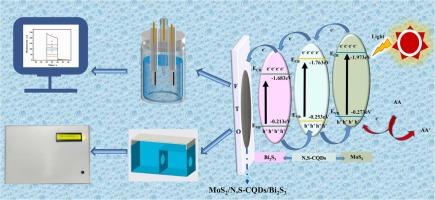
In this work, a novel photoelectrochemical (PEC) immunosensor based on molybdenum disulfide (MoS2)/nitrogen and sulfur co-doped carbon quantum dots (N,S-CQDs)/bismuth sulfide (Bi2S3) nanocomposites was designed for the quantitative detection of prostate-specific antigen (PSA) in human serum and urine. For the initial time, we used the synthesized N,S-CQDs as a Mo4+ and Bi3+ sulfur source. A one-step hydrothermal process was used to create highly photoactive MoS2/N,S-CQDs/Bi2S3 nanoheterojunctions. Compared to pure MoS2 and Bi2S3, MoS2/N,S-CQDs/Bi2S3 exhibited better photoelectric activity and electron transfer efficiency. By the layer-by-layer assembly method, the specificity between PSA and prostate-specific antibody (Anti-PSA) was used to form an immune complex, which increased the spatial site resistance of MoS2/N,S-CQDs/Bi2S3, leading to a decrease in photocurrent transmission efficiency, thus reaching the purpose of direct detection of PSA concentration. Under the optimized conditions, the photoelectric signal intensity of the MoS2/N,S-CQDs/Bi2S3 PEC immunosensor showed a good linear relationship with the concentration of PSA in the range of 0.001 ng/mL to 50 ng/mL, and the limit of detection (LOD) was 0.35 pg/mL. Regarding quantitative PSA detection, the developed PEC immunosensor offers outstanding selectivity, sensitivity, and stability, which can provide an effective strategy for diagnosing and treating prostate cancer. In addition, to detect PSA and other biomarkers with speed and precision, a novel portable PEC detector model was proposed and designed in this study, and the construction of this model has great potential for application in clinical and other disease diagnosis.
期刊介绍:
Sensors & Actuators, B: Chemical is an international journal focused on the research and development of chemical transducers. It covers chemical sensors and biosensors, chemical actuators, and analytical microsystems. The journal is interdisciplinary, aiming to publish original works showcasing substantial advancements beyond the current state of the art in these fields, with practical applicability to solving meaningful analytical problems. Review articles are accepted by invitation from an Editor of the journal.




 京公网安备 11010802042870号
京ICP备2023020795号-1
京公网安备 11010802042870号
京ICP备2023020795号-1

 分享
分享
 求助内容:
求助内容: 应助结果提醒方式:
 扫码关注我们
