{"title":"用胱抑素c估计肾小球滤过率(GFR)——过去、现在和将来","authors":"Amy B Karger, Michael G Shlipak","doi":"10.1093/clinchem/hvae226","DOIUrl":null,"url":null,"abstract":"Background Cystatin C is a long-established filtration marker which can be used to assess kidney function, but it has been sparingly used for clinical care due to creatinine’s role as the primary biomarker for kidney function assessment based on estimated glomerular filtration rate (eGFR). Content This review summarizes the evolution of cystatin C’s role in kidney disease assessment and highlights new guidelines promoting more widespread use. Specifically, the 2021 National Kidney Foundation and American Society of Nephrology Task Force on Reassessing the Inclusion of Race in Diagnosing Kidney Disease report, and the 2024 Kidney Disease Improving Global Outcomes (KDIGO) Clinical Practice Guideline for the Evaluation and Management of Chronic Kidney Disease (CKD), recommend increased use of cystatin C as an alternative and complementary biomarker for kidney function assessment, since it does not differ by race like creatinine, correlates better with adverse outcomes compared to creatinine, and provides a more accurate eGFR when used in combination with creatinine. Summary While robust literature demonstrates improved accuracy with cystatin C-based eGFR (eGFRcys) in certain clinical subpopulations, future research is needed to better understand its performance relative to creatinine-based eGFR (eGFRcr) and measured glomerular filtration rate (mGFR) in additional diverse cohorts, and to achieve assay standardization to match the performance of creatinine assays. Additionally, cystatin C testing availability will need to be broadened from primarily reference laboratories to local laboratories, and partnerships will need to be developed between clinical stakeholders and the laboratory to promote cystatin C’s clinical use, to achieve widespread adoption of guideline-recommended eGFR equations.","PeriodicalId":10690,"journal":{"name":"Clinical chemistry","volume":"39 1","pages":""},"PeriodicalIF":8.3000,"publicationDate":"2025-02-04","publicationTypes":"Journal Article","fieldsOfStudy":null,"isOpenAccess":false,"openAccessPdf":"","citationCount":"0","resultStr":"{\"title\":\"Glomerular Filtration Rate (GFR) Estimation with Cystatin C—Past, Present, and Future\",\"authors\":\"Amy B Karger, Michael G Shlipak\",\"doi\":\"10.1093/clinchem/hvae226\",\"DOIUrl\":null,\"url\":null,\"abstract\":\"Background Cystatin C is a long-established filtration marker which can be used to assess kidney function, but it has been sparingly used for clinical care due to creatinine’s role as the primary biomarker for kidney function assessment based on estimated glomerular filtration rate (eGFR). Content This review summarizes the evolution of cystatin C’s role in kidney disease assessment and highlights new guidelines promoting more widespread use. Specifically, the 2021 National Kidney Foundation and American Society of Nephrology Task Force on Reassessing the Inclusion of Race in Diagnosing Kidney Disease report, and the 2024 Kidney Disease Improving Global Outcomes (KDIGO) Clinical Practice Guideline for the Evaluation and Management of Chronic Kidney Disease (CKD), recommend increased use of cystatin C as an alternative and complementary biomarker for kidney function assessment, since it does not differ by race like creatinine, correlates better with adverse outcomes compared to creatinine, and provides a more accurate eGFR when used in combination with creatinine. Summary While robust literature demonstrates improved accuracy with cystatin C-based eGFR (eGFRcys) in certain clinical subpopulations, future research is needed to better understand its performance relative to creatinine-based eGFR (eGFRcr) and measured glomerular filtration rate (mGFR) in additional diverse cohorts, and to achieve assay standardization to match the performance of creatinine assays. Additionally, cystatin C testing availability will need to be broadened from primarily reference laboratories to local laboratories, and partnerships will need to be developed between clinical stakeholders and the laboratory to promote cystatin C’s clinical use, to achieve widespread adoption of guideline-recommended eGFR equations.\",\"PeriodicalId\":10690,\"journal\":{\"name\":\"Clinical chemistry\",\"volume\":\"39 1\",\"pages\":\"\"},\"PeriodicalIF\":8.3000,\"publicationDate\":\"2025-02-04\",\"publicationTypes\":\"Journal Article\",\"fieldsOfStudy\":null,\"isOpenAccess\":false,\"openAccessPdf\":\"\",\"citationCount\":\"0\",\"resultStr\":null,\"platform\":\"Semanticscholar\",\"paperid\":null,\"PeriodicalName\":\"Clinical chemistry\",\"FirstCategoryId\":\"3\",\"ListUrlMain\":\"https://doi.org/10.1093/clinchem/hvae226\",\"RegionNum\":2,\"RegionCategory\":\"医学\",\"ArticlePicture\":[],\"TitleCN\":null,\"AbstractTextCN\":null,\"PMCID\":null,\"EPubDate\":\"\",\"PubModel\":\"\",\"JCR\":\"Q1\",\"JCRName\":\"MEDICAL LABORATORY TECHNOLOGY\",\"Score\":null,\"Total\":0}","platform":"Semanticscholar","paperid":null,"PeriodicalName":"Clinical chemistry","FirstCategoryId":"3","ListUrlMain":"https://doi.org/10.1093/clinchem/hvae226","RegionNum":2,"RegionCategory":"医学","ArticlePicture":[],"TitleCN":null,"AbstractTextCN":null,"PMCID":null,"EPubDate":"","PubModel":"","JCR":"Q1","JCRName":"MEDICAL LABORATORY TECHNOLOGY","Score":null,"Total":0}
Glomerular Filtration Rate (GFR) Estimation with Cystatin C—Past, Present, and Future
Background Cystatin C is a long-established filtration marker which can be used to assess kidney function, but it has been sparingly used for clinical care due to creatinine’s role as the primary biomarker for kidney function assessment based on estimated glomerular filtration rate (eGFR). Content This review summarizes the evolution of cystatin C’s role in kidney disease assessment and highlights new guidelines promoting more widespread use. Specifically, the 2021 National Kidney Foundation and American Society of Nephrology Task Force on Reassessing the Inclusion of Race in Diagnosing Kidney Disease report, and the 2024 Kidney Disease Improving Global Outcomes (KDIGO) Clinical Practice Guideline for the Evaluation and Management of Chronic Kidney Disease (CKD), recommend increased use of cystatin C as an alternative and complementary biomarker for kidney function assessment, since it does not differ by race like creatinine, correlates better with adverse outcomes compared to creatinine, and provides a more accurate eGFR when used in combination with creatinine. Summary While robust literature demonstrates improved accuracy with cystatin C-based eGFR (eGFRcys) in certain clinical subpopulations, future research is needed to better understand its performance relative to creatinine-based eGFR (eGFRcr) and measured glomerular filtration rate (mGFR) in additional diverse cohorts, and to achieve assay standardization to match the performance of creatinine assays. Additionally, cystatin C testing availability will need to be broadened from primarily reference laboratories to local laboratories, and partnerships will need to be developed between clinical stakeholders and the laboratory to promote cystatin C’s clinical use, to achieve widespread adoption of guideline-recommended eGFR equations.
期刊介绍:
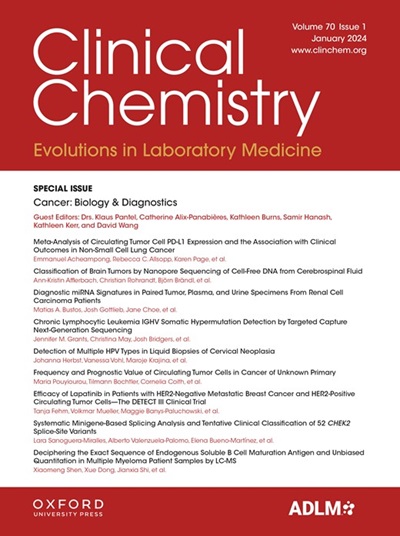
Clinical Chemistry is a peer-reviewed scientific journal that is the premier publication for the science and practice of clinical laboratory medicine. It was established in 1955 and is associated with the Association for Diagnostics & Laboratory Medicine (ADLM).
The journal focuses on laboratory diagnosis and management of patients, and has expanded to include other clinical laboratory disciplines such as genomics, hematology, microbiology, and toxicology. It also publishes articles relevant to clinical specialties including cardiology, endocrinology, gastroenterology, genetics, immunology, infectious diseases, maternal-fetal medicine, neurology, nutrition, oncology, and pediatrics.
In addition to original research, editorials, and reviews, Clinical Chemistry features recurring sections such as clinical case studies, perspectives, podcasts, and Q&A articles. It has the highest impact factor among journals of clinical chemistry, laboratory medicine, pathology, analytical chemistry, transfusion medicine, and clinical microbiology.
The journal is indexed in databases such as MEDLINE and Web of Science.




 京公网安备 11010802042870号
京ICP备2023020795号-1
京公网安备 11010802042870号
京ICP备2023020795号-1

 分享
分享
 求助内容:
求助内容: 应助结果提醒方式:
 扫码关注我们
