Dongyu Li , Heng Li , Juan Du , Yahui Zhang , Tong Li , Zebei Mao , Bo Wang
{"title":"GNP/SCF改性PEEK复合材料力学导热性能协同增强机理研究","authors":"Dongyu Li , Heng Li , Juan Du , Yahui Zhang , Tong Li , Zebei Mao , Bo Wang","doi":"10.1016/j.ijheatmasstransfer.2025.126777","DOIUrl":null,"url":null,"abstract":"<div><div>The improvement of thermal conductivity of thermoplastic composites is more dependent on the addition of thermally conductive fillers, and too much of fillers can lead to a significant decrease in mechanical properties. In order to reduce the negative correlation between thermal conductivity and mechanical properties of thermoplastic composites, in this study, graphene (GNP)/short-cut carbon fiber (SCF) synergistically reinforced network structure was constructed, high strength thermal conductivity PEEK based composites were prepared using injection molding technology. The effects of GNP/SCF synergistically reinforced network structure on the thermal conductivity, mechanical properties of PEEK composites were studied. The results showed that when the mixed filler ratio was 25 wt.% (5 wt.% GNP and 20 wt.% SCF), compared to the pure PEEK, the thermal conductivity was improved by 356.2%, tensile strength by 43.29%, the heat dissipation rate by 16.2 °C/min. The above experimental results indicate that the GNP/SCF synergistically reinforced network structure can significantly improve the thermal conductivity of composites while maintaining high tensile strength.</div></div>","PeriodicalId":336,"journal":{"name":"International Journal of Heat and Mass Transfer","volume":"241 ","pages":"Article 126777"},"PeriodicalIF":5.8000,"publicationDate":"2025-05-15","publicationTypes":"Journal Article","fieldsOfStudy":null,"isOpenAccess":false,"openAccessPdf":"","citationCount":"0","resultStr":"{\"title\":\"Synergistic enhancement mechanism study of mechanical and thermal conductivity of GNP/SCF modified PEEK composites\",\"authors\":\"Dongyu Li , Heng Li , Juan Du , Yahui Zhang , Tong Li , Zebei Mao , Bo Wang\",\"doi\":\"10.1016/j.ijheatmasstransfer.2025.126777\",\"DOIUrl\":null,\"url\":null,\"abstract\":\"<div><div>The improvement of thermal conductivity of thermoplastic composites is more dependent on the addition of thermally conductive fillers, and too much of fillers can lead to a significant decrease in mechanical properties. In order to reduce the negative correlation between thermal conductivity and mechanical properties of thermoplastic composites, in this study, graphene (GNP)/short-cut carbon fiber (SCF) synergistically reinforced network structure was constructed, high strength thermal conductivity PEEK based composites were prepared using injection molding technology. The effects of GNP/SCF synergistically reinforced network structure on the thermal conductivity, mechanical properties of PEEK composites were studied. The results showed that when the mixed filler ratio was 25 wt.% (5 wt.% GNP and 20 wt.% SCF), compared to the pure PEEK, the thermal conductivity was improved by 356.2%, tensile strength by 43.29%, the heat dissipation rate by 16.2 °C/min. The above experimental results indicate that the GNP/SCF synergistically reinforced network structure can significantly improve the thermal conductivity of composites while maintaining high tensile strength.</div></div>\",\"PeriodicalId\":336,\"journal\":{\"name\":\"International Journal of Heat and Mass Transfer\",\"volume\":\"241 \",\"pages\":\"Article 126777\"},\"PeriodicalIF\":5.8000,\"publicationDate\":\"2025-05-15\",\"publicationTypes\":\"Journal Article\",\"fieldsOfStudy\":null,\"isOpenAccess\":false,\"openAccessPdf\":\"\",\"citationCount\":\"0\",\"resultStr\":null,\"platform\":\"Semanticscholar\",\"paperid\":null,\"PeriodicalName\":\"International Journal of Heat and Mass Transfer\",\"FirstCategoryId\":\"5\",\"ListUrlMain\":\"https://www.sciencedirect.com/science/article/pii/S0017931025001188\",\"RegionNum\":2,\"RegionCategory\":\"工程技术\",\"ArticlePicture\":[],\"TitleCN\":null,\"AbstractTextCN\":null,\"PMCID\":null,\"EPubDate\":\"2025/2/4 0:00:00\",\"PubModel\":\"Epub\",\"JCR\":\"Q1\",\"JCRName\":\"ENGINEERING, MECHANICAL\",\"Score\":null,\"Total\":0}","platform":"Semanticscholar","paperid":null,"PeriodicalName":"International Journal of Heat and Mass Transfer","FirstCategoryId":"5","ListUrlMain":"https://www.sciencedirect.com/science/article/pii/S0017931025001188","RegionNum":2,"RegionCategory":"工程技术","ArticlePicture":[],"TitleCN":null,"AbstractTextCN":null,"PMCID":null,"EPubDate":"2025/2/4 0:00:00","PubModel":"Epub","JCR":"Q1","JCRName":"ENGINEERING, MECHANICAL","Score":null,"Total":0}
Synergistic enhancement mechanism study of mechanical and thermal conductivity of GNP/SCF modified PEEK composites
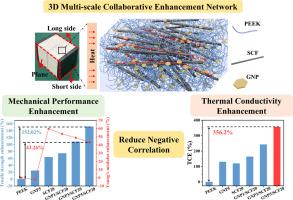
The improvement of thermal conductivity of thermoplastic composites is more dependent on the addition of thermally conductive fillers, and too much of fillers can lead to a significant decrease in mechanical properties. In order to reduce the negative correlation between thermal conductivity and mechanical properties of thermoplastic composites, in this study, graphene (GNP)/short-cut carbon fiber (SCF) synergistically reinforced network structure was constructed, high strength thermal conductivity PEEK based composites were prepared using injection molding technology. The effects of GNP/SCF synergistically reinforced network structure on the thermal conductivity, mechanical properties of PEEK composites were studied. The results showed that when the mixed filler ratio was 25 wt.% (5 wt.% GNP and 20 wt.% SCF), compared to the pure PEEK, the thermal conductivity was improved by 356.2%, tensile strength by 43.29%, the heat dissipation rate by 16.2 °C/min. The above experimental results indicate that the GNP/SCF synergistically reinforced network structure can significantly improve the thermal conductivity of composites while maintaining high tensile strength.
期刊介绍:
International Journal of Heat and Mass Transfer is the vehicle for the exchange of basic ideas in heat and mass transfer between research workers and engineers throughout the world. It focuses on both analytical and experimental research, with an emphasis on contributions which increase the basic understanding of transfer processes and their application to engineering problems.
Topics include:
-New methods of measuring and/or correlating transport-property data
-Energy engineering
-Environmental applications of heat and/or mass transfer




 京公网安备 11010802042870号
京ICP备2023020795号-1
京公网安备 11010802042870号
京ICP备2023020795号-1

 分享
分享
 求助内容:
求助内容: 应助结果提醒方式:
 扫码关注我们
