William Moloto , Pontsho Mbule , Edward Nxumalo , Bulelwa Ntsendwana
{"title":"白菜/菠菜混合天然染料敏化金属有机骨架/多金属氧酸盐- tio2基电子寿命增强和载流子重组减少的DSCCs的制备","authors":"William Moloto , Pontsho Mbule , Edward Nxumalo , Bulelwa Ntsendwana","doi":"10.1016/j.cinorg.2025.100087","DOIUrl":null,"url":null,"abstract":"<div><div>In an attempt to improve DSSCs efficiency, titanium dioxide (TiO<sub>2</sub>) hybrid photoanode materials exuding electrocatalytic and photoelectrocatalytic were incorporated into iron based metal organic frameworks (MOFs) derived from BTC = 1,3,5-Benzenetricarboxylic acid and Bismuth based polyoxometalates (POMs). The combination of FeBTC and BiPOM were used to form enhanced photoelectrocatalytic properties, with different concentrations of <em>N</em>-doped carbon quantum dots (CQDs) as the light absorbing materials. The TiO<sub>2</sub>-FeBTC-BiPOM (6 %) nanocomposites doped with 400 μg/mL CQDs exhibited improved performance with lower charge transfer resistance. As a result, this electrode was used to fabricate a novel natural dye (chlorophyll, anthocyanin and cocktail mixture)-based DSSCs.The cocktail based mixture showed higher power conversion efficiency of 1.92 % compared to spinach based DSSCs (0.98 %) and purple cabbage (0.89 %) under 100 mW/cm<sup>2</sup> light illumination with 30 ms of electron lifetime, which is three times and four times more than spinach and cabbage based DSSCs respectively. In comparison to synthetic DSSCs, the efficiency of the natural dyes was still lower than N3 dyes. However, considering practical requirements of DSSCs, the natural dye-based devices satisfy most of the criteria such as affordability, ease of extraction, multiple wavelengths that can be absorbed with large coefficient, non-toxicity, and wide availability.</div></div>","PeriodicalId":100233,"journal":{"name":"Chemistry of Inorganic Materials","volume":"5 ","pages":"Article 100087"},"PeriodicalIF":0.0000,"publicationDate":"2025-04-01","publicationTypes":"Journal Article","fieldsOfStudy":null,"isOpenAccess":false,"openAccessPdf":"","citationCount":"0","resultStr":"{\"title\":\"Fabrication of metal organic framework/Polyoxometalate-TiO2 based DSCCs with enhanced electron lifetime and reduced recombination of charge carriers sensitized with cabbage/spinach cocktail natural dyes\",\"authors\":\"William Moloto , Pontsho Mbule , Edward Nxumalo , Bulelwa Ntsendwana\",\"doi\":\"10.1016/j.cinorg.2025.100087\",\"DOIUrl\":null,\"url\":null,\"abstract\":\"<div><div>In an attempt to improve DSSCs efficiency, titanium dioxide (TiO<sub>2</sub>) hybrid photoanode materials exuding electrocatalytic and photoelectrocatalytic were incorporated into iron based metal organic frameworks (MOFs) derived from BTC = 1,3,5-Benzenetricarboxylic acid and Bismuth based polyoxometalates (POMs). The combination of FeBTC and BiPOM were used to form enhanced photoelectrocatalytic properties, with different concentrations of <em>N</em>-doped carbon quantum dots (CQDs) as the light absorbing materials. The TiO<sub>2</sub>-FeBTC-BiPOM (6 %) nanocomposites doped with 400 μg/mL CQDs exhibited improved performance with lower charge transfer resistance. As a result, this electrode was used to fabricate a novel natural dye (chlorophyll, anthocyanin and cocktail mixture)-based DSSCs.The cocktail based mixture showed higher power conversion efficiency of 1.92 % compared to spinach based DSSCs (0.98 %) and purple cabbage (0.89 %) under 100 mW/cm<sup>2</sup> light illumination with 30 ms of electron lifetime, which is three times and four times more than spinach and cabbage based DSSCs respectively. In comparison to synthetic DSSCs, the efficiency of the natural dyes was still lower than N3 dyes. However, considering practical requirements of DSSCs, the natural dye-based devices satisfy most of the criteria such as affordability, ease of extraction, multiple wavelengths that can be absorbed with large coefficient, non-toxicity, and wide availability.</div></div>\",\"PeriodicalId\":100233,\"journal\":{\"name\":\"Chemistry of Inorganic Materials\",\"volume\":\"5 \",\"pages\":\"Article 100087\"},\"PeriodicalIF\":0.0000,\"publicationDate\":\"2025-04-01\",\"publicationTypes\":\"Journal Article\",\"fieldsOfStudy\":null,\"isOpenAccess\":false,\"openAccessPdf\":\"\",\"citationCount\":\"0\",\"resultStr\":null,\"platform\":\"Semanticscholar\",\"paperid\":null,\"PeriodicalName\":\"Chemistry of Inorganic Materials\",\"FirstCategoryId\":\"1085\",\"ListUrlMain\":\"https://www.sciencedirect.com/science/article/pii/S2949746925000011\",\"RegionNum\":0,\"RegionCategory\":null,\"ArticlePicture\":[],\"TitleCN\":null,\"AbstractTextCN\":null,\"PMCID\":null,\"EPubDate\":\"2025/1/30 0:00:00\",\"PubModel\":\"Epub\",\"JCR\":\"\",\"JCRName\":\"\",\"Score\":null,\"Total\":0}","platform":"Semanticscholar","paperid":null,"PeriodicalName":"Chemistry of Inorganic Materials","FirstCategoryId":"1085","ListUrlMain":"https://www.sciencedirect.com/science/article/pii/S2949746925000011","RegionNum":0,"RegionCategory":null,"ArticlePicture":[],"TitleCN":null,"AbstractTextCN":null,"PMCID":null,"EPubDate":"2025/1/30 0:00:00","PubModel":"Epub","JCR":"","JCRName":"","Score":null,"Total":0}
Fabrication of metal organic framework/Polyoxometalate-TiO2 based DSCCs with enhanced electron lifetime and reduced recombination of charge carriers sensitized with cabbage/spinach cocktail natural dyes
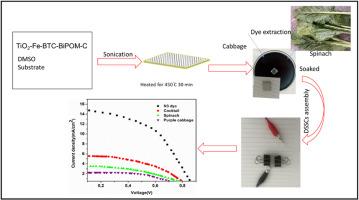
In an attempt to improve DSSCs efficiency, titanium dioxide (TiO2) hybrid photoanode materials exuding electrocatalytic and photoelectrocatalytic were incorporated into iron based metal organic frameworks (MOFs) derived from BTC = 1,3,5-Benzenetricarboxylic acid and Bismuth based polyoxometalates (POMs). The combination of FeBTC and BiPOM were used to form enhanced photoelectrocatalytic properties, with different concentrations of N-doped carbon quantum dots (CQDs) as the light absorbing materials. The TiO2-FeBTC-BiPOM (6 %) nanocomposites doped with 400 μg/mL CQDs exhibited improved performance with lower charge transfer resistance. As a result, this electrode was used to fabricate a novel natural dye (chlorophyll, anthocyanin and cocktail mixture)-based DSSCs.The cocktail based mixture showed higher power conversion efficiency of 1.92 % compared to spinach based DSSCs (0.98 %) and purple cabbage (0.89 %) under 100 mW/cm2 light illumination with 30 ms of electron lifetime, which is three times and four times more than spinach and cabbage based DSSCs respectively. In comparison to synthetic DSSCs, the efficiency of the natural dyes was still lower than N3 dyes. However, considering practical requirements of DSSCs, the natural dye-based devices satisfy most of the criteria such as affordability, ease of extraction, multiple wavelengths that can be absorbed with large coefficient, non-toxicity, and wide availability.




 京公网安备 11010802042870号
京ICP备2023020795号-1
京公网安备 11010802042870号
京ICP备2023020795号-1

 分享
分享

 求助内容:
求助内容: 应助结果提醒方式:
 扫码关注我们
