Zhichao Liu , Xiyue Cao , Lida Han , Xiaojing Li , Jianfei Xia , Zonghua Wang
{"title":"MIL-101-NH2(Fe)衍生Fe - c多孔材料掺杂还原氧化石墨烯电化学传感器的构建与应用","authors":"Zhichao Liu , Xiyue Cao , Lida Han , Xiaojing Li , Jianfei Xia , Zonghua Wang","doi":"10.1016/j.microc.2024.112324","DOIUrl":null,"url":null,"abstract":"<div><div>Baicalin (Bn), a natural flavonoid compound, possesses high pharmacological effects. Here, an electrochemical sensor has been proposed based on an MIL-101-NH<sub>2</sub>(Fe)-derived Fe porous carbon composite (Fe–C) doped with reduced graphene oxide (rGO) for detecting Bn, designated as Fe–C/rGO. Fabricated through a straightforward physical doping process, Fe–C/rGO exhibits remarkable electrochemical activity. This superiority stems primarily from two key factors. Firstly, the porous structure of Fe–C efficiently concentrates Bn, facilitating its capture and recognition. Secondly, graphene oxide, serving as a substrate for anchoring metal–organic frameworks (MOFs), boosts the electrochemical performance of the composite due to its distinctive two-dimensional structure, abundant active sites, and unparalleled stability. The synergistic interaction between Fe–C and rGO maximizes their respective advantages, leading to a significant enhancement in the sensitivity and selectivity of the electrochemical sensor. Boasting a low detection limit of 7.5 nM and a broad detection range spanning from 30 to 180 nM, this sensor holds immense potential in clinical applications and drug monitoring, offering a reliable and efficient method for Bn detection.</div></div>","PeriodicalId":391,"journal":{"name":"Microchemical Journal","volume":"208 ","pages":"Article 112324"},"PeriodicalIF":4.9000,"publicationDate":"2025-01-01","publicationTypes":"Journal Article","fieldsOfStudy":null,"isOpenAccess":false,"openAccessPdf":"","citationCount":"0","resultStr":"{\"title\":\"Construction and application of an electrochemical sensor based on MIL-101-NH2(Fe)-derived Fe–C porous materials doped with reduced graphene oxide for baicalin detection\",\"authors\":\"Zhichao Liu , Xiyue Cao , Lida Han , Xiaojing Li , Jianfei Xia , Zonghua Wang\",\"doi\":\"10.1016/j.microc.2024.112324\",\"DOIUrl\":null,\"url\":null,\"abstract\":\"<div><div>Baicalin (Bn), a natural flavonoid compound, possesses high pharmacological effects. Here, an electrochemical sensor has been proposed based on an MIL-101-NH<sub>2</sub>(Fe)-derived Fe porous carbon composite (Fe–C) doped with reduced graphene oxide (rGO) for detecting Bn, designated as Fe–C/rGO. Fabricated through a straightforward physical doping process, Fe–C/rGO exhibits remarkable electrochemical activity. This superiority stems primarily from two key factors. Firstly, the porous structure of Fe–C efficiently concentrates Bn, facilitating its capture and recognition. Secondly, graphene oxide, serving as a substrate for anchoring metal–organic frameworks (MOFs), boosts the electrochemical performance of the composite due to its distinctive two-dimensional structure, abundant active sites, and unparalleled stability. The synergistic interaction between Fe–C and rGO maximizes their respective advantages, leading to a significant enhancement in the sensitivity and selectivity of the electrochemical sensor. Boasting a low detection limit of 7.5 nM and a broad detection range spanning from 30 to 180 nM, this sensor holds immense potential in clinical applications and drug monitoring, offering a reliable and efficient method for Bn detection.</div></div>\",\"PeriodicalId\":391,\"journal\":{\"name\":\"Microchemical Journal\",\"volume\":\"208 \",\"pages\":\"Article 112324\"},\"PeriodicalIF\":4.9000,\"publicationDate\":\"2025-01-01\",\"publicationTypes\":\"Journal Article\",\"fieldsOfStudy\":null,\"isOpenAccess\":false,\"openAccessPdf\":\"\",\"citationCount\":\"0\",\"resultStr\":null,\"platform\":\"Semanticscholar\",\"paperid\":null,\"PeriodicalName\":\"Microchemical Journal\",\"FirstCategoryId\":\"92\",\"ListUrlMain\":\"https://www.sciencedirect.com/science/article/pii/S0026265X24024378\",\"RegionNum\":2,\"RegionCategory\":\"化学\",\"ArticlePicture\":[],\"TitleCN\":null,\"AbstractTextCN\":null,\"PMCID\":null,\"EPubDate\":\"2024/12/3 0:00:00\",\"PubModel\":\"Epub\",\"JCR\":\"Q1\",\"JCRName\":\"CHEMISTRY, ANALYTICAL\",\"Score\":null,\"Total\":0}","platform":"Semanticscholar","paperid":null,"PeriodicalName":"Microchemical Journal","FirstCategoryId":"92","ListUrlMain":"https://www.sciencedirect.com/science/article/pii/S0026265X24024378","RegionNum":2,"RegionCategory":"化学","ArticlePicture":[],"TitleCN":null,"AbstractTextCN":null,"PMCID":null,"EPubDate":"2024/12/3 0:00:00","PubModel":"Epub","JCR":"Q1","JCRName":"CHEMISTRY, ANALYTICAL","Score":null,"Total":0}
Construction and application of an electrochemical sensor based on MIL-101-NH2(Fe)-derived Fe–C porous materials doped with reduced graphene oxide for baicalin detection
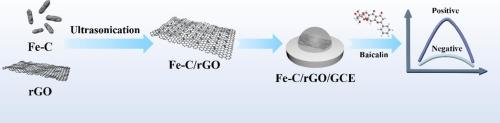
Baicalin (Bn), a natural flavonoid compound, possesses high pharmacological effects. Here, an electrochemical sensor has been proposed based on an MIL-101-NH2(Fe)-derived Fe porous carbon composite (Fe–C) doped with reduced graphene oxide (rGO) for detecting Bn, designated as Fe–C/rGO. Fabricated through a straightforward physical doping process, Fe–C/rGO exhibits remarkable electrochemical activity. This superiority stems primarily from two key factors. Firstly, the porous structure of Fe–C efficiently concentrates Bn, facilitating its capture and recognition. Secondly, graphene oxide, serving as a substrate for anchoring metal–organic frameworks (MOFs), boosts the electrochemical performance of the composite due to its distinctive two-dimensional structure, abundant active sites, and unparalleled stability. The synergistic interaction between Fe–C and rGO maximizes their respective advantages, leading to a significant enhancement in the sensitivity and selectivity of the electrochemical sensor. Boasting a low detection limit of 7.5 nM and a broad detection range spanning from 30 to 180 nM, this sensor holds immense potential in clinical applications and drug monitoring, offering a reliable and efficient method for Bn detection.
期刊介绍:
The Microchemical Journal is a peer reviewed journal devoted to all aspects and phases of analytical chemistry and chemical analysis. The Microchemical Journal publishes articles which are at the forefront of modern analytical chemistry and cover innovations in the techniques to the finest possible limits. This includes fundamental aspects, instrumentation, new developments, innovative and novel methods and applications including environmental and clinical field.
Traditional classical analytical methods such as spectrophotometry and titrimetry as well as established instrumentation methods such as flame and graphite furnace atomic absorption spectrometry, gas chromatography, and modified glassy or carbon electrode electrochemical methods will be considered, provided they show significant improvements and novelty compared to the established methods.




 京公网安备 11010802042870号
京ICP备2023020795号-1
京公网安备 11010802042870号
京ICP备2023020795号-1

 分享
分享
 求助内容:
求助内容: 应助结果提醒方式:
 扫码关注我们
