Min-Hsuan Lee , Kuan-Hsiang Teng , Ya-Yu Liang , Chien-Fang Ding , Ying-Chun Chen
{"title":"基于导电叶片网络的柔性可生物降解可穿戴设备","authors":"Min-Hsuan Lee , Kuan-Hsiang Teng , Ya-Yu Liang , Chien-Fang Ding , Ying-Chun Chen","doi":"10.1016/j.susmat.2025.e01263","DOIUrl":null,"url":null,"abstract":"<div><div>Electronic waste (<em>E</em>-waste) pollution is a global environmental problem because it contains various contaminants, including hazardous heavy metals and toxic chemicals. These contaminants may accumulate in the environment and pollute oceans worldwide, seriously threatening the environment and human health. Besides, agricultural wastes burning from straw and leaves may be the most significant contributor to haze particulate matter (PM) air pollution in developing countries. Developing biodegradable green electronics based on the circular economy principle is an ideal solution to address the above waste-related environmental issues. In this study, we report on a biodegradable conductor, integrating Poly (3,4-ethylenedioxythiophene) polystyrene sulfonate (PEDOT:PSS)-based nanocomposites into leaf skeletons (used as substrates). In addition, the effective drop-casting technique is used to prepare biodegradable conductors for potential utility in lightweight wearable devices. The biodegradable conductor exhibits a remarkable sheet resistance of 2.4 ± 0.6 Ω sq.<sup>−1</sup> with one drop-casting step. Raman spectroscopy demonstrated that the enhanced electrical performance of the conductive leaf is attributed to an increase in the predominant quinoid structure of PEDOT chains. It is proved that this high-performance biodegradable conductor can be applied as a promising component for various next-generation wearable electronics, including electrocardiogram (ECG) electrodes and flexible strain sensors, demonstrating promising potential for the development of United Nation's Sustainable Development Goals (SDGs) in green electronics.</div></div>","PeriodicalId":22097,"journal":{"name":"Sustainable Materials and Technologies","volume":"43 ","pages":"Article e01263"},"PeriodicalIF":9.7000,"publicationDate":"2025-04-01","publicationTypes":"Journal Article","fieldsOfStudy":null,"isOpenAccess":false,"openAccessPdf":"","citationCount":"0","resultStr":"{\"title\":\"Flexible biodegradable wearables based on conductive leaf networks\",\"authors\":\"Min-Hsuan Lee , Kuan-Hsiang Teng , Ya-Yu Liang , Chien-Fang Ding , Ying-Chun Chen\",\"doi\":\"10.1016/j.susmat.2025.e01263\",\"DOIUrl\":null,\"url\":null,\"abstract\":\"<div><div>Electronic waste (<em>E</em>-waste) pollution is a global environmental problem because it contains various contaminants, including hazardous heavy metals and toxic chemicals. These contaminants may accumulate in the environment and pollute oceans worldwide, seriously threatening the environment and human health. Besides, agricultural wastes burning from straw and leaves may be the most significant contributor to haze particulate matter (PM) air pollution in developing countries. Developing biodegradable green electronics based on the circular economy principle is an ideal solution to address the above waste-related environmental issues. In this study, we report on a biodegradable conductor, integrating Poly (3,4-ethylenedioxythiophene) polystyrene sulfonate (PEDOT:PSS)-based nanocomposites into leaf skeletons (used as substrates). In addition, the effective drop-casting technique is used to prepare biodegradable conductors for potential utility in lightweight wearable devices. The biodegradable conductor exhibits a remarkable sheet resistance of 2.4 ± 0.6 Ω sq.<sup>−1</sup> with one drop-casting step. Raman spectroscopy demonstrated that the enhanced electrical performance of the conductive leaf is attributed to an increase in the predominant quinoid structure of PEDOT chains. It is proved that this high-performance biodegradable conductor can be applied as a promising component for various next-generation wearable electronics, including electrocardiogram (ECG) electrodes and flexible strain sensors, demonstrating promising potential for the development of United Nation's Sustainable Development Goals (SDGs) in green electronics.</div></div>\",\"PeriodicalId\":22097,\"journal\":{\"name\":\"Sustainable Materials and Technologies\",\"volume\":\"43 \",\"pages\":\"Article e01263\"},\"PeriodicalIF\":9.7000,\"publicationDate\":\"2025-04-01\",\"publicationTypes\":\"Journal Article\",\"fieldsOfStudy\":null,\"isOpenAccess\":false,\"openAccessPdf\":\"\",\"citationCount\":\"0\",\"resultStr\":null,\"platform\":\"Semanticscholar\",\"paperid\":null,\"PeriodicalName\":\"Sustainable Materials and Technologies\",\"FirstCategoryId\":\"5\",\"ListUrlMain\":\"https://www.sciencedirect.com/science/article/pii/S2214993725000314\",\"RegionNum\":2,\"RegionCategory\":\"工程技术\",\"ArticlePicture\":[],\"TitleCN\":null,\"AbstractTextCN\":null,\"PMCID\":null,\"EPubDate\":\"2025/1/19 0:00:00\",\"PubModel\":\"Epub\",\"JCR\":\"Q1\",\"JCRName\":\"ENERGY & FUELS\",\"Score\":null,\"Total\":0}","platform":"Semanticscholar","paperid":null,"PeriodicalName":"Sustainable Materials and Technologies","FirstCategoryId":"5","ListUrlMain":"https://www.sciencedirect.com/science/article/pii/S2214993725000314","RegionNum":2,"RegionCategory":"工程技术","ArticlePicture":[],"TitleCN":null,"AbstractTextCN":null,"PMCID":null,"EPubDate":"2025/1/19 0:00:00","PubModel":"Epub","JCR":"Q1","JCRName":"ENERGY & FUELS","Score":null,"Total":0}
Flexible biodegradable wearables based on conductive leaf networks
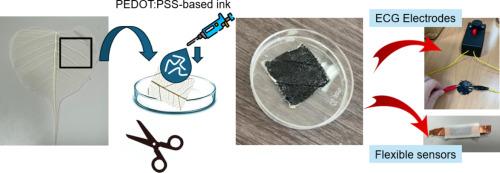
Electronic waste (E-waste) pollution is a global environmental problem because it contains various contaminants, including hazardous heavy metals and toxic chemicals. These contaminants may accumulate in the environment and pollute oceans worldwide, seriously threatening the environment and human health. Besides, agricultural wastes burning from straw and leaves may be the most significant contributor to haze particulate matter (PM) air pollution in developing countries. Developing biodegradable green electronics based on the circular economy principle is an ideal solution to address the above waste-related environmental issues. In this study, we report on a biodegradable conductor, integrating Poly (3,4-ethylenedioxythiophene) polystyrene sulfonate (PEDOT:PSS)-based nanocomposites into leaf skeletons (used as substrates). In addition, the effective drop-casting technique is used to prepare biodegradable conductors for potential utility in lightweight wearable devices. The biodegradable conductor exhibits a remarkable sheet resistance of 2.4 ± 0.6 Ω sq.−1 with one drop-casting step. Raman spectroscopy demonstrated that the enhanced electrical performance of the conductive leaf is attributed to an increase in the predominant quinoid structure of PEDOT chains. It is proved that this high-performance biodegradable conductor can be applied as a promising component for various next-generation wearable electronics, including electrocardiogram (ECG) electrodes and flexible strain sensors, demonstrating promising potential for the development of United Nation's Sustainable Development Goals (SDGs) in green electronics.
期刊介绍:
Sustainable Materials and Technologies (SM&T), an international, cross-disciplinary, fully open access journal published by Elsevier, focuses on original full-length research articles and reviews. It covers applied or fundamental science of nano-, micro-, meso-, and macro-scale aspects of materials and technologies for sustainable development. SM&T gives special attention to contributions that bridge the knowledge gap between materials and system designs.




 京公网安备 11010802042870号
京ICP备2023020795号-1
京公网安备 11010802042870号
京ICP备2023020795号-1

 分享
分享
 求助内容:
求助内容: 应助结果提醒方式:
 扫码关注我们
