{"title":"用Ni缓冲液在铜铍合金衬底上激光定向能沉积AISI H13","authors":"Zhao Zhao , Matteo Perini , Massimo Pellizzari","doi":"10.1016/j.surfcoat.2025.131772","DOIUrl":null,"url":null,"abstract":"<div><div>Steel/copper alloy multi-material structures fabricated via metal additive manufacturing hold significant promise for applications such as molding and tooling. However, the formation of a steel/copper alloy interface is highly susceptible to solidification cracking. In this study, AISI H13 cladding was deposited on copper‑beryllium alloy substrates using Laser-Directed Energy Deposition. A commercial pure Ni buffer was employed to mitigate cracking, as evidenced by the crack-free Ni-buffered specimens. The effectiveness of Ni in suppressing cracking can be attributed to two key factors: (i) establishing a chemical composition gradient from copper‑beryllium to H13, thereby minimizing solidification cracking susceptibility across the entire composition range, and (ii) reducing residual stress caused by the mismatch in the coefficient of thermal expansion between H13 and copper‑beryllium. The solidification cracking susceptibility in the Fe-Cu-Ni ternary system was qualitatively assessed by calculating key solidification characteristic values, including the solidification temperature range and the amount of terminal liquid, using Scheil's model. Easton's solidification cracking model was validated as a reliable tool for quantitatively evaluating cracking susceptibility in the Fe-Cu-Ni system. Both approaches indicated that introducing a Ni buffer creates a path with low cracking susceptibility. The as-deposited H13 exhibited high microhardness (580–690 HV) compared to the copper‑beryllium alloy (400 HV), significantly enhancing the load-bearing capability. While softer materials such as in-situ tempered martensite, Ni buffer, and heat-affected zone negatively impact the load-bearing capacity, this can be restored by increasing the number of H13 layers. Based on the typical stress levels in injection molding dies, a 3 to 5 mm thick H13 cladding is deemed sufficient to protect mold surfaces made of copper alloys.</div></div>","PeriodicalId":22009,"journal":{"name":"Surface & Coatings Technology","volume":"497 ","pages":"Article 131772"},"PeriodicalIF":6.1000,"publicationDate":"2025-02-01","publicationTypes":"Journal Article","fieldsOfStudy":null,"isOpenAccess":false,"openAccessPdf":"","citationCount":"0","resultStr":"{\"title\":\"Laser-Directed Energy Deposition of AISI H13 on copper‑beryllium alloy substrates with Ni buffer\",\"authors\":\"Zhao Zhao , Matteo Perini , Massimo Pellizzari\",\"doi\":\"10.1016/j.surfcoat.2025.131772\",\"DOIUrl\":null,\"url\":null,\"abstract\":\"<div><div>Steel/copper alloy multi-material structures fabricated via metal additive manufacturing hold significant promise for applications such as molding and tooling. However, the formation of a steel/copper alloy interface is highly susceptible to solidification cracking. In this study, AISI H13 cladding was deposited on copper‑beryllium alloy substrates using Laser-Directed Energy Deposition. A commercial pure Ni buffer was employed to mitigate cracking, as evidenced by the crack-free Ni-buffered specimens. The effectiveness of Ni in suppressing cracking can be attributed to two key factors: (i) establishing a chemical composition gradient from copper‑beryllium to H13, thereby minimizing solidification cracking susceptibility across the entire composition range, and (ii) reducing residual stress caused by the mismatch in the coefficient of thermal expansion between H13 and copper‑beryllium. The solidification cracking susceptibility in the Fe-Cu-Ni ternary system was qualitatively assessed by calculating key solidification characteristic values, including the solidification temperature range and the amount of terminal liquid, using Scheil's model. Easton's solidification cracking model was validated as a reliable tool for quantitatively evaluating cracking susceptibility in the Fe-Cu-Ni system. Both approaches indicated that introducing a Ni buffer creates a path with low cracking susceptibility. The as-deposited H13 exhibited high microhardness (580–690 HV) compared to the copper‑beryllium alloy (400 HV), significantly enhancing the load-bearing capability. While softer materials such as in-situ tempered martensite, Ni buffer, and heat-affected zone negatively impact the load-bearing capacity, this can be restored by increasing the number of H13 layers. Based on the typical stress levels in injection molding dies, a 3 to 5 mm thick H13 cladding is deemed sufficient to protect mold surfaces made of copper alloys.</div></div>\",\"PeriodicalId\":22009,\"journal\":{\"name\":\"Surface & Coatings Technology\",\"volume\":\"497 \",\"pages\":\"Article 131772\"},\"PeriodicalIF\":6.1000,\"publicationDate\":\"2025-02-01\",\"publicationTypes\":\"Journal Article\",\"fieldsOfStudy\":null,\"isOpenAccess\":false,\"openAccessPdf\":\"\",\"citationCount\":\"0\",\"resultStr\":null,\"platform\":\"Semanticscholar\",\"paperid\":null,\"PeriodicalName\":\"Surface & Coatings Technology\",\"FirstCategoryId\":\"88\",\"ListUrlMain\":\"https://www.sciencedirect.com/science/article/pii/S0257897225000465\",\"RegionNum\":2,\"RegionCategory\":\"材料科学\",\"ArticlePicture\":[],\"TitleCN\":null,\"AbstractTextCN\":null,\"PMCID\":null,\"EPubDate\":\"2025/1/12 0:00:00\",\"PubModel\":\"Epub\",\"JCR\":\"Q1\",\"JCRName\":\"MATERIALS SCIENCE, COATINGS & FILMS\",\"Score\":null,\"Total\":0}","platform":"Semanticscholar","paperid":null,"PeriodicalName":"Surface & Coatings Technology","FirstCategoryId":"88","ListUrlMain":"https://www.sciencedirect.com/science/article/pii/S0257897225000465","RegionNum":2,"RegionCategory":"材料科学","ArticlePicture":[],"TitleCN":null,"AbstractTextCN":null,"PMCID":null,"EPubDate":"2025/1/12 0:00:00","PubModel":"Epub","JCR":"Q1","JCRName":"MATERIALS SCIENCE, COATINGS & FILMS","Score":null,"Total":0}
Laser-Directed Energy Deposition of AISI H13 on copper‑beryllium alloy substrates with Ni buffer
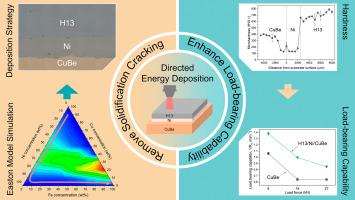
Steel/copper alloy multi-material structures fabricated via metal additive manufacturing hold significant promise for applications such as molding and tooling. However, the formation of a steel/copper alloy interface is highly susceptible to solidification cracking. In this study, AISI H13 cladding was deposited on copper‑beryllium alloy substrates using Laser-Directed Energy Deposition. A commercial pure Ni buffer was employed to mitigate cracking, as evidenced by the crack-free Ni-buffered specimens. The effectiveness of Ni in suppressing cracking can be attributed to two key factors: (i) establishing a chemical composition gradient from copper‑beryllium to H13, thereby minimizing solidification cracking susceptibility across the entire composition range, and (ii) reducing residual stress caused by the mismatch in the coefficient of thermal expansion between H13 and copper‑beryllium. The solidification cracking susceptibility in the Fe-Cu-Ni ternary system was qualitatively assessed by calculating key solidification characteristic values, including the solidification temperature range and the amount of terminal liquid, using Scheil's model. Easton's solidification cracking model was validated as a reliable tool for quantitatively evaluating cracking susceptibility in the Fe-Cu-Ni system. Both approaches indicated that introducing a Ni buffer creates a path with low cracking susceptibility. The as-deposited H13 exhibited high microhardness (580–690 HV) compared to the copper‑beryllium alloy (400 HV), significantly enhancing the load-bearing capability. While softer materials such as in-situ tempered martensite, Ni buffer, and heat-affected zone negatively impact the load-bearing capacity, this can be restored by increasing the number of H13 layers. Based on the typical stress levels in injection molding dies, a 3 to 5 mm thick H13 cladding is deemed sufficient to protect mold surfaces made of copper alloys.
期刊介绍:
Surface and Coatings Technology is an international archival journal publishing scientific papers on significant developments in surface and interface engineering to modify and improve the surface properties of materials for protection in demanding contact conditions or aggressive environments, or for enhanced functional performance. Contributions range from original scientific articles concerned with fundamental and applied aspects of research or direct applications of metallic, inorganic, organic and composite coatings, to invited reviews of current technology in specific areas. Papers submitted to this journal are expected to be in line with the following aspects in processes, and properties/performance:
A. Processes: Physical and chemical vapour deposition techniques, thermal and plasma spraying, surface modification by directed energy techniques such as ion, electron and laser beams, thermo-chemical treatment, wet chemical and electrochemical processes such as plating, sol-gel coating, anodization, plasma electrolytic oxidation, etc., but excluding painting.
B. Properties/performance: friction performance, wear resistance (e.g., abrasion, erosion, fretting, etc), corrosion and oxidation resistance, thermal protection, diffusion resistance, hydrophilicity/hydrophobicity, and properties relevant to smart materials behaviour and enhanced multifunctional performance for environmental, energy and medical applications, but excluding device aspects.




 京公网安备 11010802042870号
京ICP备2023020795号-1
京公网安备 11010802042870号
京ICP备2023020795号-1

 分享
分享
 求助内容:
求助内容: 应助结果提醒方式:
 扫码关注我们
