Xiao Yang , Yuanyuan Pan , Sang Zou , Jun-Hu Cheng
{"title":"低温大气等离子体在食品工业中的输送系统:模式、优化策略和应用","authors":"Xiao Yang , Yuanyuan Pan , Sang Zou , Jun-Hu Cheng","doi":"10.1016/j.tifs.2024.104831","DOIUrl":null,"url":null,"abstract":"<div><h3>Background</h3><div>Cold atmospheric plasma (CAP) has emerged as a potentially transformative technology in the field of food safety, producing reactive oxygen and nitrogen species at close to atmospheric pressure and room temperature in “on/off” mode, while overcoming the barriers in conventional methods. However, the effective delivery of plasma components is crucial for its successful application in the food industry.</div></div><div><h3>Scope and approach</h3><div>This review provides a comprehensive overview of plasma delivery sources, reactive species generated by plasma sources, and their diagnostics. Various applications of direct CAP delivery in the food industry for antimicrobial, contaminant removal, and food functionalization are also discussed in detail. The delivery of plasma-activated media for food applications, includes plasma-activated gases, plasma-activated liquids, and plasma-activated hydrogels. Furthermore, specific optimization strategies to enhance the CAP delivery performance are proposed, focusing on two key pathways: “device-assisted” and “technology integration” approaches for the efficient loading of reactive species. Finally, important insights into the challenges and prospects of plasma delivery research for practical applications in the food industry are provided.</div></div><div><h3>Key findings and conclusions</h3><div>CAP delivery systems are developed to different delivery purposes, and the delivery effectiveness of CAP delivery systems increases the potential for plasma applications in the food industry. These delivery systems can be applied to antimicrobial, contaminant removal, food functionalization, and other practical applications in the food industry. Future research should further extend the breadth-depth of CAP delivery and scale up CAP delivery to promote its broader implementation in food industry practices.</div></div>","PeriodicalId":441,"journal":{"name":"Trends in Food Science & Technology","volume":"156 ","pages":"Article 104831"},"PeriodicalIF":17.4000,"publicationDate":"2025-02-01","publicationTypes":"Journal Article","fieldsOfStudy":null,"isOpenAccess":false,"openAccessPdf":"","citationCount":"0","resultStr":"{\"title\":\"Delivery systems of cold atmospheric plasma in the food industry: Modes, optimization strategies, and applications\",\"authors\":\"Xiao Yang , Yuanyuan Pan , Sang Zou , Jun-Hu Cheng\",\"doi\":\"10.1016/j.tifs.2024.104831\",\"DOIUrl\":null,\"url\":null,\"abstract\":\"<div><h3>Background</h3><div>Cold atmospheric plasma (CAP) has emerged as a potentially transformative technology in the field of food safety, producing reactive oxygen and nitrogen species at close to atmospheric pressure and room temperature in “on/off” mode, while overcoming the barriers in conventional methods. However, the effective delivery of plasma components is crucial for its successful application in the food industry.</div></div><div><h3>Scope and approach</h3><div>This review provides a comprehensive overview of plasma delivery sources, reactive species generated by plasma sources, and their diagnostics. Various applications of direct CAP delivery in the food industry for antimicrobial, contaminant removal, and food functionalization are also discussed in detail. The delivery of plasma-activated media for food applications, includes plasma-activated gases, plasma-activated liquids, and plasma-activated hydrogels. Furthermore, specific optimization strategies to enhance the CAP delivery performance are proposed, focusing on two key pathways: “device-assisted” and “technology integration” approaches for the efficient loading of reactive species. Finally, important insights into the challenges and prospects of plasma delivery research for practical applications in the food industry are provided.</div></div><div><h3>Key findings and conclusions</h3><div>CAP delivery systems are developed to different delivery purposes, and the delivery effectiveness of CAP delivery systems increases the potential for plasma applications in the food industry. These delivery systems can be applied to antimicrobial, contaminant removal, food functionalization, and other practical applications in the food industry. Future research should further extend the breadth-depth of CAP delivery and scale up CAP delivery to promote its broader implementation in food industry practices.</div></div>\",\"PeriodicalId\":441,\"journal\":{\"name\":\"Trends in Food Science & Technology\",\"volume\":\"156 \",\"pages\":\"Article 104831\"},\"PeriodicalIF\":17.4000,\"publicationDate\":\"2025-02-01\",\"publicationTypes\":\"Journal Article\",\"fieldsOfStudy\":null,\"isOpenAccess\":false,\"openAccessPdf\":\"\",\"citationCount\":\"0\",\"resultStr\":null,\"platform\":\"Semanticscholar\",\"paperid\":null,\"PeriodicalName\":\"Trends in Food Science & Technology\",\"FirstCategoryId\":\"97\",\"ListUrlMain\":\"https://www.sciencedirect.com/science/article/pii/S0924224424005077\",\"RegionNum\":1,\"RegionCategory\":\"农林科学\",\"ArticlePicture\":[],\"TitleCN\":null,\"AbstractTextCN\":null,\"PMCID\":null,\"EPubDate\":\"2024/12/4 0:00:00\",\"PubModel\":\"Epub\",\"JCR\":\"Q1\",\"JCRName\":\"FOOD SCIENCE & TECHNOLOGY\",\"Score\":null,\"Total\":0}","platform":"Semanticscholar","paperid":null,"PeriodicalName":"Trends in Food Science & Technology","FirstCategoryId":"97","ListUrlMain":"https://www.sciencedirect.com/science/article/pii/S0924224424005077","RegionNum":1,"RegionCategory":"农林科学","ArticlePicture":[],"TitleCN":null,"AbstractTextCN":null,"PMCID":null,"EPubDate":"2024/12/4 0:00:00","PubModel":"Epub","JCR":"Q1","JCRName":"FOOD SCIENCE & TECHNOLOGY","Score":null,"Total":0}
Delivery systems of cold atmospheric plasma in the food industry: Modes, optimization strategies, and applications
Background
Cold atmospheric plasma (CAP) has emerged as a potentially transformative technology in the field of food safety, producing reactive oxygen and nitrogen species at close to atmospheric pressure and room temperature in “on/off” mode, while overcoming the barriers in conventional methods. However, the effective delivery of plasma components is crucial for its successful application in the food industry.
Scope and approach
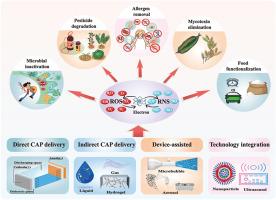
This review provides a comprehensive overview of plasma delivery sources, reactive species generated by plasma sources, and their diagnostics. Various applications of direct CAP delivery in the food industry for antimicrobial, contaminant removal, and food functionalization are also discussed in detail. The delivery of plasma-activated media for food applications, includes plasma-activated gases, plasma-activated liquids, and plasma-activated hydrogels. Furthermore, specific optimization strategies to enhance the CAP delivery performance are proposed, focusing on two key pathways: “device-assisted” and “technology integration” approaches for the efficient loading of reactive species. Finally, important insights into the challenges and prospects of plasma delivery research for practical applications in the food industry are provided.
Key findings and conclusions
CAP delivery systems are developed to different delivery purposes, and the delivery effectiveness of CAP delivery systems increases the potential for plasma applications in the food industry. These delivery systems can be applied to antimicrobial, contaminant removal, food functionalization, and other practical applications in the food industry. Future research should further extend the breadth-depth of CAP delivery and scale up CAP delivery to promote its broader implementation in food industry practices.
期刊介绍:
Trends in Food Science & Technology is a prestigious international journal that specializes in peer-reviewed articles covering the latest advancements in technology, food science, and human nutrition. It serves as a bridge between specialized primary journals and general trade magazines, providing readable and scientifically rigorous reviews and commentaries on current research developments and their potential applications in the food industry.
Unlike traditional journals, Trends in Food Science & Technology does not publish original research papers. Instead, it focuses on critical and comprehensive reviews to offer valuable insights for professionals in the field. By bringing together cutting-edge research and industry applications, this journal plays a vital role in disseminating knowledge and facilitating advancements in the food science and technology sector.




 京公网安备 11010802042870号
京ICP备2023020795号-1
京公网安备 11010802042870号
京ICP备2023020795号-1

 分享
分享
 求助内容:
求助内容: 应助结果提醒方式:
 扫码关注我们
