Ruge Cao , Jingxin Li , Han Ding , Tingting Zhao , Zicong Guo , Yaying Li , Xingchun Sun , Fang Wang , Ju Qiu
{"title":"人工智能和核磁共振在增强食品成分分析中的协同方法:综述","authors":"Ruge Cao , Jingxin Li , Han Ding , Tingting Zhao , Zicong Guo , Yaying Li , Xingchun Sun , Fang Wang , Ju Qiu","doi":"10.1016/j.tifs.2024.104852","DOIUrl":null,"url":null,"abstract":"<div><h3>Background</h3><div>The integration of artificial intelligence (AI) with nuclear magnetic resonance (NMR) spectroscopy is emerging as a transformative approach in food component analysis, offering innovative solutions for ensuring food quality and safety. Leveraging AI algorithms with NMR spectroscopy has the potential to improve the precision and efficiency of structural analysis in food science, addressing challenges in complex data interpretation and advancing methodologies for food authenticity, origin traceability, and contamination detection.</div></div><div><h3>Scope and approach</h3><div>This review examined the applications of AI techniques, particularly machine learning (ML) models, including supervised learning (SL), unsupervised learning (UL), and deep learning (DL), in enhancing NMR data interpretation and analysis. We discuss foundational NMR principles and explore the integration of AI in resolving spectral complexity and improving food component characterization. This structured approach assesses role of AI in spectral prediction, pattern recognition, and data-driven model development in the context of food science.</div></div><div><h3>Key findings and conclusions</h3><div>AI-NMR integration demonstrates significant potential in various food chemistry applications, from predicting structural properties to detecting adulterants and contaminants. SL models offer accuracy in spectral prediction, UL models enhance pattern recognition, and DL approaches enable the analysis of complex NMR spectra. However, challenges remain, particularly in model interpretability, data availability, and robustness under real-world conditions. Addressing these challenges requires interdisciplinary collaboration between AI experts and food chemists to unlock full potential of AI-NMR in food analysis and quality control, potentially revolutionizing methodologies in the field.</div></div>","PeriodicalId":441,"journal":{"name":"Trends in Food Science & Technology","volume":"156 ","pages":"Article 104852"},"PeriodicalIF":15.4000,"publicationDate":"2025-02-01","publicationTypes":"Journal Article","fieldsOfStudy":null,"isOpenAccess":false,"openAccessPdf":"","citationCount":"0","resultStr":"{\"title\":\"Synergistic approaches of AI and NMR in enhancing food component analysis: A comprehensive review\",\"authors\":\"Ruge Cao , Jingxin Li , Han Ding , Tingting Zhao , Zicong Guo , Yaying Li , Xingchun Sun , Fang Wang , Ju Qiu\",\"doi\":\"10.1016/j.tifs.2024.104852\",\"DOIUrl\":null,\"url\":null,\"abstract\":\"<div><h3>Background</h3><div>The integration of artificial intelligence (AI) with nuclear magnetic resonance (NMR) spectroscopy is emerging as a transformative approach in food component analysis, offering innovative solutions for ensuring food quality and safety. Leveraging AI algorithms with NMR spectroscopy has the potential to improve the precision and efficiency of structural analysis in food science, addressing challenges in complex data interpretation and advancing methodologies for food authenticity, origin traceability, and contamination detection.</div></div><div><h3>Scope and approach</h3><div>This review examined the applications of AI techniques, particularly machine learning (ML) models, including supervised learning (SL), unsupervised learning (UL), and deep learning (DL), in enhancing NMR data interpretation and analysis. We discuss foundational NMR principles and explore the integration of AI in resolving spectral complexity and improving food component characterization. This structured approach assesses role of AI in spectral prediction, pattern recognition, and data-driven model development in the context of food science.</div></div><div><h3>Key findings and conclusions</h3><div>AI-NMR integration demonstrates significant potential in various food chemistry applications, from predicting structural properties to detecting adulterants and contaminants. SL models offer accuracy in spectral prediction, UL models enhance pattern recognition, and DL approaches enable the analysis of complex NMR spectra. However, challenges remain, particularly in model interpretability, data availability, and robustness under real-world conditions. Addressing these challenges requires interdisciplinary collaboration between AI experts and food chemists to unlock full potential of AI-NMR in food analysis and quality control, potentially revolutionizing methodologies in the field.</div></div>\",\"PeriodicalId\":441,\"journal\":{\"name\":\"Trends in Food Science & Technology\",\"volume\":\"156 \",\"pages\":\"Article 104852\"},\"PeriodicalIF\":15.4000,\"publicationDate\":\"2025-02-01\",\"publicationTypes\":\"Journal Article\",\"fieldsOfStudy\":null,\"isOpenAccess\":false,\"openAccessPdf\":\"\",\"citationCount\":\"0\",\"resultStr\":null,\"platform\":\"Semanticscholar\",\"paperid\":null,\"PeriodicalName\":\"Trends in Food Science & Technology\",\"FirstCategoryId\":\"97\",\"ListUrlMain\":\"https://www.sciencedirect.com/science/article/pii/S0924224424005284\",\"RegionNum\":1,\"RegionCategory\":\"农林科学\",\"ArticlePicture\":[],\"TitleCN\":null,\"AbstractTextCN\":null,\"PMCID\":null,\"EPubDate\":\"2024/12/20 0:00:00\",\"PubModel\":\"Epub\",\"JCR\":\"Q1\",\"JCRName\":\"FOOD SCIENCE & TECHNOLOGY\",\"Score\":null,\"Total\":0}","platform":"Semanticscholar","paperid":null,"PeriodicalName":"Trends in Food Science & Technology","FirstCategoryId":"97","ListUrlMain":"https://www.sciencedirect.com/science/article/pii/S0924224424005284","RegionNum":1,"RegionCategory":"农林科学","ArticlePicture":[],"TitleCN":null,"AbstractTextCN":null,"PMCID":null,"EPubDate":"2024/12/20 0:00:00","PubModel":"Epub","JCR":"Q1","JCRName":"FOOD SCIENCE & TECHNOLOGY","Score":null,"Total":0}
Synergistic approaches of AI and NMR in enhancing food component analysis: A comprehensive review
Background
The integration of artificial intelligence (AI) with nuclear magnetic resonance (NMR) spectroscopy is emerging as a transformative approach in food component analysis, offering innovative solutions for ensuring food quality and safety. Leveraging AI algorithms with NMR spectroscopy has the potential to improve the precision and efficiency of structural analysis in food science, addressing challenges in complex data interpretation and advancing methodologies for food authenticity, origin traceability, and contamination detection.
Scope and approach
This review examined the applications of AI techniques, particularly machine learning (ML) models, including supervised learning (SL), unsupervised learning (UL), and deep learning (DL), in enhancing NMR data interpretation and analysis. We discuss foundational NMR principles and explore the integration of AI in resolving spectral complexity and improving food component characterization. This structured approach assesses role of AI in spectral prediction, pattern recognition, and data-driven model development in the context of food science.
Key findings and conclusions
AI-NMR integration demonstrates significant potential in various food chemistry applications, from predicting structural properties to detecting adulterants and contaminants. SL models offer accuracy in spectral prediction, UL models enhance pattern recognition, and DL approaches enable the analysis of complex NMR spectra. However, challenges remain, particularly in model interpretability, data availability, and robustness under real-world conditions. Addressing these challenges requires interdisciplinary collaboration between AI experts and food chemists to unlock full potential of AI-NMR in food analysis and quality control, potentially revolutionizing methodologies in the field.
期刊介绍:
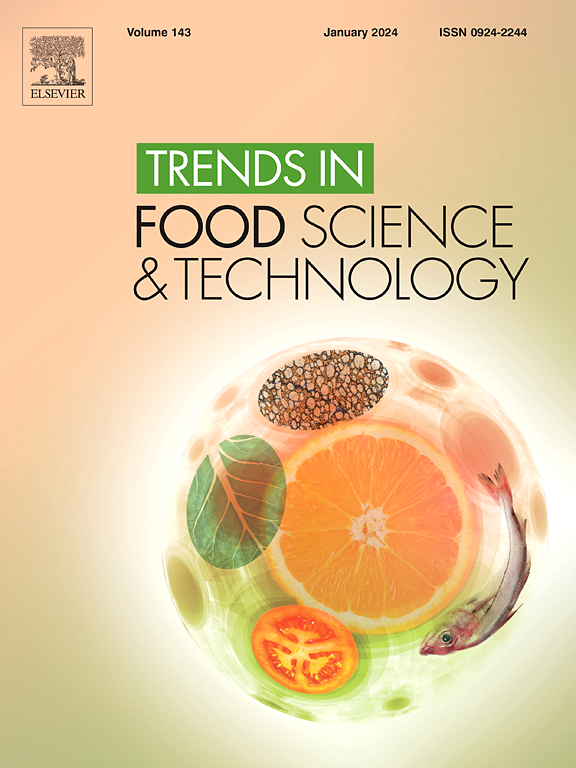
Trends in Food Science & Technology is a prestigious international journal that specializes in peer-reviewed articles covering the latest advancements in technology, food science, and human nutrition. It serves as a bridge between specialized primary journals and general trade magazines, providing readable and scientifically rigorous reviews and commentaries on current research developments and their potential applications in the food industry.
Unlike traditional journals, Trends in Food Science & Technology does not publish original research papers. Instead, it focuses on critical and comprehensive reviews to offer valuable insights for professionals in the field. By bringing together cutting-edge research and industry applications, this journal plays a vital role in disseminating knowledge and facilitating advancements in the food science and technology sector.




 京公网安备 11010802042870号
京ICP备2023020795号-1
京公网安备 11010802042870号
京ICP备2023020795号-1

 分享
分享
 求助内容:
求助内容: 应助结果提醒方式:
 扫码关注我们
