Shipeng Gao , Zhangkun Wei , Xueyun Zheng , Tianxing Wang , Xiaowei Huang , Tingting Shen , Di Zhang , Zhiming Guo , Yang Zhang , Xiaobo Zou
{"title":"同时检测食品中几种真菌毒素的多重侧流免疫分析","authors":"Shipeng Gao , Zhangkun Wei , Xueyun Zheng , Tianxing Wang , Xiaowei Huang , Tingting Shen , Di Zhang , Zhiming Guo , Yang Zhang , Xiaobo Zou","doi":"10.1016/j.tifs.2024.104858","DOIUrl":null,"url":null,"abstract":"<div><h3>Background</h3><div>Mycotoxins are secondary metabolites that present a great threat to human health. Mycotoxin contamination is probable to occur during both the pre-harvesting and post-harvesting stage of plant-based food matrices. Additionally, the co-occurring of various types of mycotoxins within a single foodstuff exhibits great frequency, leading to enhanced toxicity due to the indispensable accumulation of multiple mycotoxins. Therefore, the development of multiplex methods for simultaneously detecting several mycotoxins is becoming increasingly important in evaluating the presence of mycotoxin contamination in food matrices, yet the existing approaches are challenged with point-of-care and cost-effective.</div></div><div><h3>Scope and approach</h3><div>The advancements and applications of lateral-flow immunoassays (LFIAs), which are known for their portability and affordability, in the simultaneous detection of several mycotoxins in food matrices are summarized in this review. The elements of constructing multiplexed LFIAs in terms of strip structure, biorecognition elements, nanotags, and portable readout devices are discussed. Signal amplification strategies contributing to improved detection sensitivity and sample pretreatment approaches targeting increased detection reliability are summarized. Applications regarding the high-throughput determination of multiple mycotoxins in food samples are highlighted, with special attention being paid to colorimetric, fluorescence, and SERS modes. Further prospectives regarding the selection and optimization of the spatial arrangement of detection strips, immunoprobe compositions, and signal transduction methods of multiplexed LFIAs are proposed.</div></div><div><h3>Key findings and conclusions</h3><div>Multiplexed LFIA-based high-throughput monitoring of mycotoxins in foodstuffs demonstrates superior capabilities over traditional approaches considering affordability, portability, rapidity, sensitivity, reliability, and applicability to real food samples. It is desirable to witness the integration of LFIAs with other analytical platforms to facilitate rapid and quantitative multiplexed mycotoxins screening.</div></div>","PeriodicalId":441,"journal":{"name":"Trends in Food Science & Technology","volume":"156 ","pages":"Article 104858"},"PeriodicalIF":15.4000,"publicationDate":"2025-02-01","publicationTypes":"Journal Article","fieldsOfStudy":null,"isOpenAccess":false,"openAccessPdf":"","citationCount":"0","resultStr":"{\"title\":\"Multiplexed lateral-flow immunoassays for the simultaneous detection of several mycotoxins in foodstuffs\",\"authors\":\"Shipeng Gao , Zhangkun Wei , Xueyun Zheng , Tianxing Wang , Xiaowei Huang , Tingting Shen , Di Zhang , Zhiming Guo , Yang Zhang , Xiaobo Zou\",\"doi\":\"10.1016/j.tifs.2024.104858\",\"DOIUrl\":null,\"url\":null,\"abstract\":\"<div><h3>Background</h3><div>Mycotoxins are secondary metabolites that present a great threat to human health. Mycotoxin contamination is probable to occur during both the pre-harvesting and post-harvesting stage of plant-based food matrices. Additionally, the co-occurring of various types of mycotoxins within a single foodstuff exhibits great frequency, leading to enhanced toxicity due to the indispensable accumulation of multiple mycotoxins. Therefore, the development of multiplex methods for simultaneously detecting several mycotoxins is becoming increasingly important in evaluating the presence of mycotoxin contamination in food matrices, yet the existing approaches are challenged with point-of-care and cost-effective.</div></div><div><h3>Scope and approach</h3><div>The advancements and applications of lateral-flow immunoassays (LFIAs), which are known for their portability and affordability, in the simultaneous detection of several mycotoxins in food matrices are summarized in this review. The elements of constructing multiplexed LFIAs in terms of strip structure, biorecognition elements, nanotags, and portable readout devices are discussed. Signal amplification strategies contributing to improved detection sensitivity and sample pretreatment approaches targeting increased detection reliability are summarized. Applications regarding the high-throughput determination of multiple mycotoxins in food samples are highlighted, with special attention being paid to colorimetric, fluorescence, and SERS modes. Further prospectives regarding the selection and optimization of the spatial arrangement of detection strips, immunoprobe compositions, and signal transduction methods of multiplexed LFIAs are proposed.</div></div><div><h3>Key findings and conclusions</h3><div>Multiplexed LFIA-based high-throughput monitoring of mycotoxins in foodstuffs demonstrates superior capabilities over traditional approaches considering affordability, portability, rapidity, sensitivity, reliability, and applicability to real food samples. It is desirable to witness the integration of LFIAs with other analytical platforms to facilitate rapid and quantitative multiplexed mycotoxins screening.</div></div>\",\"PeriodicalId\":441,\"journal\":{\"name\":\"Trends in Food Science & Technology\",\"volume\":\"156 \",\"pages\":\"Article 104858\"},\"PeriodicalIF\":15.4000,\"publicationDate\":\"2025-02-01\",\"publicationTypes\":\"Journal Article\",\"fieldsOfStudy\":null,\"isOpenAccess\":false,\"openAccessPdf\":\"\",\"citationCount\":\"0\",\"resultStr\":null,\"platform\":\"Semanticscholar\",\"paperid\":null,\"PeriodicalName\":\"Trends in Food Science & Technology\",\"FirstCategoryId\":\"97\",\"ListUrlMain\":\"https://www.sciencedirect.com/science/article/pii/S092422442400534X\",\"RegionNum\":1,\"RegionCategory\":\"农林科学\",\"ArticlePicture\":[],\"TitleCN\":null,\"AbstractTextCN\":null,\"PMCID\":null,\"EPubDate\":\"2024/12/26 0:00:00\",\"PubModel\":\"Epub\",\"JCR\":\"Q1\",\"JCRName\":\"FOOD SCIENCE & TECHNOLOGY\",\"Score\":null,\"Total\":0}","platform":"Semanticscholar","paperid":null,"PeriodicalName":"Trends in Food Science & Technology","FirstCategoryId":"97","ListUrlMain":"https://www.sciencedirect.com/science/article/pii/S092422442400534X","RegionNum":1,"RegionCategory":"农林科学","ArticlePicture":[],"TitleCN":null,"AbstractTextCN":null,"PMCID":null,"EPubDate":"2024/12/26 0:00:00","PubModel":"Epub","JCR":"Q1","JCRName":"FOOD SCIENCE & TECHNOLOGY","Score":null,"Total":0}
Multiplexed lateral-flow immunoassays for the simultaneous detection of several mycotoxins in foodstuffs
Background
Mycotoxins are secondary metabolites that present a great threat to human health. Mycotoxin contamination is probable to occur during both the pre-harvesting and post-harvesting stage of plant-based food matrices. Additionally, the co-occurring of various types of mycotoxins within a single foodstuff exhibits great frequency, leading to enhanced toxicity due to the indispensable accumulation of multiple mycotoxins. Therefore, the development of multiplex methods for simultaneously detecting several mycotoxins is becoming increasingly important in evaluating the presence of mycotoxin contamination in food matrices, yet the existing approaches are challenged with point-of-care and cost-effective.
Scope and approach
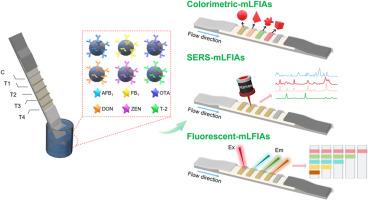
The advancements and applications of lateral-flow immunoassays (LFIAs), which are known for their portability and affordability, in the simultaneous detection of several mycotoxins in food matrices are summarized in this review. The elements of constructing multiplexed LFIAs in terms of strip structure, biorecognition elements, nanotags, and portable readout devices are discussed. Signal amplification strategies contributing to improved detection sensitivity and sample pretreatment approaches targeting increased detection reliability are summarized. Applications regarding the high-throughput determination of multiple mycotoxins in food samples are highlighted, with special attention being paid to colorimetric, fluorescence, and SERS modes. Further prospectives regarding the selection and optimization of the spatial arrangement of detection strips, immunoprobe compositions, and signal transduction methods of multiplexed LFIAs are proposed.
Key findings and conclusions
Multiplexed LFIA-based high-throughput monitoring of mycotoxins in foodstuffs demonstrates superior capabilities over traditional approaches considering affordability, portability, rapidity, sensitivity, reliability, and applicability to real food samples. It is desirable to witness the integration of LFIAs with other analytical platforms to facilitate rapid and quantitative multiplexed mycotoxins screening.
期刊介绍:
Trends in Food Science & Technology is a prestigious international journal that specializes in peer-reviewed articles covering the latest advancements in technology, food science, and human nutrition. It serves as a bridge between specialized primary journals and general trade magazines, providing readable and scientifically rigorous reviews and commentaries on current research developments and their potential applications in the food industry.
Unlike traditional journals, Trends in Food Science & Technology does not publish original research papers. Instead, it focuses on critical and comprehensive reviews to offer valuable insights for professionals in the field. By bringing together cutting-edge research and industry applications, this journal plays a vital role in disseminating knowledge and facilitating advancements in the food science and technology sector.




 京公网安备 11010802042870号
京ICP备2023020795号-1
京公网安备 11010802042870号
京ICP备2023020795号-1

 分享
分享
 求助内容:
求助内容: 应助结果提醒方式:
 扫码关注我们
