Kunderu Pallavi , Alex Koshy , Gargi Das , Chirodeep Bakli , Subhabrata Ray
{"title":"在中尺度双相流体流动过程中,纳米流体诱导单分散塞的连续产生","authors":"Kunderu Pallavi , Alex Koshy , Gargi Das , Chirodeep Bakli , Subhabrata Ray","doi":"10.1016/j.cep.2025.110193","DOIUrl":null,"url":null,"abstract":"<div><div>The study proposes a novel technique for continuous generation of monodispersed droplets during biphasic flow in mesoscale. The technique uses aqueous nanofluids to pinch-off toluene droplets during flow in a 2.38 mm diameter glass conduit. Visualisation studies over a flow rate range of 2–80 mL/min show a significant increase in plug flow range compared to water-toluene flow. The range is even higher than that reported in literature for water-toluene flow in microchannels. This is a favorable outcome as plug flow enhances rate of transport processes. Additionally, we observe an enhanced range of monodispersity (polydispersity index ≤ 1.01) compared to water-toluene flow under the same conditions. The values for critical aqueous capillary number and organic Weber number for monodispersity (<em>Ca<sub>aq</sub></em>* and <em>We<sub>org</sub></em>*) ≈ 0.024 and 7 for nanofluids and 0.01 and 2 for water. We further note the formation of inverted dispersed flow at low aqueous and moderate organic flow (<em>We<sub>org</sub></em> ≤ 8). Comparison with the flow pattern map for surfactant-toluene flow under identical flow conditions shows that the observations cannot be rationalised solely from changes in phase physical properties. We postulate interface jamming to play a significant role. A simplistic analysis shows that availability of nanoparticles exceeding 400 % of that required to cover the surface created during droplet formation ensures monodispersity under jetting at high phase flow rates. Likewise, inverted droplet flow appears when the availability of nanoparticles exceeds 100 % of that required for interface coverage and <em>We<sub>org</sub></em> ≤ 8. For higher Weber numbers, inertial forces dominate, resulting in thread flow.</div></div>","PeriodicalId":9929,"journal":{"name":"Chemical Engineering and Processing - Process Intensification","volume":"209 ","pages":"Article 110193"},"PeriodicalIF":3.9000,"publicationDate":"2025-03-01","publicationTypes":"Journal Article","fieldsOfStudy":null,"isOpenAccess":false,"openAccessPdf":"","citationCount":"0","resultStr":"{\"title\":\"Nanofluid induced continuous production of monodispersed plugs during biphasic liquid flow in meso-scale\",\"authors\":\"Kunderu Pallavi , Alex Koshy , Gargi Das , Chirodeep Bakli , Subhabrata Ray\",\"doi\":\"10.1016/j.cep.2025.110193\",\"DOIUrl\":null,\"url\":null,\"abstract\":\"<div><div>The study proposes a novel technique for continuous generation of monodispersed droplets during biphasic flow in mesoscale. The technique uses aqueous nanofluids to pinch-off toluene droplets during flow in a 2.38 mm diameter glass conduit. Visualisation studies over a flow rate range of 2–80 mL/min show a significant increase in plug flow range compared to water-toluene flow. The range is even higher than that reported in literature for water-toluene flow in microchannels. This is a favorable outcome as plug flow enhances rate of transport processes. Additionally, we observe an enhanced range of monodispersity (polydispersity index ≤ 1.01) compared to water-toluene flow under the same conditions. The values for critical aqueous capillary number and organic Weber number for monodispersity (<em>Ca<sub>aq</sub></em>* and <em>We<sub>org</sub></em>*) ≈ 0.024 and 7 for nanofluids and 0.01 and 2 for water. We further note the formation of inverted dispersed flow at low aqueous and moderate organic flow (<em>We<sub>org</sub></em> ≤ 8). Comparison with the flow pattern map for surfactant-toluene flow under identical flow conditions shows that the observations cannot be rationalised solely from changes in phase physical properties. We postulate interface jamming to play a significant role. A simplistic analysis shows that availability of nanoparticles exceeding 400 % of that required to cover the surface created during droplet formation ensures monodispersity under jetting at high phase flow rates. Likewise, inverted droplet flow appears when the availability of nanoparticles exceeds 100 % of that required for interface coverage and <em>We<sub>org</sub></em> ≤ 8. For higher Weber numbers, inertial forces dominate, resulting in thread flow.</div></div>\",\"PeriodicalId\":9929,\"journal\":{\"name\":\"Chemical Engineering and Processing - Process Intensification\",\"volume\":\"209 \",\"pages\":\"Article 110193\"},\"PeriodicalIF\":3.9000,\"publicationDate\":\"2025-03-01\",\"publicationTypes\":\"Journal Article\",\"fieldsOfStudy\":null,\"isOpenAccess\":false,\"openAccessPdf\":\"\",\"citationCount\":\"0\",\"resultStr\":null,\"platform\":\"Semanticscholar\",\"paperid\":null,\"PeriodicalName\":\"Chemical Engineering and Processing - Process Intensification\",\"FirstCategoryId\":\"5\",\"ListUrlMain\":\"https://www.sciencedirect.com/science/article/pii/S0255270125000431\",\"RegionNum\":3,\"RegionCategory\":\"工程技术\",\"ArticlePicture\":[],\"TitleCN\":null,\"AbstractTextCN\":null,\"PMCID\":null,\"EPubDate\":\"2025/1/25 0:00:00\",\"PubModel\":\"Epub\",\"JCR\":\"Q3\",\"JCRName\":\"ENERGY & FUELS\",\"Score\":null,\"Total\":0}","platform":"Semanticscholar","paperid":null,"PeriodicalName":"Chemical Engineering and Processing - Process Intensification","FirstCategoryId":"5","ListUrlMain":"https://www.sciencedirect.com/science/article/pii/S0255270125000431","RegionNum":3,"RegionCategory":"工程技术","ArticlePicture":[],"TitleCN":null,"AbstractTextCN":null,"PMCID":null,"EPubDate":"2025/1/25 0:00:00","PubModel":"Epub","JCR":"Q3","JCRName":"ENERGY & FUELS","Score":null,"Total":0}
Nanofluid induced continuous production of monodispersed plugs during biphasic liquid flow in meso-scale
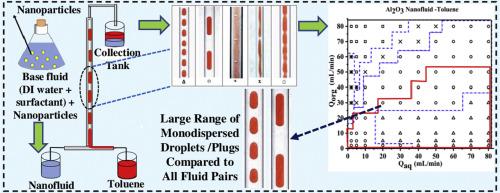
The study proposes a novel technique for continuous generation of monodispersed droplets during biphasic flow in mesoscale. The technique uses aqueous nanofluids to pinch-off toluene droplets during flow in a 2.38 mm diameter glass conduit. Visualisation studies over a flow rate range of 2–80 mL/min show a significant increase in plug flow range compared to water-toluene flow. The range is even higher than that reported in literature for water-toluene flow in microchannels. This is a favorable outcome as plug flow enhances rate of transport processes. Additionally, we observe an enhanced range of monodispersity (polydispersity index ≤ 1.01) compared to water-toluene flow under the same conditions. The values for critical aqueous capillary number and organic Weber number for monodispersity (Caaq* and Weorg*) ≈ 0.024 and 7 for nanofluids and 0.01 and 2 for water. We further note the formation of inverted dispersed flow at low aqueous and moderate organic flow (Weorg ≤ 8). Comparison with the flow pattern map for surfactant-toluene flow under identical flow conditions shows that the observations cannot be rationalised solely from changes in phase physical properties. We postulate interface jamming to play a significant role. A simplistic analysis shows that availability of nanoparticles exceeding 400 % of that required to cover the surface created during droplet formation ensures monodispersity under jetting at high phase flow rates. Likewise, inverted droplet flow appears when the availability of nanoparticles exceeds 100 % of that required for interface coverage and Weorg ≤ 8. For higher Weber numbers, inertial forces dominate, resulting in thread flow.
期刊介绍:
Chemical Engineering and Processing: Process Intensification is intended for practicing researchers in industry and academia, working in the field of Process Engineering and related to the subject of Process Intensification.Articles published in the Journal demonstrate how novel discoveries, developments and theories in the field of Process Engineering and in particular Process Intensification may be used for analysis and design of innovative equipment and processing methods with substantially improved sustainability, efficiency and environmental performance.




 京公网安备 11010802042870号
京ICP备2023020795号-1
京公网安备 11010802042870号
京ICP备2023020795号-1

 分享
分享

 求助内容:
求助内容: 应助结果提醒方式:
 扫码关注我们
