Imane Ziani , Hamza Bouakline , Abdelqader El Guerraf , Ali El Bachiri , Marie-Laure Fauconnier , Farooq Sher
{"title":"集成人工智能和先进的光谱技术,用于精确的食品安全和质量控制","authors":"Imane Ziani , Hamza Bouakline , Abdelqader El Guerraf , Ali El Bachiri , Marie-Laure Fauconnier , Farooq Sher","doi":"10.1016/j.tifs.2024.104850","DOIUrl":null,"url":null,"abstract":"<div><div>Traditional methods like high-performance liquid chromatography (HPLC) and gas chromatography-mass spectrometry (GC-MS) are widely used in food analysis but often face limitations in detecting trace contaminants at ultra-low levels or in complex matrices. This review highlights recent breakthroughs in food analysis technologies that deliver unprecedented sensitivity and accuracy for consumers' health protection. Among these advances, Wide Line Surface-Enhanced Raman scattering (WL-SERS) has delivered a tenfold increase in sensitivity, enabling the detection of contaminants like melamine in raw milk at concentrations far below conventional thresholds. Mass spectrometry imaging (MSI), particularly matrix-assisted laser desorption/ionization (MALDI-MSI), has made significant progress in spatial resolution, allowing for precise mapping of food constituents and contaminants. Additionally, two-dimensional liquid chromatography (2D-LC) and multidimensional gas chromatography have evolved rapidly, achieving detection as low as 1 ppb in complex food systems. Innovative sensor technologies, such as the Dpyt near-infrared (NIR) fluorescent probe and electrochemiluminescence (ECL) aptasensors, offer rapid and highly sensitive detection, effectively complementing traditional methods. Furthermore, the integration of artificial intelligence (AI) and machine learning (ML) has revolutionized food quality assessment, with models like convolutional neural networks (CNNs) reaching up to 99.85% accuracy in identifying adulterants. Despite these advancements, challenges such as high operational costs, sensor stability and AI's computational demands remain. This review highlights the integration of advanced spectroscopy, AI-driven analysis, and novel sensor technologies, outlining future strategies such as miniaturization, nanomaterial innovations, and standardized protocols. These approaches present transformative pathways for improving the precision, efficiency, and accessibility of food safety and quality management, ultimately enhancing public health protection.</div></div>","PeriodicalId":441,"journal":{"name":"Trends in Food Science & Technology","volume":"156 ","pages":"Article 104850"},"PeriodicalIF":15.4000,"publicationDate":"2025-02-01","publicationTypes":"Journal Article","fieldsOfStudy":null,"isOpenAccess":false,"openAccessPdf":"","citationCount":"0","resultStr":"{\"title\":\"Integrating AI and advanced spectroscopic techniques for precision food safety and quality control\",\"authors\":\"Imane Ziani , Hamza Bouakline , Abdelqader El Guerraf , Ali El Bachiri , Marie-Laure Fauconnier , Farooq Sher\",\"doi\":\"10.1016/j.tifs.2024.104850\",\"DOIUrl\":null,\"url\":null,\"abstract\":\"<div><div>Traditional methods like high-performance liquid chromatography (HPLC) and gas chromatography-mass spectrometry (GC-MS) are widely used in food analysis but often face limitations in detecting trace contaminants at ultra-low levels or in complex matrices. This review highlights recent breakthroughs in food analysis technologies that deliver unprecedented sensitivity and accuracy for consumers' health protection. Among these advances, Wide Line Surface-Enhanced Raman scattering (WL-SERS) has delivered a tenfold increase in sensitivity, enabling the detection of contaminants like melamine in raw milk at concentrations far below conventional thresholds. Mass spectrometry imaging (MSI), particularly matrix-assisted laser desorption/ionization (MALDI-MSI), has made significant progress in spatial resolution, allowing for precise mapping of food constituents and contaminants. Additionally, two-dimensional liquid chromatography (2D-LC) and multidimensional gas chromatography have evolved rapidly, achieving detection as low as 1 ppb in complex food systems. Innovative sensor technologies, such as the Dpyt near-infrared (NIR) fluorescent probe and electrochemiluminescence (ECL) aptasensors, offer rapid and highly sensitive detection, effectively complementing traditional methods. Furthermore, the integration of artificial intelligence (AI) and machine learning (ML) has revolutionized food quality assessment, with models like convolutional neural networks (CNNs) reaching up to 99.85% accuracy in identifying adulterants. Despite these advancements, challenges such as high operational costs, sensor stability and AI's computational demands remain. This review highlights the integration of advanced spectroscopy, AI-driven analysis, and novel sensor technologies, outlining future strategies such as miniaturization, nanomaterial innovations, and standardized protocols. These approaches present transformative pathways for improving the precision, efficiency, and accessibility of food safety and quality management, ultimately enhancing public health protection.</div></div>\",\"PeriodicalId\":441,\"journal\":{\"name\":\"Trends in Food Science & Technology\",\"volume\":\"156 \",\"pages\":\"Article 104850\"},\"PeriodicalIF\":15.4000,\"publicationDate\":\"2025-02-01\",\"publicationTypes\":\"Journal Article\",\"fieldsOfStudy\":null,\"isOpenAccess\":false,\"openAccessPdf\":\"\",\"citationCount\":\"0\",\"resultStr\":null,\"platform\":\"Semanticscholar\",\"paperid\":null,\"PeriodicalName\":\"Trends in Food Science & Technology\",\"FirstCategoryId\":\"97\",\"ListUrlMain\":\"https://www.sciencedirect.com/science/article/pii/S0924224424005260\",\"RegionNum\":1,\"RegionCategory\":\"农林科学\",\"ArticlePicture\":[],\"TitleCN\":null,\"AbstractTextCN\":null,\"PMCID\":null,\"EPubDate\":\"2024/12/20 0:00:00\",\"PubModel\":\"Epub\",\"JCR\":\"Q1\",\"JCRName\":\"FOOD SCIENCE & TECHNOLOGY\",\"Score\":null,\"Total\":0}","platform":"Semanticscholar","paperid":null,"PeriodicalName":"Trends in Food Science & Technology","FirstCategoryId":"97","ListUrlMain":"https://www.sciencedirect.com/science/article/pii/S0924224424005260","RegionNum":1,"RegionCategory":"农林科学","ArticlePicture":[],"TitleCN":null,"AbstractTextCN":null,"PMCID":null,"EPubDate":"2024/12/20 0:00:00","PubModel":"Epub","JCR":"Q1","JCRName":"FOOD SCIENCE & TECHNOLOGY","Score":null,"Total":0}
Integrating AI and advanced spectroscopic techniques for precision food safety and quality control
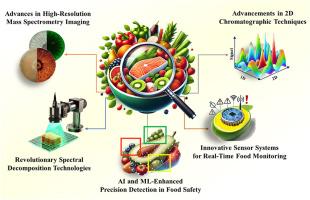
Traditional methods like high-performance liquid chromatography (HPLC) and gas chromatography-mass spectrometry (GC-MS) are widely used in food analysis but often face limitations in detecting trace contaminants at ultra-low levels or in complex matrices. This review highlights recent breakthroughs in food analysis technologies that deliver unprecedented sensitivity and accuracy for consumers' health protection. Among these advances, Wide Line Surface-Enhanced Raman scattering (WL-SERS) has delivered a tenfold increase in sensitivity, enabling the detection of contaminants like melamine in raw milk at concentrations far below conventional thresholds. Mass spectrometry imaging (MSI), particularly matrix-assisted laser desorption/ionization (MALDI-MSI), has made significant progress in spatial resolution, allowing for precise mapping of food constituents and contaminants. Additionally, two-dimensional liquid chromatography (2D-LC) and multidimensional gas chromatography have evolved rapidly, achieving detection as low as 1 ppb in complex food systems. Innovative sensor technologies, such as the Dpyt near-infrared (NIR) fluorescent probe and electrochemiluminescence (ECL) aptasensors, offer rapid and highly sensitive detection, effectively complementing traditional methods. Furthermore, the integration of artificial intelligence (AI) and machine learning (ML) has revolutionized food quality assessment, with models like convolutional neural networks (CNNs) reaching up to 99.85% accuracy in identifying adulterants. Despite these advancements, challenges such as high operational costs, sensor stability and AI's computational demands remain. This review highlights the integration of advanced spectroscopy, AI-driven analysis, and novel sensor technologies, outlining future strategies such as miniaturization, nanomaterial innovations, and standardized protocols. These approaches present transformative pathways for improving the precision, efficiency, and accessibility of food safety and quality management, ultimately enhancing public health protection.
期刊介绍:
Trends in Food Science & Technology is a prestigious international journal that specializes in peer-reviewed articles covering the latest advancements in technology, food science, and human nutrition. It serves as a bridge between specialized primary journals and general trade magazines, providing readable and scientifically rigorous reviews and commentaries on current research developments and their potential applications in the food industry.
Unlike traditional journals, Trends in Food Science & Technology does not publish original research papers. Instead, it focuses on critical and comprehensive reviews to offer valuable insights for professionals in the field. By bringing together cutting-edge research and industry applications, this journal plays a vital role in disseminating knowledge and facilitating advancements in the food science and technology sector.




 京公网安备 11010802042870号
京ICP备2023020795号-1
京公网安备 11010802042870号
京ICP备2023020795号-1

 分享
分享
 求助内容:
求助内容: 应助结果提醒方式:
 扫码关注我们
