Zhi Ren , Cheng-Biao Leng , Yiping Yang , Jiajie Chen , Andong Wang , Shuilong Wang
{"title":"德兴矿田辉钼矿显微结构及微量元素赋存特征:对铼差异富集的启示","authors":"Zhi Ren , Cheng-Biao Leng , Yiping Yang , Jiajie Chen , Andong Wang , Shuilong Wang","doi":"10.1016/j.oregeorev.2025.106473","DOIUrl":null,"url":null,"abstract":"<div><div>Rhenium (Re), a critical metal of significant importance to national security and military strategies, has garnered extensive attention in recent years. Most of the world’s rhenium is extracted from molybdenite in porphyry deposits. As the primary host-mineral of Re, molybdenite (MoS<sub>2</sub>) is a layered sulfide mineral featuring two hexagonally coordinated sulfur layers enclosing a molybdenum layer. Molybdenite, a mineral commonly found in hydrothermal ore deposits, is similar to other layered minerals in that it exhibits polytypism. Nevertheless, the nanoscale distribution and enrichment mechanisms of rhenium (Re) within molybdenite remain largely enigmatic. This research utilizes high-resolution transmission electron microscopy (HRTEM), in combination with the nanobeam techniques, to explore the occurrence and variable enrichment of rhenium (Re) in molybdenite extracted from the Fujiawu and Tongchang deposits within the Dexing ore field, eastern China, where notably diverse average rhenium contents are observed. The molybdenite polytypes identified in the Dexing ore field encompass 2<em>H</em><sub>1</sub> and 2<em>H</em><sub>1</sub> + 3<em>R</em>, whereas those from Fujiawu are categorized as 2<em>H</em><sub>1</sub> and 2<em>H</em><sub>d</sub>, and those from Tongchang as 2<em>H</em><sub>1</sub>, 3<em>R</em> and 2<em>H</em><sub>d</sub> and 3<em>R</em><sub>d</sub>. The disordered molybdenite from the Dexing ore field formed under non-equilibrium conditions, with molybdenite from Fujiawu displaying a higher degree of orderliness compared to that from Tongchang. Rhenium is found adsorbed on the surface of molybdenite from the Dexing ore field in the form of Re-S complexes. By comparing the trace element compositions and microstructures of molybdenite from the Fujiawu and Tongchang deposits, we ascribe the differential enrichment of Re predominantly to the microstructures of molybdenite, the impurity content of ore-forming fluids, the rates of cooling and crystallization during molybdenite formation.</div></div>","PeriodicalId":19644,"journal":{"name":"Ore Geology Reviews","volume":"177 ","pages":"Article 106473"},"PeriodicalIF":4.3000,"publicationDate":"2025-02-01","publicationTypes":"Journal Article","fieldsOfStudy":null,"isOpenAccess":false,"openAccessPdf":"","citationCount":"0","resultStr":"{\"title\":\"Microstructure and trace element occurrence in molybdenite (MoS2) from the Dexing ore field: Implications for the differential enrichment of rhenium\",\"authors\":\"Zhi Ren , Cheng-Biao Leng , Yiping Yang , Jiajie Chen , Andong Wang , Shuilong Wang\",\"doi\":\"10.1016/j.oregeorev.2025.106473\",\"DOIUrl\":null,\"url\":null,\"abstract\":\"<div><div>Rhenium (Re), a critical metal of significant importance to national security and military strategies, has garnered extensive attention in recent years. Most of the world’s rhenium is extracted from molybdenite in porphyry deposits. As the primary host-mineral of Re, molybdenite (MoS<sub>2</sub>) is a layered sulfide mineral featuring two hexagonally coordinated sulfur layers enclosing a molybdenum layer. Molybdenite, a mineral commonly found in hydrothermal ore deposits, is similar to other layered minerals in that it exhibits polytypism. Nevertheless, the nanoscale distribution and enrichment mechanisms of rhenium (Re) within molybdenite remain largely enigmatic. This research utilizes high-resolution transmission electron microscopy (HRTEM), in combination with the nanobeam techniques, to explore the occurrence and variable enrichment of rhenium (Re) in molybdenite extracted from the Fujiawu and Tongchang deposits within the Dexing ore field, eastern China, where notably diverse average rhenium contents are observed. The molybdenite polytypes identified in the Dexing ore field encompass 2<em>H</em><sub>1</sub> and 2<em>H</em><sub>1</sub> + 3<em>R</em>, whereas those from Fujiawu are categorized as 2<em>H</em><sub>1</sub> and 2<em>H</em><sub>d</sub>, and those from Tongchang as 2<em>H</em><sub>1</sub>, 3<em>R</em> and 2<em>H</em><sub>d</sub> and 3<em>R</em><sub>d</sub>. The disordered molybdenite from the Dexing ore field formed under non-equilibrium conditions, with molybdenite from Fujiawu displaying a higher degree of orderliness compared to that from Tongchang. Rhenium is found adsorbed on the surface of molybdenite from the Dexing ore field in the form of Re-S complexes. By comparing the trace element compositions and microstructures of molybdenite from the Fujiawu and Tongchang deposits, we ascribe the differential enrichment of Re predominantly to the microstructures of molybdenite, the impurity content of ore-forming fluids, the rates of cooling and crystallization during molybdenite formation.</div></div>\",\"PeriodicalId\":19644,\"journal\":{\"name\":\"Ore Geology Reviews\",\"volume\":\"177 \",\"pages\":\"Article 106473\"},\"PeriodicalIF\":4.3000,\"publicationDate\":\"2025-02-01\",\"publicationTypes\":\"Journal Article\",\"fieldsOfStudy\":null,\"isOpenAccess\":false,\"openAccessPdf\":\"\",\"citationCount\":\"0\",\"resultStr\":null,\"platform\":\"Semanticscholar\",\"paperid\":null,\"PeriodicalName\":\"Ore Geology Reviews\",\"FirstCategoryId\":\"89\",\"ListUrlMain\":\"https://www.sciencedirect.com/science/article/pii/S0169136825000332\",\"RegionNum\":2,\"RegionCategory\":\"地球科学\",\"ArticlePicture\":[],\"TitleCN\":null,\"AbstractTextCN\":null,\"PMCID\":null,\"EPubDate\":\"2025/1/24 0:00:00\",\"PubModel\":\"Epub\",\"JCR\":\"Q1\",\"JCRName\":\"GEOLOGY\",\"Score\":null,\"Total\":0}","platform":"Semanticscholar","paperid":null,"PeriodicalName":"Ore Geology Reviews","FirstCategoryId":"89","ListUrlMain":"https://www.sciencedirect.com/science/article/pii/S0169136825000332","RegionNum":2,"RegionCategory":"地球科学","ArticlePicture":[],"TitleCN":null,"AbstractTextCN":null,"PMCID":null,"EPubDate":"2025/1/24 0:00:00","PubModel":"Epub","JCR":"Q1","JCRName":"GEOLOGY","Score":null,"Total":0}
Microstructure and trace element occurrence in molybdenite (MoS2) from the Dexing ore field: Implications for the differential enrichment of rhenium
Rhenium (Re), a critical metal of significant importance to national security and military strategies, has garnered extensive attention in recent years. Most of the world’s rhenium is extracted from molybdenite in porphyry deposits. As the primary host-mineral of Re, molybdenite (MoS2) is a layered sulfide mineral featuring two hexagonally coordinated sulfur layers enclosing a molybdenum layer. Molybdenite, a mineral commonly found in hydrothermal ore deposits, is similar to other layered minerals in that it exhibits polytypism. Nevertheless, the nanoscale distribution and enrichment mechanisms of rhenium (Re) within molybdenite remain largely enigmatic. This research utilizes high-resolution transmission electron microscopy (HRTEM), in combination with the nanobeam techniques, to explore the occurrence and variable enrichment of rhenium (Re) in molybdenite extracted from the Fujiawu and Tongchang deposits within the Dexing ore field, eastern China, where notably diverse average rhenium contents are observed. The molybdenite polytypes identified in the Dexing ore field encompass 2H1 and 2H1 + 3R, whereas those from Fujiawu are categorized as 2H1 and 2Hd, and those from Tongchang as 2H1, 3R and 2Hd and 3Rd. The disordered molybdenite from the Dexing ore field formed under non-equilibrium conditions, with molybdenite from Fujiawu displaying a higher degree of orderliness compared to that from Tongchang. Rhenium is found adsorbed on the surface of molybdenite from the Dexing ore field in the form of Re-S complexes. By comparing the trace element compositions and microstructures of molybdenite from the Fujiawu and Tongchang deposits, we ascribe the differential enrichment of Re predominantly to the microstructures of molybdenite, the impurity content of ore-forming fluids, the rates of cooling and crystallization during molybdenite formation.
期刊介绍:
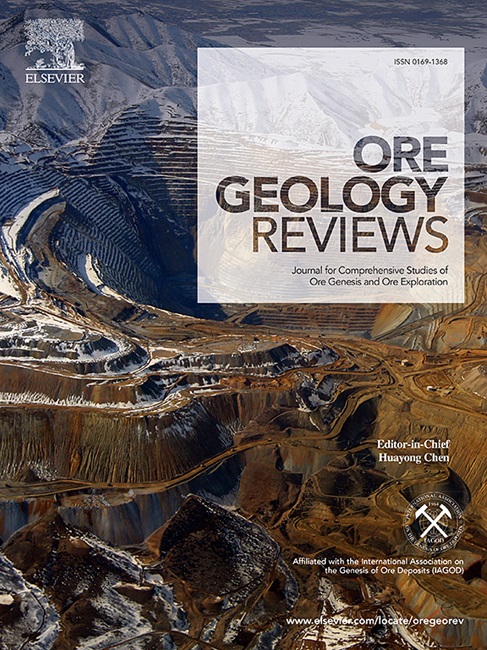
Ore Geology Reviews aims to familiarize all earth scientists with recent advances in a number of interconnected disciplines related to the study of, and search for, ore deposits. The reviews range from brief to longer contributions, but the journal preferentially publishes manuscripts that fill the niche between the commonly shorter journal articles and the comprehensive book coverages, and thus has a special appeal to many authors and readers.





 京公网安备 11010802042870号
京ICP备2023020795号-1
京公网安备 11010802042870号
京ICP备2023020795号-1

 分享
分享
 求助内容:
求助内容: 应助结果提醒方式:
 扫码关注我们
