{"title":"流体过程的多种组合对Au-Te富集的控制——来自东平巨型Au-Te矿床的启示","authors":"Gao-Hua Fan , Xiao-Dong Deng , Zhan-Ke Li , Bo Zu","doi":"10.1016/j.oregeorev.2025.106464","DOIUrl":null,"url":null,"abstract":"<div><div>Te-rich gold ores are important potential targets for the Te recovery and their formation is usually the results of different fluid processes, including fluid boiling, mixing and fluid-rock interaction. However, how the various combinations of these processes control Te enrichment together with Au remains poorly understood. The giant Dongping Au-Te deposit in the North China Craton provides an excellent opportunity to investigate this question. Here, we present major, trace element, and S isotope compositions of three generations of pyrite (Py-1, Py-2a, and Py-2b) at Dongping, based on the detailed petrographic observations. The results show that Te and Au occur mainly as solid solution in pre-ore Py-1, distinct from their existence mostly in form of mineral inclusion in Py-2a of <em>syn</em>-ore veining stage. These two styles of occurrence are suggested for Py-2b in <em>syn</em>-ore disseminated gold ores. In addition, trace element mapping reveals a coupling characteristic between Te and Au. When combining the results presented here and previous data, such enrichment behaviors of Te and Au are proposed to be related to different degrees of various combinations of fluid processes. Pre-ore fluids forming Py-1 are under a condition of high temperature and <em>f</em><sub>O2</sub>, and thus contain high Te concentrations (HTeO<sub>3</sub><sup>–</sup> and/or TeO<sub>3</sub><sup>2–</sup>) and low Au concentrations (Au(HS)<sub>2</sub><sup>–</sup>). Gentle boiling during the Py-1 formation decreased the loss of Te to vapor phase, thereby causing the co-enrichment of Te and Au in liquid-rich fluids. Meanwhile, high As concentrations facilitated the co-incorporation of Te and Au into Py-1 as solid inclusions. Vigorous fluid mixing at the onset of Py-1 formation cannot trigger the precipitation of Te because of high temperature and <em>f</em><sub>O2</sub>. HTe<sup>–</sup> and/or Te<sub>2</sub><sup>2–</sup> are dominant for Te transport in reduced fluids of <em>syn</em>-ore stage. During the formation of Py-2a, a process involving Te-rich metallic melts scavenging Au from ore fluids could account for the co-enrichment of Te and Au. This process was activated by fluid oxidation caused by vigorous processes of fluid boiling and mixing. The deficient As concentrations likely led to the scarce occurrence of Te and Au as solid inclusions in Py-2a. The oxidation of fluids systems induced by igorous boiling and fluid-rock interaction was responsible for the co-enrichment of Te and Au in Py-2b, which also invoked Te-rich metallic melts. The moderate As concentrations may explain some Te and Au as solid solution in Py-2b.</div></div>","PeriodicalId":19644,"journal":{"name":"Ore Geology Reviews","volume":"177 ","pages":"Article 106464"},"PeriodicalIF":3.6000,"publicationDate":"2025-02-01","publicationTypes":"Journal Article","fieldsOfStudy":null,"isOpenAccess":false,"openAccessPdf":"","citationCount":"0","resultStr":"{\"title\":\"The control of various combinations of fluid processes on Au-Te enrichment: Insights from the giant Dongping Au-Te deposit\",\"authors\":\"Gao-Hua Fan , Xiao-Dong Deng , Zhan-Ke Li , Bo Zu\",\"doi\":\"10.1016/j.oregeorev.2025.106464\",\"DOIUrl\":null,\"url\":null,\"abstract\":\"<div><div>Te-rich gold ores are important potential targets for the Te recovery and their formation is usually the results of different fluid processes, including fluid boiling, mixing and fluid-rock interaction. However, how the various combinations of these processes control Te enrichment together with Au remains poorly understood. The giant Dongping Au-Te deposit in the North China Craton provides an excellent opportunity to investigate this question. Here, we present major, trace element, and S isotope compositions of three generations of pyrite (Py-1, Py-2a, and Py-2b) at Dongping, based on the detailed petrographic observations. The results show that Te and Au occur mainly as solid solution in pre-ore Py-1, distinct from their existence mostly in form of mineral inclusion in Py-2a of <em>syn</em>-ore veining stage. These two styles of occurrence are suggested for Py-2b in <em>syn</em>-ore disseminated gold ores. In addition, trace element mapping reveals a coupling characteristic between Te and Au. When combining the results presented here and previous data, such enrichment behaviors of Te and Au are proposed to be related to different degrees of various combinations of fluid processes. Pre-ore fluids forming Py-1 are under a condition of high temperature and <em>f</em><sub>O2</sub>, and thus contain high Te concentrations (HTeO<sub>3</sub><sup>–</sup> and/or TeO<sub>3</sub><sup>2–</sup>) and low Au concentrations (Au(HS)<sub>2</sub><sup>–</sup>). Gentle boiling during the Py-1 formation decreased the loss of Te to vapor phase, thereby causing the co-enrichment of Te and Au in liquid-rich fluids. Meanwhile, high As concentrations facilitated the co-incorporation of Te and Au into Py-1 as solid inclusions. Vigorous fluid mixing at the onset of Py-1 formation cannot trigger the precipitation of Te because of high temperature and <em>f</em><sub>O2</sub>. HTe<sup>–</sup> and/or Te<sub>2</sub><sup>2–</sup> are dominant for Te transport in reduced fluids of <em>syn</em>-ore stage. During the formation of Py-2a, a process involving Te-rich metallic melts scavenging Au from ore fluids could account for the co-enrichment of Te and Au. This process was activated by fluid oxidation caused by vigorous processes of fluid boiling and mixing. The deficient As concentrations likely led to the scarce occurrence of Te and Au as solid inclusions in Py-2a. The oxidation of fluids systems induced by igorous boiling and fluid-rock interaction was responsible for the co-enrichment of Te and Au in Py-2b, which also invoked Te-rich metallic melts. The moderate As concentrations may explain some Te and Au as solid solution in Py-2b.</div></div>\",\"PeriodicalId\":19644,\"journal\":{\"name\":\"Ore Geology Reviews\",\"volume\":\"177 \",\"pages\":\"Article 106464\"},\"PeriodicalIF\":3.6000,\"publicationDate\":\"2025-02-01\",\"publicationTypes\":\"Journal Article\",\"fieldsOfStudy\":null,\"isOpenAccess\":false,\"openAccessPdf\":\"\",\"citationCount\":\"0\",\"resultStr\":null,\"platform\":\"Semanticscholar\",\"paperid\":null,\"PeriodicalName\":\"Ore Geology Reviews\",\"FirstCategoryId\":\"89\",\"ListUrlMain\":\"https://www.sciencedirect.com/science/article/pii/S0169136825000241\",\"RegionNum\":2,\"RegionCategory\":\"地球科学\",\"ArticlePicture\":[],\"TitleCN\":null,\"AbstractTextCN\":null,\"PMCID\":null,\"EPubDate\":\"2025/1/20 0:00:00\",\"PubModel\":\"Epub\",\"JCR\":\"Q1\",\"JCRName\":\"GEOLOGY\",\"Score\":null,\"Total\":0}","platform":"Semanticscholar","paperid":null,"PeriodicalName":"Ore Geology Reviews","FirstCategoryId":"89","ListUrlMain":"https://www.sciencedirect.com/science/article/pii/S0169136825000241","RegionNum":2,"RegionCategory":"地球科学","ArticlePicture":[],"TitleCN":null,"AbstractTextCN":null,"PMCID":null,"EPubDate":"2025/1/20 0:00:00","PubModel":"Epub","JCR":"Q1","JCRName":"GEOLOGY","Score":null,"Total":0}
The control of various combinations of fluid processes on Au-Te enrichment: Insights from the giant Dongping Au-Te deposit
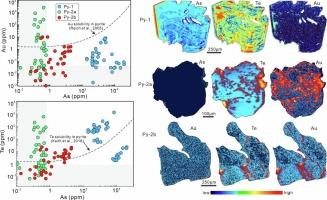
Te-rich gold ores are important potential targets for the Te recovery and their formation is usually the results of different fluid processes, including fluid boiling, mixing and fluid-rock interaction. However, how the various combinations of these processes control Te enrichment together with Au remains poorly understood. The giant Dongping Au-Te deposit in the North China Craton provides an excellent opportunity to investigate this question. Here, we present major, trace element, and S isotope compositions of three generations of pyrite (Py-1, Py-2a, and Py-2b) at Dongping, based on the detailed petrographic observations. The results show that Te and Au occur mainly as solid solution in pre-ore Py-1, distinct from their existence mostly in form of mineral inclusion in Py-2a of syn-ore veining stage. These two styles of occurrence are suggested for Py-2b in syn-ore disseminated gold ores. In addition, trace element mapping reveals a coupling characteristic between Te and Au. When combining the results presented here and previous data, such enrichment behaviors of Te and Au are proposed to be related to different degrees of various combinations of fluid processes. Pre-ore fluids forming Py-1 are under a condition of high temperature and fO2, and thus contain high Te concentrations (HTeO3– and/or TeO32–) and low Au concentrations (Au(HS)2–). Gentle boiling during the Py-1 formation decreased the loss of Te to vapor phase, thereby causing the co-enrichment of Te and Au in liquid-rich fluids. Meanwhile, high As concentrations facilitated the co-incorporation of Te and Au into Py-1 as solid inclusions. Vigorous fluid mixing at the onset of Py-1 formation cannot trigger the precipitation of Te because of high temperature and fO2. HTe– and/or Te22– are dominant for Te transport in reduced fluids of syn-ore stage. During the formation of Py-2a, a process involving Te-rich metallic melts scavenging Au from ore fluids could account for the co-enrichment of Te and Au. This process was activated by fluid oxidation caused by vigorous processes of fluid boiling and mixing. The deficient As concentrations likely led to the scarce occurrence of Te and Au as solid inclusions in Py-2a. The oxidation of fluids systems induced by igorous boiling and fluid-rock interaction was responsible for the co-enrichment of Te and Au in Py-2b, which also invoked Te-rich metallic melts. The moderate As concentrations may explain some Te and Au as solid solution in Py-2b.
期刊介绍:
Ore Geology Reviews aims to familiarize all earth scientists with recent advances in a number of interconnected disciplines related to the study of, and search for, ore deposits. The reviews range from brief to longer contributions, but the journal preferentially publishes manuscripts that fill the niche between the commonly shorter journal articles and the comprehensive book coverages, and thus has a special appeal to many authors and readers.




 京公网安备 11010802042870号
京ICP备2023020795号-1
京公网安备 11010802042870号
京ICP备2023020795号-1

 分享
分享
 求助内容:
求助内容: 应助结果提醒方式:
 扫码关注我们
