{"title":"刚果民主共和国Karagwe-Ankole带Imonga-Saramabila (Maniema)造山带金矿成矿流体的详细特征","authors":"Inge Cools , Stijn Dewaele , Chantal Peiffert , Philippe Muchez","doi":"10.1016/j.oregeorev.2025.106461","DOIUrl":null,"url":null,"abstract":"<div><div>The Western Domain (WD) of the Karagwe-Ankole Belt (KAB) in the Great Lakes Region in Central Africa is part of a metallogenic province rich in elements such as Nb-Ta-Sn-W-Li-Be-Au, which are essential for high-tech and green industries. In contrast to the Sn, W and Nb-Ta mineralisation, the characteristics and source of the Au mineralising fluids are largely unknown. Therefore, the Imonga gold prospect in the WD of the KAB in the Democratic Republic of the Congo (DR Congo) was studied to investigate the gold mineralising fluids.</div><div>The host rocks at Imonga are deformed and intensely altered, dominantly by dolomitisation and chloritisation. Metamorphism is characterised by foliation development (e.g. mica-schist) and post-foliation andalusite porphyroblasts. In total, four vein generations were distinguished. Most important for the mineralisation is the post-foliation second vein generation (V2), composed of mainly quartz and ferroan-dolomite, with the gold in close association with sulfides. The subsequent post-foliation third vein generation (V3) is composed of mainly ferroan-calcite and quartz, and is inferred to post-date V2 by cross-cutting relationships. This vein generation is also associated with sulfides, but no gold mineralisation was observed. The characterisation of the mineralising fluid in both vein generations was performed through extensive fluid inclusion petrography, microthermometry, Raman spectroscopy, LA-ICP-MS and modelling to deduce the fluid characteristics, source and formation conditions of the mineralisation. Both vein generations (V2 and V3) are characterised by a low saline (3.1–7.0 eq.<!--> <!-->wt.%<!--> <!-->NaCl) H<sub>2</sub>O-NaCl-KCl-CO<sub>2</sub> fluid with a wide range in CO<sub>2</sub>-N<sub>2</sub>-CH<sub>4</sub> composition, indicating varying degrees of fluid rock interactions during metamorphism. This fluid composition corresponds to a typical metamorphic origin of the orogenic gold mineralising fluid. Individual fluid inclusion LA-ICP-MS data for Mg, K, Ca, Mn, Fe, Rb, Sr and Ba were compared with the typical composition of sedimentary, metamorphic and magmatic fluids in the literature. The elemental compositions correspond with those of a metamorphic fluid and resemble those found in other studies on orogenic gold deposits. The low concentrations of Rb and Cs (as well as Sr and Ba) indicate that there has been no influence of a magmatic fluid. The fluids have a density between 0.74 and 0.94 g/cm<sup>3</sup>. For a formation temperature window of 350–400 °C (based on the occurrence of andalusite porphyroblasts, the type of quartz deformation and the total homogenisation temperatures of fluid inclusions), a pressure window of 75–250 MPa is derived corresponding to a formation depth of 7.6–9.6 km. The gold was likely transported as gold-sulfur complexes, as indicated by the presence of H<sub>2</sub>S in the fluid inclusions. Precipitation of the gold could have occurred due to the destabilisation of the gold-sulfur complex by interaction with the iron-bearing host-rock resulting in the precipitation of Fe-sulfide minerals, and by changes in fluid pressure related to fault-valve activity.</div></div>","PeriodicalId":19644,"journal":{"name":"Ore Geology Reviews","volume":"178 ","pages":"Article 106461"},"PeriodicalIF":4.3000,"publicationDate":"2025-03-01","publicationTypes":"Journal Article","fieldsOfStudy":null,"isOpenAccess":false,"openAccessPdf":"","citationCount":"0","resultStr":"{\"title\":\"Detailed characterisation of the fluids responsible for orogenic gold mineralisation at Imonga-Saramabila (Maniema) in the Karagwe-Ankole Belt, DR Congo\",\"authors\":\"Inge Cools , Stijn Dewaele , Chantal Peiffert , Philippe Muchez\",\"doi\":\"10.1016/j.oregeorev.2025.106461\",\"DOIUrl\":null,\"url\":null,\"abstract\":\"<div><div>The Western Domain (WD) of the Karagwe-Ankole Belt (KAB) in the Great Lakes Region in Central Africa is part of a metallogenic province rich in elements such as Nb-Ta-Sn-W-Li-Be-Au, which are essential for high-tech and green industries. In contrast to the Sn, W and Nb-Ta mineralisation, the characteristics and source of the Au mineralising fluids are largely unknown. Therefore, the Imonga gold prospect in the WD of the KAB in the Democratic Republic of the Congo (DR Congo) was studied to investigate the gold mineralising fluids.</div><div>The host rocks at Imonga are deformed and intensely altered, dominantly by dolomitisation and chloritisation. Metamorphism is characterised by foliation development (e.g. mica-schist) and post-foliation andalusite porphyroblasts. In total, four vein generations were distinguished. Most important for the mineralisation is the post-foliation second vein generation (V2), composed of mainly quartz and ferroan-dolomite, with the gold in close association with sulfides. The subsequent post-foliation third vein generation (V3) is composed of mainly ferroan-calcite and quartz, and is inferred to post-date V2 by cross-cutting relationships. This vein generation is also associated with sulfides, but no gold mineralisation was observed. The characterisation of the mineralising fluid in both vein generations was performed through extensive fluid inclusion petrography, microthermometry, Raman spectroscopy, LA-ICP-MS and modelling to deduce the fluid characteristics, source and formation conditions of the mineralisation. Both vein generations (V2 and V3) are characterised by a low saline (3.1–7.0 eq.<!--> <!-->wt.%<!--> <!-->NaCl) H<sub>2</sub>O-NaCl-KCl-CO<sub>2</sub> fluid with a wide range in CO<sub>2</sub>-N<sub>2</sub>-CH<sub>4</sub> composition, indicating varying degrees of fluid rock interactions during metamorphism. This fluid composition corresponds to a typical metamorphic origin of the orogenic gold mineralising fluid. Individual fluid inclusion LA-ICP-MS data for Mg, K, Ca, Mn, Fe, Rb, Sr and Ba were compared with the typical composition of sedimentary, metamorphic and magmatic fluids in the literature. The elemental compositions correspond with those of a metamorphic fluid and resemble those found in other studies on orogenic gold deposits. The low concentrations of Rb and Cs (as well as Sr and Ba) indicate that there has been no influence of a magmatic fluid. The fluids have a density between 0.74 and 0.94 g/cm<sup>3</sup>. For a formation temperature window of 350–400 °C (based on the occurrence of andalusite porphyroblasts, the type of quartz deformation and the total homogenisation temperatures of fluid inclusions), a pressure window of 75–250 MPa is derived corresponding to a formation depth of 7.6–9.6 km. The gold was likely transported as gold-sulfur complexes, as indicated by the presence of H<sub>2</sub>S in the fluid inclusions. Precipitation of the gold could have occurred due to the destabilisation of the gold-sulfur complex by interaction with the iron-bearing host-rock resulting in the precipitation of Fe-sulfide minerals, and by changes in fluid pressure related to fault-valve activity.</div></div>\",\"PeriodicalId\":19644,\"journal\":{\"name\":\"Ore Geology Reviews\",\"volume\":\"178 \",\"pages\":\"Article 106461\"},\"PeriodicalIF\":4.3000,\"publicationDate\":\"2025-03-01\",\"publicationTypes\":\"Journal Article\",\"fieldsOfStudy\":null,\"isOpenAccess\":false,\"openAccessPdf\":\"\",\"citationCount\":\"0\",\"resultStr\":null,\"platform\":\"Semanticscholar\",\"paperid\":null,\"PeriodicalName\":\"Ore Geology Reviews\",\"FirstCategoryId\":\"89\",\"ListUrlMain\":\"https://www.sciencedirect.com/science/article/pii/S0169136825000216\",\"RegionNum\":2,\"RegionCategory\":\"地球科学\",\"ArticlePicture\":[],\"TitleCN\":null,\"AbstractTextCN\":null,\"PMCID\":null,\"EPubDate\":\"2025/1/25 0:00:00\",\"PubModel\":\"Epub\",\"JCR\":\"Q1\",\"JCRName\":\"GEOLOGY\",\"Score\":null,\"Total\":0}","platform":"Semanticscholar","paperid":null,"PeriodicalName":"Ore Geology Reviews","FirstCategoryId":"89","ListUrlMain":"https://www.sciencedirect.com/science/article/pii/S0169136825000216","RegionNum":2,"RegionCategory":"地球科学","ArticlePicture":[],"TitleCN":null,"AbstractTextCN":null,"PMCID":null,"EPubDate":"2025/1/25 0:00:00","PubModel":"Epub","JCR":"Q1","JCRName":"GEOLOGY","Score":null,"Total":0}
Detailed characterisation of the fluids responsible for orogenic gold mineralisation at Imonga-Saramabila (Maniema) in the Karagwe-Ankole Belt, DR Congo
The Western Domain (WD) of the Karagwe-Ankole Belt (KAB) in the Great Lakes Region in Central Africa is part of a metallogenic province rich in elements such as Nb-Ta-Sn-W-Li-Be-Au, which are essential for high-tech and green industries. In contrast to the Sn, W and Nb-Ta mineralisation, the characteristics and source of the Au mineralising fluids are largely unknown. Therefore, the Imonga gold prospect in the WD of the KAB in the Democratic Republic of the Congo (DR Congo) was studied to investigate the gold mineralising fluids.
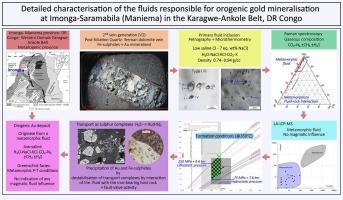
The host rocks at Imonga are deformed and intensely altered, dominantly by dolomitisation and chloritisation. Metamorphism is characterised by foliation development (e.g. mica-schist) and post-foliation andalusite porphyroblasts. In total, four vein generations were distinguished. Most important for the mineralisation is the post-foliation second vein generation (V2), composed of mainly quartz and ferroan-dolomite, with the gold in close association with sulfides. The subsequent post-foliation third vein generation (V3) is composed of mainly ferroan-calcite and quartz, and is inferred to post-date V2 by cross-cutting relationships. This vein generation is also associated with sulfides, but no gold mineralisation was observed. The characterisation of the mineralising fluid in both vein generations was performed through extensive fluid inclusion petrography, microthermometry, Raman spectroscopy, LA-ICP-MS and modelling to deduce the fluid characteristics, source and formation conditions of the mineralisation. Both vein generations (V2 and V3) are characterised by a low saline (3.1–7.0 eq. wt.% NaCl) H2O-NaCl-KCl-CO2 fluid with a wide range in CO2-N2-CH4 composition, indicating varying degrees of fluid rock interactions during metamorphism. This fluid composition corresponds to a typical metamorphic origin of the orogenic gold mineralising fluid. Individual fluid inclusion LA-ICP-MS data for Mg, K, Ca, Mn, Fe, Rb, Sr and Ba were compared with the typical composition of sedimentary, metamorphic and magmatic fluids in the literature. The elemental compositions correspond with those of a metamorphic fluid and resemble those found in other studies on orogenic gold deposits. The low concentrations of Rb and Cs (as well as Sr and Ba) indicate that there has been no influence of a magmatic fluid. The fluids have a density between 0.74 and 0.94 g/cm3. For a formation temperature window of 350–400 °C (based on the occurrence of andalusite porphyroblasts, the type of quartz deformation and the total homogenisation temperatures of fluid inclusions), a pressure window of 75–250 MPa is derived corresponding to a formation depth of 7.6–9.6 km. The gold was likely transported as gold-sulfur complexes, as indicated by the presence of H2S in the fluid inclusions. Precipitation of the gold could have occurred due to the destabilisation of the gold-sulfur complex by interaction with the iron-bearing host-rock resulting in the precipitation of Fe-sulfide minerals, and by changes in fluid pressure related to fault-valve activity.
期刊介绍:
Ore Geology Reviews aims to familiarize all earth scientists with recent advances in a number of interconnected disciplines related to the study of, and search for, ore deposits. The reviews range from brief to longer contributions, but the journal preferentially publishes manuscripts that fill the niche between the commonly shorter journal articles and the comprehensive book coverages, and thus has a special appeal to many authors and readers.




 京公网安备 11010802042870号
京ICP备2023020795号-1
京公网安备 11010802042870号
京ICP备2023020795号-1

 分享
分享
 求助内容:
求助内容: 应助结果提醒方式:
 扫码关注我们
