Xianmeng Tu , Tian Qin , Xiaoyuan Ji , Zeming Wang , Jialong Chen , Zejun Zhang , Zhiguo Wang , Wei Wang , Yingxiong Qin , Jianxin Zhou
{"title":"基于Zr-4合金激光切割边缘形貌特征的DBSCAN聚类模型参数反演","authors":"Xianmeng Tu , Tian Qin , Xiaoyuan Ji , Zeming Wang , Jialong Chen , Zejun Zhang , Zhiguo Wang , Wei Wang , Yingxiong Qin , Jianxin Zhou","doi":"10.1016/j.optlastec.2025.112461","DOIUrl":null,"url":null,"abstract":"<div><div>Laser cutting, as an efficient, high-quality, non-contact metal cutting technology, has the potential to replace traditional manufacturing processes for Zircaloy-4 (Zr-4 alloy) cladding materials of nuclear reactors. However, the stability of the laser cutting process has a significant impact on the quality and service safety of Zr-4 alloy and its key components in nuclear engineering. Therefore, this work first proposes a novel approach for recognizing abnormal fluctuations in the laser cutting process using cutting edge morphology characteristics, thereby ensuring the stability of the process. Firstly, the cutting edge images are captured using an ultra-depth of field microscopy, and the edge morphology feature parameters (the length (<em>L</em>) of vertical striations, the inclination angle (<em>θ</em>) of inclined striations, and surface roughness (<em>Ra</em>)) are measured. Secondly, a density-based spatial clustering of applications with noise (DBSCAN) model for process parameter inversion is established with only 2 cutting edge feature parameters (<em>L</em> and <em>θ</em>, Comprising 386 pairs of data) as model input. Then, a three-standard fusion method is proposed to optimize the model and the model can identify process parameters (laser power, defocus amount, cutting speed, and auxiliary gas pressure, etc.) abnormal fluctuations at 80% accuracy. Finally, by incorporating <em>Ra</em> as an additional input feature parameter along with <em>L</em> and <em>θ</em>, the model can identify process parameters abnormal fluctuations at 100% accuracy. This work effectively recognizes abnormal fluctuations of process parameters during laser cutting of Zr-4 cladding materials, thus benefiting the control of these fluctuations and quality management in metal sheet laser cutting.</div></div>","PeriodicalId":19511,"journal":{"name":"Optics and Laser Technology","volume":"184 ","pages":"Article 112461"},"PeriodicalIF":5.0000,"publicationDate":"2025-06-01","publicationTypes":"Journal Article","fieldsOfStudy":null,"isOpenAccess":false,"openAccessPdf":"","citationCount":"0","resultStr":"{\"title\":\"DBSCAN clustering model for parameter inversion using laser cutting edge morphology characteristic in Zr-4 alloy\",\"authors\":\"Xianmeng Tu , Tian Qin , Xiaoyuan Ji , Zeming Wang , Jialong Chen , Zejun Zhang , Zhiguo Wang , Wei Wang , Yingxiong Qin , Jianxin Zhou\",\"doi\":\"10.1016/j.optlastec.2025.112461\",\"DOIUrl\":null,\"url\":null,\"abstract\":\"<div><div>Laser cutting, as an efficient, high-quality, non-contact metal cutting technology, has the potential to replace traditional manufacturing processes for Zircaloy-4 (Zr-4 alloy) cladding materials of nuclear reactors. However, the stability of the laser cutting process has a significant impact on the quality and service safety of Zr-4 alloy and its key components in nuclear engineering. Therefore, this work first proposes a novel approach for recognizing abnormal fluctuations in the laser cutting process using cutting edge morphology characteristics, thereby ensuring the stability of the process. Firstly, the cutting edge images are captured using an ultra-depth of field microscopy, and the edge morphology feature parameters (the length (<em>L</em>) of vertical striations, the inclination angle (<em>θ</em>) of inclined striations, and surface roughness (<em>Ra</em>)) are measured. Secondly, a density-based spatial clustering of applications with noise (DBSCAN) model for process parameter inversion is established with only 2 cutting edge feature parameters (<em>L</em> and <em>θ</em>, Comprising 386 pairs of data) as model input. Then, a three-standard fusion method is proposed to optimize the model and the model can identify process parameters (laser power, defocus amount, cutting speed, and auxiliary gas pressure, etc.) abnormal fluctuations at 80% accuracy. Finally, by incorporating <em>Ra</em> as an additional input feature parameter along with <em>L</em> and <em>θ</em>, the model can identify process parameters abnormal fluctuations at 100% accuracy. This work effectively recognizes abnormal fluctuations of process parameters during laser cutting of Zr-4 cladding materials, thus benefiting the control of these fluctuations and quality management in metal sheet laser cutting.</div></div>\",\"PeriodicalId\":19511,\"journal\":{\"name\":\"Optics and Laser Technology\",\"volume\":\"184 \",\"pages\":\"Article 112461\"},\"PeriodicalIF\":5.0000,\"publicationDate\":\"2025-06-01\",\"publicationTypes\":\"Journal Article\",\"fieldsOfStudy\":null,\"isOpenAccess\":false,\"openAccessPdf\":\"\",\"citationCount\":\"0\",\"resultStr\":null,\"platform\":\"Semanticscholar\",\"paperid\":null,\"PeriodicalName\":\"Optics and Laser Technology\",\"FirstCategoryId\":\"101\",\"ListUrlMain\":\"https://www.sciencedirect.com/science/article/pii/S0030399225000490\",\"RegionNum\":2,\"RegionCategory\":\"物理与天体物理\",\"ArticlePicture\":[],\"TitleCN\":null,\"AbstractTextCN\":null,\"PMCID\":null,\"EPubDate\":\"2025/1/17 0:00:00\",\"PubModel\":\"Epub\",\"JCR\":\"Q1\",\"JCRName\":\"OPTICS\",\"Score\":null,\"Total\":0}","platform":"Semanticscholar","paperid":null,"PeriodicalName":"Optics and Laser Technology","FirstCategoryId":"101","ListUrlMain":"https://www.sciencedirect.com/science/article/pii/S0030399225000490","RegionNum":2,"RegionCategory":"物理与天体物理","ArticlePicture":[],"TitleCN":null,"AbstractTextCN":null,"PMCID":null,"EPubDate":"2025/1/17 0:00:00","PubModel":"Epub","JCR":"Q1","JCRName":"OPTICS","Score":null,"Total":0}
DBSCAN clustering model for parameter inversion using laser cutting edge morphology characteristic in Zr-4 alloy
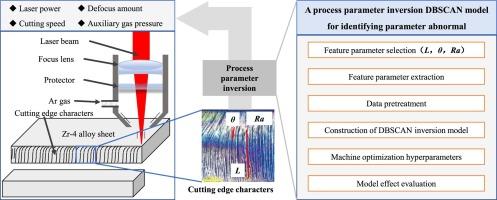
Laser cutting, as an efficient, high-quality, non-contact metal cutting technology, has the potential to replace traditional manufacturing processes for Zircaloy-4 (Zr-4 alloy) cladding materials of nuclear reactors. However, the stability of the laser cutting process has a significant impact on the quality and service safety of Zr-4 alloy and its key components in nuclear engineering. Therefore, this work first proposes a novel approach for recognizing abnormal fluctuations in the laser cutting process using cutting edge morphology characteristics, thereby ensuring the stability of the process. Firstly, the cutting edge images are captured using an ultra-depth of field microscopy, and the edge morphology feature parameters (the length (L) of vertical striations, the inclination angle (θ) of inclined striations, and surface roughness (Ra)) are measured. Secondly, a density-based spatial clustering of applications with noise (DBSCAN) model for process parameter inversion is established with only 2 cutting edge feature parameters (L and θ, Comprising 386 pairs of data) as model input. Then, a three-standard fusion method is proposed to optimize the model and the model can identify process parameters (laser power, defocus amount, cutting speed, and auxiliary gas pressure, etc.) abnormal fluctuations at 80% accuracy. Finally, by incorporating Ra as an additional input feature parameter along with L and θ, the model can identify process parameters abnormal fluctuations at 100% accuracy. This work effectively recognizes abnormal fluctuations of process parameters during laser cutting of Zr-4 cladding materials, thus benefiting the control of these fluctuations and quality management in metal sheet laser cutting.
期刊介绍:
Optics & Laser Technology aims to provide a vehicle for the publication of a broad range of high quality research and review papers in those fields of scientific and engineering research appertaining to the development and application of the technology of optics and lasers. Papers describing original work in these areas are submitted to rigorous refereeing prior to acceptance for publication.
The scope of Optics & Laser Technology encompasses, but is not restricted to, the following areas:
•development in all types of lasers
•developments in optoelectronic devices and photonics
•developments in new photonics and optical concepts
•developments in conventional optics, optical instruments and components
•techniques of optical metrology, including interferometry and optical fibre sensors
•LIDAR and other non-contact optical measurement techniques, including optical methods in heat and fluid flow
•applications of lasers to materials processing, optical NDT display (including holography) and optical communication
•research and development in the field of laser safety including studies of hazards resulting from the applications of lasers (laser safety, hazards of laser fume)
•developments in optical computing and optical information processing
•developments in new optical materials
•developments in new optical characterization methods and techniques
•developments in quantum optics
•developments in light assisted micro and nanofabrication methods and techniques
•developments in nanophotonics and biophotonics
•developments in imaging processing and systems




 京公网安备 11010802042870号
京ICP备2023020795号-1
京公网安备 11010802042870号
京ICP备2023020795号-1

 分享
分享

 求助内容:
求助内容: 应助结果提醒方式:
 扫码关注我们
