Qian Liu , Wanting Sun , Shuangjie Chu , Yuqian Wang , Bohao Zhou , Hao Wang , Bo Mao
{"title":"激光冲击强化AZ31B镁合金梯度孪晶组织热稳定性的准原位EBSD研究","authors":"Qian Liu , Wanting Sun , Shuangjie Chu , Yuqian Wang , Bohao Zhou , Hao Wang , Bo Mao","doi":"10.1016/j.matchar.2025.114769","DOIUrl":null,"url":null,"abstract":"<div><div>In this study, the thermal stability of gradient microstructure in the commercial AZ31B magnesium (Mg) alloy processed by laser shock peening (LSP) is systematically explored using quasi-in-situ electron backscatter diffraction (EBSD) measurement. The mechanisms of grain growth and twinning evolution of LSP-processed AZ31B Mg alloy during the annealing treatment at 300 °C are revealed. The experimental results demonstrate that there is a significant transformation of a gradient twinning microstructure into an almost twin-free microstructure, and the trend of grain growth is associated with LSP-induced strain energy storage. From the topmost surface to the sublayer of LSP-processed sample, the grain growth is mainly driven by the migrations of twin boundaries (TBs) and high-angle grain boundaries (HAGBs), respectively, which is attributed to the reduced accumulated strain energy along the LSP direction. It was demonstrated that the {10<span><math><mover><mn>1</mn><mo>¯</mo></mover></math></span>2} tension twins possess the capability to engulf non-corresponding parent phases, which transcends the conventional understanding that twins interact solely with their corresponding parent grains. The twins not only interact with the parent grain but also have the capacity to engulf twins of adjacent parent grains. In contrast, the isolated twins within the parent grains struggle to grow during annealing, indicating that {10<span><math><mover><mn>1</mn><mo>¯</mo></mover></math></span>2} tension twins have excellent thermal stability. The findings of this work can contribute to an in-depth understanding of the thermal stability and the grain growth mechanisms of LSP-induced gradient twinning microstructure in Mg alloys and provide the potential for the microstructure optimization to improve the comprehensive mechanical properties.</div></div>","PeriodicalId":18727,"journal":{"name":"Materials Characterization","volume":"221 ","pages":"Article 114769"},"PeriodicalIF":5.5000,"publicationDate":"2025-03-01","publicationTypes":"Journal Article","fieldsOfStudy":null,"isOpenAccess":false,"openAccessPdf":"","citationCount":"0","resultStr":"{\"title\":\"Quasi-in-situ EBSD study of the thermal stability of gradient twinning microstructure of an AZ31B magnesium alloy processed by laser shock peening\",\"authors\":\"Qian Liu , Wanting Sun , Shuangjie Chu , Yuqian Wang , Bohao Zhou , Hao Wang , Bo Mao\",\"doi\":\"10.1016/j.matchar.2025.114769\",\"DOIUrl\":null,\"url\":null,\"abstract\":\"<div><div>In this study, the thermal stability of gradient microstructure in the commercial AZ31B magnesium (Mg) alloy processed by laser shock peening (LSP) is systematically explored using quasi-in-situ electron backscatter diffraction (EBSD) measurement. The mechanisms of grain growth and twinning evolution of LSP-processed AZ31B Mg alloy during the annealing treatment at 300 °C are revealed. The experimental results demonstrate that there is a significant transformation of a gradient twinning microstructure into an almost twin-free microstructure, and the trend of grain growth is associated with LSP-induced strain energy storage. From the topmost surface to the sublayer of LSP-processed sample, the grain growth is mainly driven by the migrations of twin boundaries (TBs) and high-angle grain boundaries (HAGBs), respectively, which is attributed to the reduced accumulated strain energy along the LSP direction. It was demonstrated that the {10<span><math><mover><mn>1</mn><mo>¯</mo></mover></math></span>2} tension twins possess the capability to engulf non-corresponding parent phases, which transcends the conventional understanding that twins interact solely with their corresponding parent grains. The twins not only interact with the parent grain but also have the capacity to engulf twins of adjacent parent grains. In contrast, the isolated twins within the parent grains struggle to grow during annealing, indicating that {10<span><math><mover><mn>1</mn><mo>¯</mo></mover></math></span>2} tension twins have excellent thermal stability. The findings of this work can contribute to an in-depth understanding of the thermal stability and the grain growth mechanisms of LSP-induced gradient twinning microstructure in Mg alloys and provide the potential for the microstructure optimization to improve the comprehensive mechanical properties.</div></div>\",\"PeriodicalId\":18727,\"journal\":{\"name\":\"Materials Characterization\",\"volume\":\"221 \",\"pages\":\"Article 114769\"},\"PeriodicalIF\":5.5000,\"publicationDate\":\"2025-03-01\",\"publicationTypes\":\"Journal Article\",\"fieldsOfStudy\":null,\"isOpenAccess\":false,\"openAccessPdf\":\"\",\"citationCount\":\"0\",\"resultStr\":null,\"platform\":\"Semanticscholar\",\"paperid\":null,\"PeriodicalName\":\"Materials Characterization\",\"FirstCategoryId\":\"88\",\"ListUrlMain\":\"https://www.sciencedirect.com/science/article/pii/S1044580325000580\",\"RegionNum\":2,\"RegionCategory\":\"材料科学\",\"ArticlePicture\":[],\"TitleCN\":null,\"AbstractTextCN\":null,\"PMCID\":null,\"EPubDate\":\"2025/1/30 0:00:00\",\"PubModel\":\"Epub\",\"JCR\":\"Q1\",\"JCRName\":\"MATERIALS SCIENCE, CHARACTERIZATION & TESTING\",\"Score\":null,\"Total\":0}","platform":"Semanticscholar","paperid":null,"PeriodicalName":"Materials Characterization","FirstCategoryId":"88","ListUrlMain":"https://www.sciencedirect.com/science/article/pii/S1044580325000580","RegionNum":2,"RegionCategory":"材料科学","ArticlePicture":[],"TitleCN":null,"AbstractTextCN":null,"PMCID":null,"EPubDate":"2025/1/30 0:00:00","PubModel":"Epub","JCR":"Q1","JCRName":"MATERIALS SCIENCE, CHARACTERIZATION & TESTING","Score":null,"Total":0}
Quasi-in-situ EBSD study of the thermal stability of gradient twinning microstructure of an AZ31B magnesium alloy processed by laser shock peening
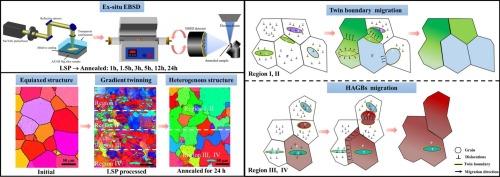
In this study, the thermal stability of gradient microstructure in the commercial AZ31B magnesium (Mg) alloy processed by laser shock peening (LSP) is systematically explored using quasi-in-situ electron backscatter diffraction (EBSD) measurement. The mechanisms of grain growth and twinning evolution of LSP-processed AZ31B Mg alloy during the annealing treatment at 300 °C are revealed. The experimental results demonstrate that there is a significant transformation of a gradient twinning microstructure into an almost twin-free microstructure, and the trend of grain growth is associated with LSP-induced strain energy storage. From the topmost surface to the sublayer of LSP-processed sample, the grain growth is mainly driven by the migrations of twin boundaries (TBs) and high-angle grain boundaries (HAGBs), respectively, which is attributed to the reduced accumulated strain energy along the LSP direction. It was demonstrated that the {102} tension twins possess the capability to engulf non-corresponding parent phases, which transcends the conventional understanding that twins interact solely with their corresponding parent grains. The twins not only interact with the parent grain but also have the capacity to engulf twins of adjacent parent grains. In contrast, the isolated twins within the parent grains struggle to grow during annealing, indicating that {102} tension twins have excellent thermal stability. The findings of this work can contribute to an in-depth understanding of the thermal stability and the grain growth mechanisms of LSP-induced gradient twinning microstructure in Mg alloys and provide the potential for the microstructure optimization to improve the comprehensive mechanical properties.
期刊介绍:
Materials Characterization features original articles and state-of-the-art reviews on theoretical and practical aspects of the structure and behaviour of materials.
The Journal focuses on all characterization techniques, including all forms of microscopy (light, electron, acoustic, etc.,) and analysis (especially microanalysis and surface analytical techniques). Developments in both this wide range of techniques and their application to the quantification of the microstructure of materials are essential facets of the Journal.
The Journal provides the Materials Scientist/Engineer with up-to-date information on many types of materials with an underlying theme of explaining the behavior of materials using novel approaches. Materials covered by the journal include:
Metals & Alloys
Ceramics
Nanomaterials
Biomedical materials
Optical materials
Composites
Natural Materials.




 京公网安备 11010802042870号
京ICP备2023020795号-1
京公网安备 11010802042870号
京ICP备2023020795号-1

 分享
分享
 求助内容:
求助内容: 应助结果提醒方式:
 扫码关注我们
