Svetlana Buyakova, Igor Fotin, Yuriy Mirovoy, Alexander Burlachenko, Vasiliy Shmakov, Ekaterina Abdulmenova, Ales Buyakov
{"title":"梯度层状ZrC-Al2O3陶瓷复合材料断裂韧性控制","authors":"Svetlana Buyakova, Igor Fotin, Yuriy Mirovoy, Alexander Burlachenko, Vasiliy Shmakov, Ekaterina Abdulmenova, Ales Buyakov","doi":"10.1016/j.matchar.2025.114785","DOIUrl":null,"url":null,"abstract":"<div><div>Fracture toughness of ZrC-Al<sub>2</sub>O<sub>3</sub> composites with gradient layered structure have been studied. The outer layers were represented purely by ZrC and Al<sub>2</sub>O<sub>3</sub>, and the intermediate layers were represented by their composites. It is shown that a crack nucleated in the ZrC experiences deflections and bifurcations under the action of residual compressive stresses. In the case of crack nucleation in Al<sub>2</sub>O<sub>3</sub> tensile microstresses create favorable conditions for its development. It was found that increasing the number of intermediate layers leads to equalization of residual microstresses, reducing the fracture toughness. Thus, there is a compromise when creating gradient composites based on components with a noticeable difference in the coefficient of thermal expansion values: increasing the number of layers provide a gradient transition from one phase to another, reduces the risk of structure defects formation. Reducing the number of layers carries the risk of delamination, but is more efficient in dissipation of crack energy.</div></div>","PeriodicalId":18727,"journal":{"name":"Materials Characterization","volume":"221 ","pages":"Article 114785"},"PeriodicalIF":5.5000,"publicationDate":"2025-03-01","publicationTypes":"Journal Article","fieldsOfStudy":null,"isOpenAccess":false,"openAccessPdf":"","citationCount":"0","resultStr":"{\"title\":\"Fracture toughness control of gradient layered ZrC–Al2O3 ceramic composites\",\"authors\":\"Svetlana Buyakova, Igor Fotin, Yuriy Mirovoy, Alexander Burlachenko, Vasiliy Shmakov, Ekaterina Abdulmenova, Ales Buyakov\",\"doi\":\"10.1016/j.matchar.2025.114785\",\"DOIUrl\":null,\"url\":null,\"abstract\":\"<div><div>Fracture toughness of ZrC-Al<sub>2</sub>O<sub>3</sub> composites with gradient layered structure have been studied. The outer layers were represented purely by ZrC and Al<sub>2</sub>O<sub>3</sub>, and the intermediate layers were represented by their composites. It is shown that a crack nucleated in the ZrC experiences deflections and bifurcations under the action of residual compressive stresses. In the case of crack nucleation in Al<sub>2</sub>O<sub>3</sub> tensile microstresses create favorable conditions for its development. It was found that increasing the number of intermediate layers leads to equalization of residual microstresses, reducing the fracture toughness. Thus, there is a compromise when creating gradient composites based on components with a noticeable difference in the coefficient of thermal expansion values: increasing the number of layers provide a gradient transition from one phase to another, reduces the risk of structure defects formation. Reducing the number of layers carries the risk of delamination, but is more efficient in dissipation of crack energy.</div></div>\",\"PeriodicalId\":18727,\"journal\":{\"name\":\"Materials Characterization\",\"volume\":\"221 \",\"pages\":\"Article 114785\"},\"PeriodicalIF\":5.5000,\"publicationDate\":\"2025-03-01\",\"publicationTypes\":\"Journal Article\",\"fieldsOfStudy\":null,\"isOpenAccess\":false,\"openAccessPdf\":\"\",\"citationCount\":\"0\",\"resultStr\":null,\"platform\":\"Semanticscholar\",\"paperid\":null,\"PeriodicalName\":\"Materials Characterization\",\"FirstCategoryId\":\"88\",\"ListUrlMain\":\"https://www.sciencedirect.com/science/article/pii/S1044580325000749\",\"RegionNum\":2,\"RegionCategory\":\"材料科学\",\"ArticlePicture\":[],\"TitleCN\":null,\"AbstractTextCN\":null,\"PMCID\":null,\"EPubDate\":\"2025/1/28 0:00:00\",\"PubModel\":\"Epub\",\"JCR\":\"Q1\",\"JCRName\":\"MATERIALS SCIENCE, CHARACTERIZATION & TESTING\",\"Score\":null,\"Total\":0}","platform":"Semanticscholar","paperid":null,"PeriodicalName":"Materials Characterization","FirstCategoryId":"88","ListUrlMain":"https://www.sciencedirect.com/science/article/pii/S1044580325000749","RegionNum":2,"RegionCategory":"材料科学","ArticlePicture":[],"TitleCN":null,"AbstractTextCN":null,"PMCID":null,"EPubDate":"2025/1/28 0:00:00","PubModel":"Epub","JCR":"Q1","JCRName":"MATERIALS SCIENCE, CHARACTERIZATION & TESTING","Score":null,"Total":0}
Fracture toughness control of gradient layered ZrC–Al2O3 ceramic composites
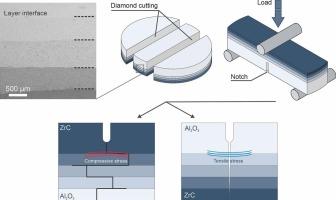
Fracture toughness of ZrC-Al2O3 composites with gradient layered structure have been studied. The outer layers were represented purely by ZrC and Al2O3, and the intermediate layers were represented by their composites. It is shown that a crack nucleated in the ZrC experiences deflections and bifurcations under the action of residual compressive stresses. In the case of crack nucleation in Al2O3 tensile microstresses create favorable conditions for its development. It was found that increasing the number of intermediate layers leads to equalization of residual microstresses, reducing the fracture toughness. Thus, there is a compromise when creating gradient composites based on components with a noticeable difference in the coefficient of thermal expansion values: increasing the number of layers provide a gradient transition from one phase to another, reduces the risk of structure defects formation. Reducing the number of layers carries the risk of delamination, but is more efficient in dissipation of crack energy.
期刊介绍:
Materials Characterization features original articles and state-of-the-art reviews on theoretical and practical aspects of the structure and behaviour of materials.
The Journal focuses on all characterization techniques, including all forms of microscopy (light, electron, acoustic, etc.,) and analysis (especially microanalysis and surface analytical techniques). Developments in both this wide range of techniques and their application to the quantification of the microstructure of materials are essential facets of the Journal.
The Journal provides the Materials Scientist/Engineer with up-to-date information on many types of materials with an underlying theme of explaining the behavior of materials using novel approaches. Materials covered by the journal include:
Metals & Alloys
Ceramics
Nanomaterials
Biomedical materials
Optical materials
Composites
Natural Materials.




 京公网安备 11010802042870号
京ICP备2023020795号-1
京公网安备 11010802042870号
京ICP备2023020795号-1

 分享
分享
 求助内容:
求助内容: 应助结果提醒方式:
 扫码关注我们
