Larissa L. Bailey , Richard Henderson , Wendy A. Estes-Zumpf , Charles C. Rhoades , Ellie Miller , Dominique Lujan , Erin Muths
{"title":"未燃烧的栖息地对野火后两栖动物的繁殖至关重要","authors":"Larissa L. Bailey , Richard Henderson , Wendy A. Estes-Zumpf , Charles C. Rhoades , Ellie Miller , Dominique Lujan , Erin Muths","doi":"10.1016/j.gecco.2024.e03389","DOIUrl":null,"url":null,"abstract":"<div><div>Wildfire regimes are changing rapidly with widespread increase in the intensity, frequency, and duration of fire activity, especially in the western United States. Limited studies explore the impacts of wildfires on aquatic taxa and few focus on lentic habitats that are essential for amphibians, many of which are of conservation concern. We capitalized on existing pre-fire surveys for anuran species and resurveyed a random subset of wetlands across a gradient of soil burn severity to investigate the short-term effects of wildfire on a relict population of wood frogs in the southern Rocky Mountains. We also investigated whether maps created to support rapid post-fire emergency response activities (i.e., United States Forest Service Burned Area Emergency Response program) accurately characterize soil burn severity around small habitat features (i.e., ponds) that serve as important amphibian breeding and rearing habitat. Soil burn severity reflects fire impacts on soil and surface organic layers, including vegetation loss and changes in soil structure and function. We found that wood frog (<em>Lithobates sylvaticus</em>) breeding persistence following fires was negatively influenced by the percentage of their terrestrial habitat (100 m buffer surrounding breeding ponds) that was burned. Wood frog colonization probability of previously unoccupied ponds was low (∼ 0.10) and unaffected by soil burn severity. Importantly, we found that remotely sensed data typically produced to predict flooding and erosion at broad (catchment) scales is a poor representation of the amount and variation in soil burn severity surrounding small habitat features, suggesting that additional field sampling is necessary to understand wildfire responses for species that rely on these small habitat features. Understanding short-term geographic- and species-specific variation in response to wildfires provides the basis to explore time to recovery (e.g., when wood frogs return to burned breeding sites) or to determine if declines in breeding distributions intensify over time.</div></div>","PeriodicalId":54264,"journal":{"name":"Global Ecology and Conservation","volume":"57 ","pages":"Article e03389"},"PeriodicalIF":3.7000,"publicationDate":"2025-01-01","publicationTypes":"Journal Article","fieldsOfStudy":null,"isOpenAccess":false,"openAccessPdf":"","citationCount":"0","resultStr":"{\"title\":\"Unburned habitat essential for amphibian breeding persistence following wildfire\",\"authors\":\"Larissa L. Bailey , Richard Henderson , Wendy A. Estes-Zumpf , Charles C. Rhoades , Ellie Miller , Dominique Lujan , Erin Muths\",\"doi\":\"10.1016/j.gecco.2024.e03389\",\"DOIUrl\":null,\"url\":null,\"abstract\":\"<div><div>Wildfire regimes are changing rapidly with widespread increase in the intensity, frequency, and duration of fire activity, especially in the western United States. Limited studies explore the impacts of wildfires on aquatic taxa and few focus on lentic habitats that are essential for amphibians, many of which are of conservation concern. We capitalized on existing pre-fire surveys for anuran species and resurveyed a random subset of wetlands across a gradient of soil burn severity to investigate the short-term effects of wildfire on a relict population of wood frogs in the southern Rocky Mountains. We also investigated whether maps created to support rapid post-fire emergency response activities (i.e., United States Forest Service Burned Area Emergency Response program) accurately characterize soil burn severity around small habitat features (i.e., ponds) that serve as important amphibian breeding and rearing habitat. Soil burn severity reflects fire impacts on soil and surface organic layers, including vegetation loss and changes in soil structure and function. We found that wood frog (<em>Lithobates sylvaticus</em>) breeding persistence following fires was negatively influenced by the percentage of their terrestrial habitat (100 m buffer surrounding breeding ponds) that was burned. Wood frog colonization probability of previously unoccupied ponds was low (∼ 0.10) and unaffected by soil burn severity. Importantly, we found that remotely sensed data typically produced to predict flooding and erosion at broad (catchment) scales is a poor representation of the amount and variation in soil burn severity surrounding small habitat features, suggesting that additional field sampling is necessary to understand wildfire responses for species that rely on these small habitat features. Understanding short-term geographic- and species-specific variation in response to wildfires provides the basis to explore time to recovery (e.g., when wood frogs return to burned breeding sites) or to determine if declines in breeding distributions intensify over time.</div></div>\",\"PeriodicalId\":54264,\"journal\":{\"name\":\"Global Ecology and Conservation\",\"volume\":\"57 \",\"pages\":\"Article e03389\"},\"PeriodicalIF\":3.7000,\"publicationDate\":\"2025-01-01\",\"publicationTypes\":\"Journal Article\",\"fieldsOfStudy\":null,\"isOpenAccess\":false,\"openAccessPdf\":\"\",\"citationCount\":\"0\",\"resultStr\":null,\"platform\":\"Semanticscholar\",\"paperid\":null,\"PeriodicalName\":\"Global Ecology and Conservation\",\"FirstCategoryId\":\"93\",\"ListUrlMain\":\"https://www.sciencedirect.com/science/article/pii/S2351989424005936\",\"RegionNum\":2,\"RegionCategory\":\"环境科学与生态学\",\"ArticlePicture\":[],\"TitleCN\":null,\"AbstractTextCN\":null,\"PMCID\":null,\"EPubDate\":\"2024/12/30 0:00:00\",\"PubModel\":\"Epub\",\"JCR\":\"Q1\",\"JCRName\":\"BIODIVERSITY CONSERVATION\",\"Score\":null,\"Total\":0}","platform":"Semanticscholar","paperid":null,"PeriodicalName":"Global Ecology and Conservation","FirstCategoryId":"93","ListUrlMain":"https://www.sciencedirect.com/science/article/pii/S2351989424005936","RegionNum":2,"RegionCategory":"环境科学与生态学","ArticlePicture":[],"TitleCN":null,"AbstractTextCN":null,"PMCID":null,"EPubDate":"2024/12/30 0:00:00","PubModel":"Epub","JCR":"Q1","JCRName":"BIODIVERSITY CONSERVATION","Score":null,"Total":0}
Unburned habitat essential for amphibian breeding persistence following wildfire
Wildfire regimes are changing rapidly with widespread increase in the intensity, frequency, and duration of fire activity, especially in the western United States. Limited studies explore the impacts of wildfires on aquatic taxa and few focus on lentic habitats that are essential for amphibians, many of which are of conservation concern. We capitalized on existing pre-fire surveys for anuran species and resurveyed a random subset of wetlands across a gradient of soil burn severity to investigate the short-term effects of wildfire on a relict population of wood frogs in the southern Rocky Mountains. We also investigated whether maps created to support rapid post-fire emergency response activities (i.e., United States Forest Service Burned Area Emergency Response program) accurately characterize soil burn severity around small habitat features (i.e., ponds) that serve as important amphibian breeding and rearing habitat. Soil burn severity reflects fire impacts on soil and surface organic layers, including vegetation loss and changes in soil structure and function. We found that wood frog (Lithobates sylvaticus) breeding persistence following fires was negatively influenced by the percentage of their terrestrial habitat (100 m buffer surrounding breeding ponds) that was burned. Wood frog colonization probability of previously unoccupied ponds was low (∼ 0.10) and unaffected by soil burn severity. Importantly, we found that remotely sensed data typically produced to predict flooding and erosion at broad (catchment) scales is a poor representation of the amount and variation in soil burn severity surrounding small habitat features, suggesting that additional field sampling is necessary to understand wildfire responses for species that rely on these small habitat features. Understanding short-term geographic- and species-specific variation in response to wildfires provides the basis to explore time to recovery (e.g., when wood frogs return to burned breeding sites) or to determine if declines in breeding distributions intensify over time.
期刊介绍:
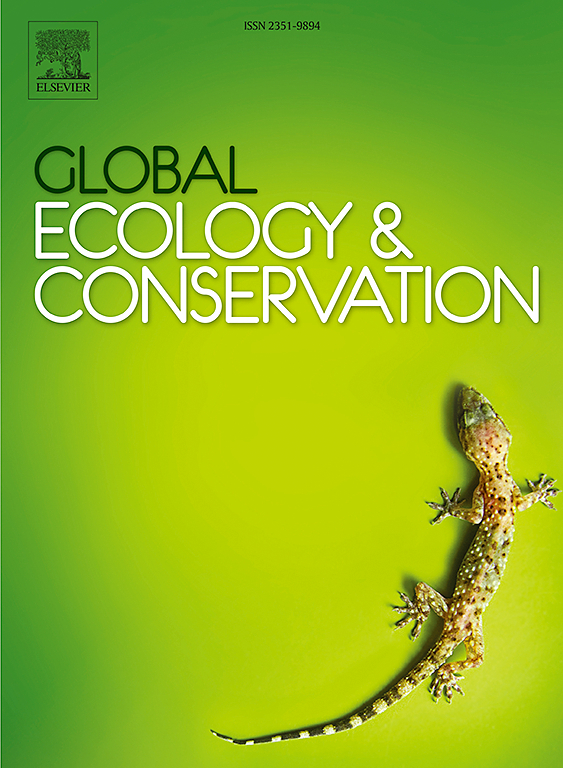
Global Ecology and Conservation is a peer-reviewed, open-access journal covering all sub-disciplines of ecological and conservation science: from theory to practice, from molecules to ecosystems, from regional to global. The fields covered include: organismal, population, community, and ecosystem ecology; physiological, evolutionary, and behavioral ecology; and conservation science.




 京公网安备 11010802042870号
京ICP备2023020795号-1
京公网安备 11010802042870号
京ICP备2023020795号-1

 分享
分享
 求助内容:
求助内容: 应助结果提醒方式:
 扫码关注我们
