Yu-Guo Jiang , Jia-Fan Kuo , Chung-Wei Cheng , An-Chen Lee , Yasuhiro Okamoto
{"title":"用飞秒激光直接焊接碳化硅和熔融二氧化硅:重复频率和焦深的影响","authors":"Yu-Guo Jiang , Jia-Fan Kuo , Chung-Wei Cheng , An-Chen Lee , Yasuhiro Okamoto","doi":"10.1016/j.optlastec.2025.112489","DOIUrl":null,"url":null,"abstract":"<div><div>Silicon carbide (SiC) is a wide bandgap semiconductor known for its durability and high performance. These properties make it an ideal material for advanced applications. In this study, a femtosecond laser with a wavelength of 1030 nm was employed to weld SiC to fused silica directly. The key experimental variables examined were the laser repetition rate (100, 300, 1000 kHz) and focal depth. Energy-dispersive spectroscopy (EDS) was used to analyze the elemental distribution, revealing a spatial gradient in composition. This indicated the mixing and diffusion of elements between the two materials under focused laser energy. Separation specimens showed that fractures occurred primarily within the fused silica near the welded region, where island-like structures formed as fused silica adhered to the SiC surface.</div></div>","PeriodicalId":19511,"journal":{"name":"Optics and Laser Technology","volume":"184 ","pages":"Article 112489"},"PeriodicalIF":5.2000,"publicationDate":"2025-06-01","publicationTypes":"Journal Article","fieldsOfStudy":null,"isOpenAccess":false,"openAccessPdf":"","citationCount":"0","resultStr":"{\"title\":\"Direct welding of silicon carbide and fused silica using femtosecond lasers: Effects of repetition rate and focal depth\",\"authors\":\"Yu-Guo Jiang , Jia-Fan Kuo , Chung-Wei Cheng , An-Chen Lee , Yasuhiro Okamoto\",\"doi\":\"10.1016/j.optlastec.2025.112489\",\"DOIUrl\":null,\"url\":null,\"abstract\":\"<div><div>Silicon carbide (SiC) is a wide bandgap semiconductor known for its durability and high performance. These properties make it an ideal material for advanced applications. In this study, a femtosecond laser with a wavelength of 1030 nm was employed to weld SiC to fused silica directly. The key experimental variables examined were the laser repetition rate (100, 300, 1000 kHz) and focal depth. Energy-dispersive spectroscopy (EDS) was used to analyze the elemental distribution, revealing a spatial gradient in composition. This indicated the mixing and diffusion of elements between the two materials under focused laser energy. Separation specimens showed that fractures occurred primarily within the fused silica near the welded region, where island-like structures formed as fused silica adhered to the SiC surface.</div></div>\",\"PeriodicalId\":19511,\"journal\":{\"name\":\"Optics and Laser Technology\",\"volume\":\"184 \",\"pages\":\"Article 112489\"},\"PeriodicalIF\":5.2000,\"publicationDate\":\"2025-06-01\",\"publicationTypes\":\"Journal Article\",\"fieldsOfStudy\":null,\"isOpenAccess\":false,\"openAccessPdf\":\"\",\"citationCount\":\"0\",\"resultStr\":null,\"platform\":\"Semanticscholar\",\"paperid\":null,\"PeriodicalName\":\"Optics and Laser Technology\",\"FirstCategoryId\":\"101\",\"ListUrlMain\":\"https://www.sciencedirect.com/science/article/pii/S0030399225000775\",\"RegionNum\":2,\"RegionCategory\":\"物理与天体物理\",\"ArticlePicture\":[],\"TitleCN\":null,\"AbstractTextCN\":null,\"PMCID\":null,\"EPubDate\":\"2025/1/27 0:00:00\",\"PubModel\":\"Epub\",\"JCR\":\"Q1\",\"JCRName\":\"OPTICS\",\"Score\":null,\"Total\":0}","platform":"Semanticscholar","paperid":null,"PeriodicalName":"Optics and Laser Technology","FirstCategoryId":"101","ListUrlMain":"https://www.sciencedirect.com/science/article/pii/S0030399225000775","RegionNum":2,"RegionCategory":"物理与天体物理","ArticlePicture":[],"TitleCN":null,"AbstractTextCN":null,"PMCID":null,"EPubDate":"2025/1/27 0:00:00","PubModel":"Epub","JCR":"Q1","JCRName":"OPTICS","Score":null,"Total":0}
Direct welding of silicon carbide and fused silica using femtosecond lasers: Effects of repetition rate and focal depth
Silicon carbide (SiC) is a wide bandgap semiconductor known for its durability and high performance. These properties make it an ideal material for advanced applications. In this study, a femtosecond laser with a wavelength of 1030 nm was employed to weld SiC to fused silica directly. The key experimental variables examined were the laser repetition rate (100, 300, 1000 kHz) and focal depth. Energy-dispersive spectroscopy (EDS) was used to analyze the elemental distribution, revealing a spatial gradient in composition. This indicated the mixing and diffusion of elements between the two materials under focused laser energy. Separation specimens showed that fractures occurred primarily within the fused silica near the welded region, where island-like structures formed as fused silica adhered to the SiC surface.
期刊介绍:
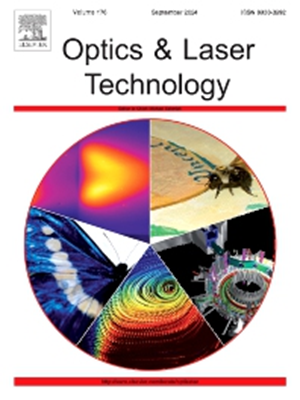
Optics & Laser Technology aims to provide a vehicle for the publication of a broad range of high quality research and review papers in those fields of scientific and engineering research appertaining to the development and application of the technology of optics and lasers. Papers describing original work in these areas are submitted to rigorous refereeing prior to acceptance for publication.
The scope of Optics & Laser Technology encompasses, but is not restricted to, the following areas:
•development in all types of lasers
•developments in optoelectronic devices and photonics
•developments in new photonics and optical concepts
•developments in conventional optics, optical instruments and components
•techniques of optical metrology, including interferometry and optical fibre sensors
•LIDAR and other non-contact optical measurement techniques, including optical methods in heat and fluid flow
•applications of lasers to materials processing, optical NDT display (including holography) and optical communication
•research and development in the field of laser safety including studies of hazards resulting from the applications of lasers (laser safety, hazards of laser fume)
•developments in optical computing and optical information processing
•developments in new optical materials
•developments in new optical characterization methods and techniques
•developments in quantum optics
•developments in light assisted micro and nanofabrication methods and techniques
•developments in nanophotonics and biophotonics
•developments in imaging processing and systems




 京公网安备 11010802042870号
京ICP备2023020795号-1
京公网安备 11010802042870号
京ICP备2023020795号-1

 分享
分享
 求助内容:
求助内容: 应助结果提醒方式:
 扫码关注我们
