Xiao-Yun Li, Ruo-Hui Gao, Jie Zhu, Xiao-Hong Yang, Yu-Jie Wang, Yu-Han Jiang, Xue-Chao Wang
{"title":"semaxanib类3-烷基烷氧吲哚的合成及其与ctDNA结合的研究","authors":"Xiao-Yun Li, Ruo-Hui Gao, Jie Zhu, Xiao-Hong Yang, Yu-Jie Wang, Yu-Han Jiang, Xue-Chao Wang","doi":"10.1016/j.molliq.2024.126777","DOIUrl":null,"url":null,"abstract":"<div><div>Compounds with 3-alkylideneoxindole units are common seen in natural products, medicines and active molecules. Here, three Semaxanib-like 3-alkylideneoxindole derivatives were designed, synthesized, and characterized by <sup>1</sup>H NMR, <sup>13</sup>C NMR, HRMS and FT-IR. And their binding information with ctDNA were investigated by multiple methods including UV spectroscopy, fluorescence spectroscopy, <sup>1</sup>H NMR, viscometric method and MOE-docking. Fluorescence competition experiments reflected that all of these compounds bound to the groove region of ctDNA with the binding constants 10<sup>4</sup> by orders of magnitude. Minor alterations were observed from viscometric method, which also indicated that all compounds interacted with ctDNA in a grooved manner. UV spectroscopy and <sup>1</sup>H NMR further proved the above conclusion. Furthermore, MOE docking provided visualization of the binding results, and demonstrated that hydrogen bonds play a crucial role in the binding between the three compounds and ctDNA. This study offered detailed information about 3-alkylideneoxindole compounds binding to ctDNA, and provided valuable reference for more fully developing of drugs with 3-alkylideneoxindole units.</div></div>","PeriodicalId":371,"journal":{"name":"Journal of Molecular Liquids","volume":"419 ","pages":"Article 126777"},"PeriodicalIF":5.2000,"publicationDate":"2025-02-01","publicationTypes":"Journal Article","fieldsOfStudy":null,"isOpenAccess":false,"openAccessPdf":"","citationCount":"0","resultStr":"{\"title\":\"Synthesis of Semaxanib-like 3-alkylideneoxindoles and their binding investigation with ctDNA by multiple methods\",\"authors\":\"Xiao-Yun Li, Ruo-Hui Gao, Jie Zhu, Xiao-Hong Yang, Yu-Jie Wang, Yu-Han Jiang, Xue-Chao Wang\",\"doi\":\"10.1016/j.molliq.2024.126777\",\"DOIUrl\":null,\"url\":null,\"abstract\":\"<div><div>Compounds with 3-alkylideneoxindole units are common seen in natural products, medicines and active molecules. Here, three Semaxanib-like 3-alkylideneoxindole derivatives were designed, synthesized, and characterized by <sup>1</sup>H NMR, <sup>13</sup>C NMR, HRMS and FT-IR. And their binding information with ctDNA were investigated by multiple methods including UV spectroscopy, fluorescence spectroscopy, <sup>1</sup>H NMR, viscometric method and MOE-docking. Fluorescence competition experiments reflected that all of these compounds bound to the groove region of ctDNA with the binding constants 10<sup>4</sup> by orders of magnitude. Minor alterations were observed from viscometric method, which also indicated that all compounds interacted with ctDNA in a grooved manner. UV spectroscopy and <sup>1</sup>H NMR further proved the above conclusion. Furthermore, MOE docking provided visualization of the binding results, and demonstrated that hydrogen bonds play a crucial role in the binding between the three compounds and ctDNA. This study offered detailed information about 3-alkylideneoxindole compounds binding to ctDNA, and provided valuable reference for more fully developing of drugs with 3-alkylideneoxindole units.</div></div>\",\"PeriodicalId\":371,\"journal\":{\"name\":\"Journal of Molecular Liquids\",\"volume\":\"419 \",\"pages\":\"Article 126777\"},\"PeriodicalIF\":5.2000,\"publicationDate\":\"2025-02-01\",\"publicationTypes\":\"Journal Article\",\"fieldsOfStudy\":null,\"isOpenAccess\":false,\"openAccessPdf\":\"\",\"citationCount\":\"0\",\"resultStr\":null,\"platform\":\"Semanticscholar\",\"paperid\":null,\"PeriodicalName\":\"Journal of Molecular Liquids\",\"FirstCategoryId\":\"92\",\"ListUrlMain\":\"https://www.sciencedirect.com/science/article/pii/S0167732224028381\",\"RegionNum\":2,\"RegionCategory\":\"化学\",\"ArticlePicture\":[],\"TitleCN\":null,\"AbstractTextCN\":null,\"PMCID\":null,\"EPubDate\":\"2024/12/25 0:00:00\",\"PubModel\":\"Epub\",\"JCR\":\"Q2\",\"JCRName\":\"CHEMISTRY, PHYSICAL\",\"Score\":null,\"Total\":0}","platform":"Semanticscholar","paperid":null,"PeriodicalName":"Journal of Molecular Liquids","FirstCategoryId":"92","ListUrlMain":"https://www.sciencedirect.com/science/article/pii/S0167732224028381","RegionNum":2,"RegionCategory":"化学","ArticlePicture":[],"TitleCN":null,"AbstractTextCN":null,"PMCID":null,"EPubDate":"2024/12/25 0:00:00","PubModel":"Epub","JCR":"Q2","JCRName":"CHEMISTRY, PHYSICAL","Score":null,"Total":0}
Synthesis of Semaxanib-like 3-alkylideneoxindoles and their binding investigation with ctDNA by multiple methods
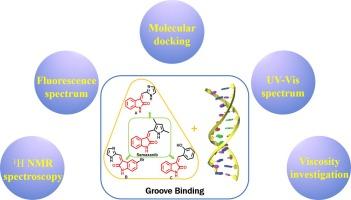
Compounds with 3-alkylideneoxindole units are common seen in natural products, medicines and active molecules. Here, three Semaxanib-like 3-alkylideneoxindole derivatives were designed, synthesized, and characterized by 1H NMR, 13C NMR, HRMS and FT-IR. And their binding information with ctDNA were investigated by multiple methods including UV spectroscopy, fluorescence spectroscopy, 1H NMR, viscometric method and MOE-docking. Fluorescence competition experiments reflected that all of these compounds bound to the groove region of ctDNA with the binding constants 104 by orders of magnitude. Minor alterations were observed from viscometric method, which also indicated that all compounds interacted with ctDNA in a grooved manner. UV spectroscopy and 1H NMR further proved the above conclusion. Furthermore, MOE docking provided visualization of the binding results, and demonstrated that hydrogen bonds play a crucial role in the binding between the three compounds and ctDNA. This study offered detailed information about 3-alkylideneoxindole compounds binding to ctDNA, and provided valuable reference for more fully developing of drugs with 3-alkylideneoxindole units.
期刊介绍:
The journal includes papers in the following areas:
– Simple organic liquids and mixtures
– Ionic liquids
– Surfactant solutions (including micelles and vesicles) and liquid interfaces
– Colloidal solutions and nanoparticles
– Thermotropic and lyotropic liquid crystals
– Ferrofluids
– Water, aqueous solutions and other hydrogen-bonded liquids
– Lubricants, polymer solutions and melts
– Molten metals and salts
– Phase transitions and critical phenomena in liquids and confined fluids
– Self assembly in complex liquids.– Biomolecules in solution
The emphasis is on the molecular (or microscopic) understanding of particular liquids or liquid systems, especially concerning structure, dynamics and intermolecular forces. The experimental techniques used may include:
– Conventional spectroscopy (mid-IR and far-IR, Raman, NMR, etc.)
– Non-linear optics and time resolved spectroscopy (psec, fsec, asec, ISRS, etc.)
– Light scattering (Rayleigh, Brillouin, PCS, etc.)
– Dielectric relaxation
– X-ray and neutron scattering and diffraction.
Experimental studies, computer simulations (MD or MC) and analytical theory will be considered for publication; papers just reporting experimental results that do not contribute to the understanding of the fundamentals of molecular and ionic liquids will not be accepted. Only papers of a non-routine nature and advancing the field will be considered for publication.




 京公网安备 11010802042870号
京ICP备2023020795号-1
京公网安备 11010802042870号
京ICP备2023020795号-1

 分享
分享
 求助内容:
求助内容: 应助结果提醒方式:
 扫码关注我们
