Lizhang Chen , Yu Fang , Mingxin Pang , Ruoxu Sun , Lin Xu , Qixing Zhou , Yawen Tang
{"title":"核心/卫星结构RuP/RuP2异质结增强pH-universal析氢反应的界面工程","authors":"Lizhang Chen , Yu Fang , Mingxin Pang , Ruoxu Sun , Lin Xu , Qixing Zhou , Yawen Tang","doi":"10.1016/j.cjsc.2024.100461","DOIUrl":null,"url":null,"abstract":"<div><div>Developing renewable hydrogen technologies requires high-efficiency pH-universal hydrogen evolution reaction (HER) electrocatalysts. Ruthenium phosphides (RuP<sub><em>x</em></sub>) have great potentials to replace the commercial Pt-based materials, whereas the optimization of their electronic structure for favorable reaction intermediate adsorption remains a significant challenge. Herein, we report an innovative phosphorization-controlled strategy for the <em>in-situ</em> immobilization of core/satellite-structured RuP/RuP<sub>2</sub> heteronanoparticles onto N, P co-doped porous carbon nanosheets (abbreviated as RuP/RuP<sub>2</sub>@N/P-CNSs hereafter). Density functional theory (DFT) calculations further reveal that the electron shuttling at the RuP/RuP<sub>2</sub> interface leads to a reduced energy barrier for H<sub>2</sub>O dissociation by electron-deficient Ru atoms in the RuP and the optimized H∗ adsorption of electron-gaining Ru atoms in the RuP<sub>2</sub>. Impressively, the as-synthesized RuP/RuP<sub>2</sub>@N/P-CNSs exhibits low overpotentials of 8, 29, and 66 mV to achieve 10 mA cm<sup>−2</sup> in alkaline, acid and neutral media electrolyte, respectively. This research presents a viable approach to synthesize high-efficiency transition metal phosphide-based electrocatalysts and offers a deeper comprehension of interface effects for HER catalysis.</div></div>","PeriodicalId":10151,"journal":{"name":"结构化学","volume":"44 1","pages":"Article 100461"},"PeriodicalIF":10.5000,"publicationDate":"2025-01-01","publicationTypes":"Journal Article","fieldsOfStudy":null,"isOpenAccess":false,"openAccessPdf":"","citationCount":"0","resultStr":"{\"title\":\"Interfacial engineering of core/satellite-structured RuP/RuP2 heterojunctions for enhancing pH-universal hydrogen evolution reaction\",\"authors\":\"Lizhang Chen , Yu Fang , Mingxin Pang , Ruoxu Sun , Lin Xu , Qixing Zhou , Yawen Tang\",\"doi\":\"10.1016/j.cjsc.2024.100461\",\"DOIUrl\":null,\"url\":null,\"abstract\":\"<div><div>Developing renewable hydrogen technologies requires high-efficiency pH-universal hydrogen evolution reaction (HER) electrocatalysts. Ruthenium phosphides (RuP<sub><em>x</em></sub>) have great potentials to replace the commercial Pt-based materials, whereas the optimization of their electronic structure for favorable reaction intermediate adsorption remains a significant challenge. Herein, we report an innovative phosphorization-controlled strategy for the <em>in-situ</em> immobilization of core/satellite-structured RuP/RuP<sub>2</sub> heteronanoparticles onto N, P co-doped porous carbon nanosheets (abbreviated as RuP/RuP<sub>2</sub>@N/P-CNSs hereafter). Density functional theory (DFT) calculations further reveal that the electron shuttling at the RuP/RuP<sub>2</sub> interface leads to a reduced energy barrier for H<sub>2</sub>O dissociation by electron-deficient Ru atoms in the RuP and the optimized H∗ adsorption of electron-gaining Ru atoms in the RuP<sub>2</sub>. Impressively, the as-synthesized RuP/RuP<sub>2</sub>@N/P-CNSs exhibits low overpotentials of 8, 29, and 66 mV to achieve 10 mA cm<sup>−2</sup> in alkaline, acid and neutral media electrolyte, respectively. This research presents a viable approach to synthesize high-efficiency transition metal phosphide-based electrocatalysts and offers a deeper comprehension of interface effects for HER catalysis.</div></div>\",\"PeriodicalId\":10151,\"journal\":{\"name\":\"结构化学\",\"volume\":\"44 1\",\"pages\":\"Article 100461\"},\"PeriodicalIF\":10.5000,\"publicationDate\":\"2025-01-01\",\"publicationTypes\":\"Journal Article\",\"fieldsOfStudy\":null,\"isOpenAccess\":false,\"openAccessPdf\":\"\",\"citationCount\":\"0\",\"resultStr\":null,\"platform\":\"Semanticscholar\",\"paperid\":null,\"PeriodicalName\":\"结构化学\",\"FirstCategoryId\":\"92\",\"ListUrlMain\":\"https://www.sciencedirect.com/science/article/pii/S025458612400343X\",\"RegionNum\":4,\"RegionCategory\":\"化学\",\"ArticlePicture\":[],\"TitleCN\":null,\"AbstractTextCN\":null,\"PMCID\":null,\"EPubDate\":\"2024/11/9 0:00:00\",\"PubModel\":\"Epub\",\"JCR\":\"Q1\",\"JCRName\":\"CHEMISTRY, INORGANIC & NUCLEAR\",\"Score\":null,\"Total\":0}","platform":"Semanticscholar","paperid":null,"PeriodicalName":"结构化学","FirstCategoryId":"92","ListUrlMain":"https://www.sciencedirect.com/science/article/pii/S025458612400343X","RegionNum":4,"RegionCategory":"化学","ArticlePicture":[],"TitleCN":null,"AbstractTextCN":null,"PMCID":null,"EPubDate":"2024/11/9 0:00:00","PubModel":"Epub","JCR":"Q1","JCRName":"CHEMISTRY, INORGANIC & NUCLEAR","Score":null,"Total":0}
引用次数: 0
摘要
发展可再生氢技术需要高效的ph -通用析氢反应(HER)电催化剂。磷化钌(Ruthenium phosphides, RuPx)有很大的潜力取代商业pt基材料,但优化其电子结构以吸附有利的反应中间体仍然是一个重大的挑战。在此,我们报告了一种创新的磷化控制策略,用于将核心/卫星结构的RuP/RuP2异离子颗粒原位固定在N, P共掺杂的多孔碳纳米片上(以下简称为RuP/RuP2@N/P- cnss)。密度泛函理论(DFT)计算进一步揭示了RuP/RuP2界面上的电子迁移导致RuP中缺乏电子的Ru原子对H2O解离的能量垒降低,以及RuP2中获得电子的Ru原子对H *的优化吸附。令人印象深刻的是,合成的RuP/RuP2@N/P-CNSs在碱性、酸性和中性介质电解质中分别表现出8、29和66 mV的低过电位,达到10 mA cm - 2。本研究为合成高效过渡金属磷化基电催化剂提供了一条可行的途径,并对HER催化的界面效应有了更深入的了解。
Interfacial engineering of core/satellite-structured RuP/RuP2 heterojunctions for enhancing pH-universal hydrogen evolution reaction
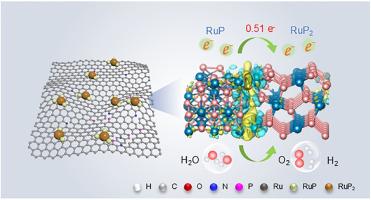
Developing renewable hydrogen technologies requires high-efficiency pH-universal hydrogen evolution reaction (HER) electrocatalysts. Ruthenium phosphides (RuPx) have great potentials to replace the commercial Pt-based materials, whereas the optimization of their electronic structure for favorable reaction intermediate adsorption remains a significant challenge. Herein, we report an innovative phosphorization-controlled strategy for the in-situ immobilization of core/satellite-structured RuP/RuP2 heteronanoparticles onto N, P co-doped porous carbon nanosheets (abbreviated as RuP/RuP2@N/P-CNSs hereafter). Density functional theory (DFT) calculations further reveal that the electron shuttling at the RuP/RuP2 interface leads to a reduced energy barrier for H2O dissociation by electron-deficient Ru atoms in the RuP and the optimized H∗ adsorption of electron-gaining Ru atoms in the RuP2. Impressively, the as-synthesized RuP/RuP2@N/P-CNSs exhibits low overpotentials of 8, 29, and 66 mV to achieve 10 mA cm−2 in alkaline, acid and neutral media electrolyte, respectively. This research presents a viable approach to synthesize high-efficiency transition metal phosphide-based electrocatalysts and offers a deeper comprehension of interface effects for HER catalysis.
期刊介绍:
Chinese Journal of Structural Chemistry “JIEGOU HUAXUE ”, an academic journal consisting of reviews, articles, communications and notes, provides a forum for the reporting and discussion of current novel research achievements in the fields of structural chemistry, crystallography, spectroscopy, quantum chemistry, pharmaceutical chemistry, biochemistry, material science, etc. Structural Chemistry has been indexed by SCI, CA, and some other prestigious publications.




 京公网安备 11010802042870号
京ICP备2023020795号-1
京公网安备 11010802042870号
京ICP备2023020795号-1

 分享
分享
 求助内容:
求助内容: 应助结果提醒方式:
 扫码关注我们
