{"title":"搅拌介质磨机中两种不同粒度磨矿介质混合效果的数值模拟研究","authors":"ORyo Miyazawa , Ryuto Kamo , Yutaro Takaya , Susumu Gunji , Kenichi Momota , Satoshi Shiina , Kyoko Okuyama , Hidehiro Kamiya , Chiharu Tokoro","doi":"10.1016/j.apt.2025.104810","DOIUrl":null,"url":null,"abstract":"<div><div>The effects of using large and small media in an agitated media mill were investigated by performing experiments and discrete element method (DEM) simulations to improve grinding efficiency and reduce operating time. Four conditions were examined: only large or small media, the same number of large and small media, and an excess of small media. Experimental results showed that the addition of small media resulted in a sharper particle size distribution and a smaller grinding limit compared with only large or small media condition. Furthermore, since the temperature rise of the cooling water under the large-media-only condition was higher than small and large media mixing condition, it suggested that more energy was lost during the grinding process. In the DEM simulations, In the case of only small media use, the collision energy was not enough to grind material. Using the same number of large and small media, the collision energy was not significantly different from that of the large-media-only condition and the number of collision points could be increased without decreasing the collision energy by improving the collision of the large media to small media and the agitator shaft. Based on the above mechanism, the improve of grinding efficiency and the reduction of grinding limit were explained by DEM.</div></div>","PeriodicalId":7232,"journal":{"name":"Advanced Powder Technology","volume":"36 3","pages":"Article 104810"},"PeriodicalIF":4.5000,"publicationDate":"2025-03-01","publicationTypes":"Journal Article","fieldsOfStudy":null,"isOpenAccess":false,"openAccessPdf":"","citationCount":"0","resultStr":"{\"title\":\"DEM study for investigating the mixing effect of two differently sized grinding media in an agitated media mill\",\"authors\":\"ORyo Miyazawa , Ryuto Kamo , Yutaro Takaya , Susumu Gunji , Kenichi Momota , Satoshi Shiina , Kyoko Okuyama , Hidehiro Kamiya , Chiharu Tokoro\",\"doi\":\"10.1016/j.apt.2025.104810\",\"DOIUrl\":null,\"url\":null,\"abstract\":\"<div><div>The effects of using large and small media in an agitated media mill were investigated by performing experiments and discrete element method (DEM) simulations to improve grinding efficiency and reduce operating time. Four conditions were examined: only large or small media, the same number of large and small media, and an excess of small media. Experimental results showed that the addition of small media resulted in a sharper particle size distribution and a smaller grinding limit compared with only large or small media condition. Furthermore, since the temperature rise of the cooling water under the large-media-only condition was higher than small and large media mixing condition, it suggested that more energy was lost during the grinding process. In the DEM simulations, In the case of only small media use, the collision energy was not enough to grind material. Using the same number of large and small media, the collision energy was not significantly different from that of the large-media-only condition and the number of collision points could be increased without decreasing the collision energy by improving the collision of the large media to small media and the agitator shaft. Based on the above mechanism, the improve of grinding efficiency and the reduction of grinding limit were explained by DEM.</div></div>\",\"PeriodicalId\":7232,\"journal\":{\"name\":\"Advanced Powder Technology\",\"volume\":\"36 3\",\"pages\":\"Article 104810\"},\"PeriodicalIF\":4.5000,\"publicationDate\":\"2025-03-01\",\"publicationTypes\":\"Journal Article\",\"fieldsOfStudy\":null,\"isOpenAccess\":false,\"openAccessPdf\":\"\",\"citationCount\":\"0\",\"resultStr\":null,\"platform\":\"Semanticscholar\",\"paperid\":null,\"PeriodicalName\":\"Advanced Powder Technology\",\"FirstCategoryId\":\"5\",\"ListUrlMain\":\"https://www.sciencedirect.com/science/article/pii/S0921883125000317\",\"RegionNum\":2,\"RegionCategory\":\"工程技术\",\"ArticlePicture\":[],\"TitleCN\":null,\"AbstractTextCN\":null,\"PMCID\":null,\"EPubDate\":\"2025/2/4 0:00:00\",\"PubModel\":\"Epub\",\"JCR\":\"Q2\",\"JCRName\":\"ENGINEERING, CHEMICAL\",\"Score\":null,\"Total\":0}","platform":"Semanticscholar","paperid":null,"PeriodicalName":"Advanced Powder Technology","FirstCategoryId":"5","ListUrlMain":"https://www.sciencedirect.com/science/article/pii/S0921883125000317","RegionNum":2,"RegionCategory":"工程技术","ArticlePicture":[],"TitleCN":null,"AbstractTextCN":null,"PMCID":null,"EPubDate":"2025/2/4 0:00:00","PubModel":"Epub","JCR":"Q2","JCRName":"ENGINEERING, CHEMICAL","Score":null,"Total":0}
DEM study for investigating the mixing effect of two differently sized grinding media in an agitated media mill
The effects of using large and small media in an agitated media mill were investigated by performing experiments and discrete element method (DEM) simulations to improve grinding efficiency and reduce operating time. Four conditions were examined: only large or small media, the same number of large and small media, and an excess of small media. Experimental results showed that the addition of small media resulted in a sharper particle size distribution and a smaller grinding limit compared with only large or small media condition. Furthermore, since the temperature rise of the cooling water under the large-media-only condition was higher than small and large media mixing condition, it suggested that more energy was lost during the grinding process. In the DEM simulations, In the case of only small media use, the collision energy was not enough to grind material. Using the same number of large and small media, the collision energy was not significantly different from that of the large-media-only condition and the number of collision points could be increased without decreasing the collision energy by improving the collision of the large media to small media and the agitator shaft. Based on the above mechanism, the improve of grinding efficiency and the reduction of grinding limit were explained by DEM.
期刊介绍:
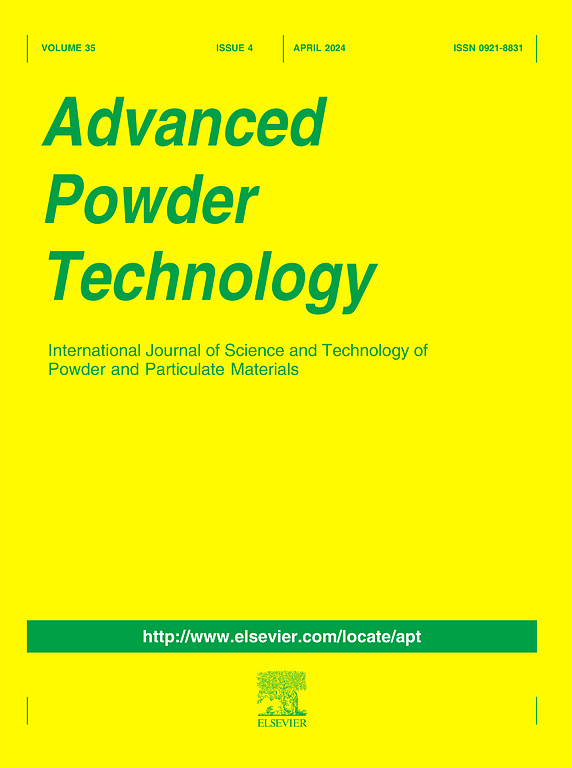
The aim of Advanced Powder Technology is to meet the demand for an international journal that integrates all aspects of science and technology research on powder and particulate materials. The journal fulfills this purpose by publishing original research papers, rapid communications, reviews, and translated articles by prominent researchers worldwide.
The editorial work of Advanced Powder Technology, which was founded as the International Journal of the Society of Powder Technology, Japan, is now shared by distinguished board members, who operate in a unique framework designed to respond to the increasing global demand for articles on not only powder and particles, but also on various materials produced from them.
Advanced Powder Technology covers various areas, but a discussion of powder and particles is required in articles. Topics include: Production of powder and particulate materials in gases and liquids(nanoparticles, fine ceramics, pharmaceuticals, novel functional materials, etc.); Aerosol and colloidal processing; Powder and particle characterization; Dynamics and phenomena; Calculation and simulation (CFD, DEM, Monte Carlo method, population balance, etc.); Measurement and control of powder processes; Particle modification; Comminution; Powder handling and operations (storage, transport, granulation, separation, fluidization, etc.)





 京公网安备 11010802042870号
京ICP备2023020795号-1
京公网安备 11010802042870号
京ICP备2023020795号-1

 分享
分享
 求助内容:
求助内容: 应助结果提醒方式:
 扫码关注我们
