{"title":"纳米颗粒设计:工艺参数在热等离子体合成中的作用","authors":"Kwangjae Park , Yusuke Hirayama , Masaya Shigeta","doi":"10.1016/j.apt.2025.104793","DOIUrl":null,"url":null,"abstract":"<div><div>This study comprehensively investigated the effects of feed and cooling rates on the formation and particle diameter of Fe nanopowders synthesized using the thermal plasma process. The particle diameters of the Fe nanopowders were analyzed by microscopic observations, X-ray diffraction, and small-angle X-ray scattering measurements. The experimental results indicated that the mean particle diameter decreased as the feed rate decreased, and quenching was applied. Numerical simulations were employed to examine the effects of the feed and cooling rates on the nanoparticle diameter and to visualize the particle growth mechanism. According to the results of the numerical study, the feed and cooling rates were identified as critical experimental parameters that significantly affect the homogeneous nucleation, total concentration of vapor atoms, and frequency of heterogeneous condensation on nuclei, ultimately determining the final diameter of the nanoparticles. This study bridges experimental and numerical analyses, clarifies particle growth mechanisms, and demonstrates the feasibility of designing nanoparticles with sizes ranging from a few to hundreds of nanometers that can be utilized in a multitude of applications using thermal plasma processes.</div></div>","PeriodicalId":7232,"journal":{"name":"Advanced Powder Technology","volume":"36 3","pages":"Article 104793"},"PeriodicalIF":4.5000,"publicationDate":"2025-03-01","publicationTypes":"Journal Article","fieldsOfStudy":null,"isOpenAccess":false,"openAccessPdf":"","citationCount":"0","resultStr":"{\"title\":\"Designing nanoparticles: The role of process parameters in thermal plasma synthesis\",\"authors\":\"Kwangjae Park , Yusuke Hirayama , Masaya Shigeta\",\"doi\":\"10.1016/j.apt.2025.104793\",\"DOIUrl\":null,\"url\":null,\"abstract\":\"<div><div>This study comprehensively investigated the effects of feed and cooling rates on the formation and particle diameter of Fe nanopowders synthesized using the thermal plasma process. The particle diameters of the Fe nanopowders were analyzed by microscopic observations, X-ray diffraction, and small-angle X-ray scattering measurements. The experimental results indicated that the mean particle diameter decreased as the feed rate decreased, and quenching was applied. Numerical simulations were employed to examine the effects of the feed and cooling rates on the nanoparticle diameter and to visualize the particle growth mechanism. According to the results of the numerical study, the feed and cooling rates were identified as critical experimental parameters that significantly affect the homogeneous nucleation, total concentration of vapor atoms, and frequency of heterogeneous condensation on nuclei, ultimately determining the final diameter of the nanoparticles. This study bridges experimental and numerical analyses, clarifies particle growth mechanisms, and demonstrates the feasibility of designing nanoparticles with sizes ranging from a few to hundreds of nanometers that can be utilized in a multitude of applications using thermal plasma processes.</div></div>\",\"PeriodicalId\":7232,\"journal\":{\"name\":\"Advanced Powder Technology\",\"volume\":\"36 3\",\"pages\":\"Article 104793\"},\"PeriodicalIF\":4.5000,\"publicationDate\":\"2025-03-01\",\"publicationTypes\":\"Journal Article\",\"fieldsOfStudy\":null,\"isOpenAccess\":false,\"openAccessPdf\":\"\",\"citationCount\":\"0\",\"resultStr\":null,\"platform\":\"Semanticscholar\",\"paperid\":null,\"PeriodicalName\":\"Advanced Powder Technology\",\"FirstCategoryId\":\"5\",\"ListUrlMain\":\"https://www.sciencedirect.com/science/article/pii/S0921883125000147\",\"RegionNum\":2,\"RegionCategory\":\"工程技术\",\"ArticlePicture\":[],\"TitleCN\":null,\"AbstractTextCN\":null,\"PMCID\":null,\"EPubDate\":\"2025/2/5 0:00:00\",\"PubModel\":\"Epub\",\"JCR\":\"Q2\",\"JCRName\":\"ENGINEERING, CHEMICAL\",\"Score\":null,\"Total\":0}","platform":"Semanticscholar","paperid":null,"PeriodicalName":"Advanced Powder Technology","FirstCategoryId":"5","ListUrlMain":"https://www.sciencedirect.com/science/article/pii/S0921883125000147","RegionNum":2,"RegionCategory":"工程技术","ArticlePicture":[],"TitleCN":null,"AbstractTextCN":null,"PMCID":null,"EPubDate":"2025/2/5 0:00:00","PubModel":"Epub","JCR":"Q2","JCRName":"ENGINEERING, CHEMICAL","Score":null,"Total":0}
Designing nanoparticles: The role of process parameters in thermal plasma synthesis
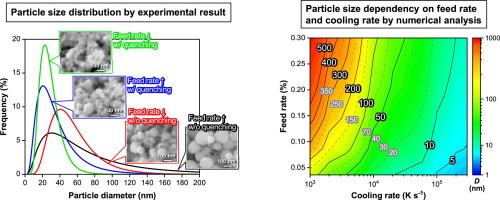
This study comprehensively investigated the effects of feed and cooling rates on the formation and particle diameter of Fe nanopowders synthesized using the thermal plasma process. The particle diameters of the Fe nanopowders were analyzed by microscopic observations, X-ray diffraction, and small-angle X-ray scattering measurements. The experimental results indicated that the mean particle diameter decreased as the feed rate decreased, and quenching was applied. Numerical simulations were employed to examine the effects of the feed and cooling rates on the nanoparticle diameter and to visualize the particle growth mechanism. According to the results of the numerical study, the feed and cooling rates were identified as critical experimental parameters that significantly affect the homogeneous nucleation, total concentration of vapor atoms, and frequency of heterogeneous condensation on nuclei, ultimately determining the final diameter of the nanoparticles. This study bridges experimental and numerical analyses, clarifies particle growth mechanisms, and demonstrates the feasibility of designing nanoparticles with sizes ranging from a few to hundreds of nanometers that can be utilized in a multitude of applications using thermal plasma processes.
期刊介绍:
The aim of Advanced Powder Technology is to meet the demand for an international journal that integrates all aspects of science and technology research on powder and particulate materials. The journal fulfills this purpose by publishing original research papers, rapid communications, reviews, and translated articles by prominent researchers worldwide.
The editorial work of Advanced Powder Technology, which was founded as the International Journal of the Society of Powder Technology, Japan, is now shared by distinguished board members, who operate in a unique framework designed to respond to the increasing global demand for articles on not only powder and particles, but also on various materials produced from them.
Advanced Powder Technology covers various areas, but a discussion of powder and particles is required in articles. Topics include: Production of powder and particulate materials in gases and liquids(nanoparticles, fine ceramics, pharmaceuticals, novel functional materials, etc.); Aerosol and colloidal processing; Powder and particle characterization; Dynamics and phenomena; Calculation and simulation (CFD, DEM, Monte Carlo method, population balance, etc.); Measurement and control of powder processes; Particle modification; Comminution; Powder handling and operations (storage, transport, granulation, separation, fluidization, etc.)




 京公网安备 11010802042870号
京ICP备2023020795号-1
京公网安备 11010802042870号
京ICP备2023020795号-1

 分享
分享
 求助内容:
求助内容: 应助结果提醒方式:
 扫码关注我们
