Peng Lu , Yutong Che , Shuang Wu , Jinlei Zhang , Yiming Gao , Xiaosheng Wang , Yuxiang Liu
{"title":"利用晶种策略将催化裂化催化剂残渣转化为具有全复合比的MOR/MFI","authors":"Peng Lu , Yutong Che , Shuang Wu , Jinlei Zhang , Yiming Gao , Xiaosheng Wang , Yuxiang Liu","doi":"10.1016/j.micromeso.2025.113492","DOIUrl":null,"url":null,"abstract":"<div><div>Considering the complex composition of fluid catalytic cracking catalyst residue (FCCR), it is a challenge to convert FCCR into MOR/MFI composite zeolites with a full composite ratio (i.e., MOR:MFI = 0: 100 %–100 %: 0). A crystal seed strategy is proposed to guide the crystallization phase and regulate properties such as porosity, morphology, acidity, and chemical coordination of MOR/MFI composite zeolites. In dehydration of glucose, MOR/MFI composite zeolite has a more excellent conversion of glucose and higher yield of 5-HMF than those of MOR zeolite. Based on the <em>in-situ</em> FTIR investigation, a higher concentration of fructose improve the dehydration to generate 5-HMF on MOR/MFI composite zeolites. Activation energy of dehydration of glucose decreases from 136.73 kJ/mol to 120.12 kJ/mol when using MOR/MFI composite zeolites. Proposed crystal seed strategy achieves the oriented conversion of FCCR to MOR/MFI composite zeolites with a desirable composition, which is also an important reference for other types of composite zeolites.</div></div>","PeriodicalId":392,"journal":{"name":"Microporous and Mesoporous Materials","volume":"386 ","pages":"Article 113492"},"PeriodicalIF":4.7000,"publicationDate":"2025-03-15","publicationTypes":"Journal Article","fieldsOfStudy":null,"isOpenAccess":false,"openAccessPdf":"","citationCount":"0","resultStr":"{\"title\":\"Converting residues of fluid catalytic cracking catalysts into MOR/MFI with a full composite ratio via a crystal seed strategy\",\"authors\":\"Peng Lu , Yutong Che , Shuang Wu , Jinlei Zhang , Yiming Gao , Xiaosheng Wang , Yuxiang Liu\",\"doi\":\"10.1016/j.micromeso.2025.113492\",\"DOIUrl\":null,\"url\":null,\"abstract\":\"<div><div>Considering the complex composition of fluid catalytic cracking catalyst residue (FCCR), it is a challenge to convert FCCR into MOR/MFI composite zeolites with a full composite ratio (i.e., MOR:MFI = 0: 100 %–100 %: 0). A crystal seed strategy is proposed to guide the crystallization phase and regulate properties such as porosity, morphology, acidity, and chemical coordination of MOR/MFI composite zeolites. In dehydration of glucose, MOR/MFI composite zeolite has a more excellent conversion of glucose and higher yield of 5-HMF than those of MOR zeolite. Based on the <em>in-situ</em> FTIR investigation, a higher concentration of fructose improve the dehydration to generate 5-HMF on MOR/MFI composite zeolites. Activation energy of dehydration of glucose decreases from 136.73 kJ/mol to 120.12 kJ/mol when using MOR/MFI composite zeolites. Proposed crystal seed strategy achieves the oriented conversion of FCCR to MOR/MFI composite zeolites with a desirable composition, which is also an important reference for other types of composite zeolites.</div></div>\",\"PeriodicalId\":392,\"journal\":{\"name\":\"Microporous and Mesoporous Materials\",\"volume\":\"386 \",\"pages\":\"Article 113492\"},\"PeriodicalIF\":4.7000,\"publicationDate\":\"2025-03-15\",\"publicationTypes\":\"Journal Article\",\"fieldsOfStudy\":null,\"isOpenAccess\":false,\"openAccessPdf\":\"\",\"citationCount\":\"0\",\"resultStr\":null,\"platform\":\"Semanticscholar\",\"paperid\":null,\"PeriodicalName\":\"Microporous and Mesoporous Materials\",\"FirstCategoryId\":\"88\",\"ListUrlMain\":\"https://www.sciencedirect.com/science/article/pii/S138718112500006X\",\"RegionNum\":3,\"RegionCategory\":\"材料科学\",\"ArticlePicture\":[],\"TitleCN\":null,\"AbstractTextCN\":null,\"PMCID\":null,\"EPubDate\":\"2025/1/10 0:00:00\",\"PubModel\":\"Epub\",\"JCR\":\"Q1\",\"JCRName\":\"CHEMISTRY, APPLIED\",\"Score\":null,\"Total\":0}","platform":"Semanticscholar","paperid":null,"PeriodicalName":"Microporous and Mesoporous Materials","FirstCategoryId":"88","ListUrlMain":"https://www.sciencedirect.com/science/article/pii/S138718112500006X","RegionNum":3,"RegionCategory":"材料科学","ArticlePicture":[],"TitleCN":null,"AbstractTextCN":null,"PMCID":null,"EPubDate":"2025/1/10 0:00:00","PubModel":"Epub","JCR":"Q1","JCRName":"CHEMISTRY, APPLIED","Score":null,"Total":0}
Converting residues of fluid catalytic cracking catalysts into MOR/MFI with a full composite ratio via a crystal seed strategy
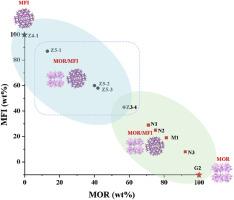
Considering the complex composition of fluid catalytic cracking catalyst residue (FCCR), it is a challenge to convert FCCR into MOR/MFI composite zeolites with a full composite ratio (i.e., MOR:MFI = 0: 100 %–100 %: 0). A crystal seed strategy is proposed to guide the crystallization phase and regulate properties such as porosity, morphology, acidity, and chemical coordination of MOR/MFI composite zeolites. In dehydration of glucose, MOR/MFI composite zeolite has a more excellent conversion of glucose and higher yield of 5-HMF than those of MOR zeolite. Based on the in-situ FTIR investigation, a higher concentration of fructose improve the dehydration to generate 5-HMF on MOR/MFI composite zeolites. Activation energy of dehydration of glucose decreases from 136.73 kJ/mol to 120.12 kJ/mol when using MOR/MFI composite zeolites. Proposed crystal seed strategy achieves the oriented conversion of FCCR to MOR/MFI composite zeolites with a desirable composition, which is also an important reference for other types of composite zeolites.
期刊介绍:
Microporous and Mesoporous Materials covers novel and significant aspects of porous solids classified as either microporous (pore size up to 2 nm) or mesoporous (pore size 2 to 50 nm). The porosity should have a specific impact on the material properties or application. Typical examples are zeolites and zeolite-like materials, pillared materials, clathrasils and clathrates, carbon molecular sieves, ordered mesoporous materials, organic/inorganic porous hybrid materials, or porous metal oxides. Both natural and synthetic porous materials are within the scope of the journal.
Topics which are particularly of interest include:
All aspects of natural microporous and mesoporous solids
The synthesis of crystalline or amorphous porous materials
The physico-chemical characterization of microporous and mesoporous solids, especially spectroscopic and microscopic
The modification of microporous and mesoporous solids, for example by ion exchange or solid-state reactions
All topics related to diffusion of mobile species in the pores of microporous and mesoporous materials
Adsorption (and other separation techniques) using microporous or mesoporous adsorbents
Catalysis by microporous and mesoporous materials
Host/guest interactions
Theoretical chemistry and modelling of host/guest interactions
All topics related to the application of microporous and mesoporous materials in industrial catalysis, separation technology, environmental protection, electrochemistry, membranes, sensors, optical devices, etc.




 京公网安备 11010802042870号
京ICP备2023020795号-1
京公网安备 11010802042870号
京ICP备2023020795号-1

 分享
分享
 求助内容:
求助内容: 应助结果提醒方式:
 扫码关注我们
