Jun Zhao , Zhaopeng Liu , Dehui Wang , Lei Zhao , Diandian Shi , Zhiyu He , Feng Shao , Peng Lu , Valentin Valtchev
{"title":"原子分散锌位限制在层状硅-2沸石与丙烷脱氢增强的稳定性","authors":"Jun Zhao , Zhaopeng Liu , Dehui Wang , Lei Zhao , Diandian Shi , Zhiyu He , Feng Shao , Peng Lu , Valentin Valtchev","doi":"10.1016/j.micromeso.2025.113503","DOIUrl":null,"url":null,"abstract":"<div><div>The goal of obtaining non-oxidative propane dehydrogenation (PDH) catalysts with low cost and environmental friendliness as alternatives to Pt and Cr-based catalysts, has been pursued for years. Zn-based catalysts have demonstrated great potential in the PDH process, but their activity and stability still need to be improved. Herein, we report a Zn-based zeolite catalyst with atomic Zn active sites that are highly dispersed and confined in a layered-like pure silica zeolite (Silicalite-2), via one-pot hydrothermal synthesis using a ligand-protection method. The atomic dispersion of isolated Zn<sup>2+</sup> species and their successful trapping and stabilizing by Si−OH in pure-silica LS-2-150 zeolite are unambiguously corroborated using complementary characterization techniques. In PDH reaction (550 °C, WHSV = 2.4 h<sup>−1</sup>), the optimized Zn<sub>2.65 %</sub>@LS-2 exhibits excellent initial activity (the propane conversion at 32.2 % and the propene selectivity at 90.1 %) and good catalytic stability after 6 cycles for 60 h on stream (the deactivation rate of 0.0087 h<sup>−1</sup>). Thus, this work presents a highly active and more durable Zn-based zeolite catalyst that is promising for PDH applications.</div></div>","PeriodicalId":392,"journal":{"name":"Microporous and Mesoporous Materials","volume":"386 ","pages":"Article 113503"},"PeriodicalIF":4.5000,"publicationDate":"2025-03-15","publicationTypes":"Journal Article","fieldsOfStudy":null,"isOpenAccess":false,"openAccessPdf":"","citationCount":"0","resultStr":"{\"title\":\"Atomically dispersed zinc sites confined in a layered silicalite-2 zeolite with enhanced stability for propane dehydrogenation\",\"authors\":\"Jun Zhao , Zhaopeng Liu , Dehui Wang , Lei Zhao , Diandian Shi , Zhiyu He , Feng Shao , Peng Lu , Valentin Valtchev\",\"doi\":\"10.1016/j.micromeso.2025.113503\",\"DOIUrl\":null,\"url\":null,\"abstract\":\"<div><div>The goal of obtaining non-oxidative propane dehydrogenation (PDH) catalysts with low cost and environmental friendliness as alternatives to Pt and Cr-based catalysts, has been pursued for years. Zn-based catalysts have demonstrated great potential in the PDH process, but their activity and stability still need to be improved. Herein, we report a Zn-based zeolite catalyst with atomic Zn active sites that are highly dispersed and confined in a layered-like pure silica zeolite (Silicalite-2), via one-pot hydrothermal synthesis using a ligand-protection method. The atomic dispersion of isolated Zn<sup>2+</sup> species and their successful trapping and stabilizing by Si−OH in pure-silica LS-2-150 zeolite are unambiguously corroborated using complementary characterization techniques. In PDH reaction (550 °C, WHSV = 2.4 h<sup>−1</sup>), the optimized Zn<sub>2.65 %</sub>@LS-2 exhibits excellent initial activity (the propane conversion at 32.2 % and the propene selectivity at 90.1 %) and good catalytic stability after 6 cycles for 60 h on stream (the deactivation rate of 0.0087 h<sup>−1</sup>). Thus, this work presents a highly active and more durable Zn-based zeolite catalyst that is promising for PDH applications.</div></div>\",\"PeriodicalId\":392,\"journal\":{\"name\":\"Microporous and Mesoporous Materials\",\"volume\":\"386 \",\"pages\":\"Article 113503\"},\"PeriodicalIF\":4.5000,\"publicationDate\":\"2025-03-15\",\"publicationTypes\":\"Journal Article\",\"fieldsOfStudy\":null,\"isOpenAccess\":false,\"openAccessPdf\":\"\",\"citationCount\":\"0\",\"resultStr\":null,\"platform\":\"Semanticscholar\",\"paperid\":null,\"PeriodicalName\":\"Microporous and Mesoporous Materials\",\"FirstCategoryId\":\"88\",\"ListUrlMain\":\"https://www.sciencedirect.com/science/article/pii/S1387181125000174\",\"RegionNum\":3,\"RegionCategory\":\"材料科学\",\"ArticlePicture\":[],\"TitleCN\":null,\"AbstractTextCN\":null,\"PMCID\":null,\"EPubDate\":\"2025/1/8 0:00:00\",\"PubModel\":\"Epub\",\"JCR\":\"Q1\",\"JCRName\":\"CHEMISTRY, APPLIED\",\"Score\":null,\"Total\":0}","platform":"Semanticscholar","paperid":null,"PeriodicalName":"Microporous and Mesoporous Materials","FirstCategoryId":"88","ListUrlMain":"https://www.sciencedirect.com/science/article/pii/S1387181125000174","RegionNum":3,"RegionCategory":"材料科学","ArticlePicture":[],"TitleCN":null,"AbstractTextCN":null,"PMCID":null,"EPubDate":"2025/1/8 0:00:00","PubModel":"Epub","JCR":"Q1","JCRName":"CHEMISTRY, APPLIED","Score":null,"Total":0}
Atomically dispersed zinc sites confined in a layered silicalite-2 zeolite with enhanced stability for propane dehydrogenation
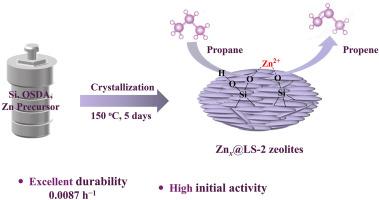
The goal of obtaining non-oxidative propane dehydrogenation (PDH) catalysts with low cost and environmental friendliness as alternatives to Pt and Cr-based catalysts, has been pursued for years. Zn-based catalysts have demonstrated great potential in the PDH process, but their activity and stability still need to be improved. Herein, we report a Zn-based zeolite catalyst with atomic Zn active sites that are highly dispersed and confined in a layered-like pure silica zeolite (Silicalite-2), via one-pot hydrothermal synthesis using a ligand-protection method. The atomic dispersion of isolated Zn2+ species and their successful trapping and stabilizing by Si−OH in pure-silica LS-2-150 zeolite are unambiguously corroborated using complementary characterization techniques. In PDH reaction (550 °C, WHSV = 2.4 h−1), the optimized Zn2.65 %@LS-2 exhibits excellent initial activity (the propane conversion at 32.2 % and the propene selectivity at 90.1 %) and good catalytic stability after 6 cycles for 60 h on stream (the deactivation rate of 0.0087 h−1). Thus, this work presents a highly active and more durable Zn-based zeolite catalyst that is promising for PDH applications.
期刊介绍:
Microporous and Mesoporous Materials covers novel and significant aspects of porous solids classified as either microporous (pore size up to 2 nm) or mesoporous (pore size 2 to 50 nm). The porosity should have a specific impact on the material properties or application. Typical examples are zeolites and zeolite-like materials, pillared materials, clathrasils and clathrates, carbon molecular sieves, ordered mesoporous materials, organic/inorganic porous hybrid materials, or porous metal oxides. Both natural and synthetic porous materials are within the scope of the journal.
Topics which are particularly of interest include:
All aspects of natural microporous and mesoporous solids
The synthesis of crystalline or amorphous porous materials
The physico-chemical characterization of microporous and mesoporous solids, especially spectroscopic and microscopic
The modification of microporous and mesoporous solids, for example by ion exchange or solid-state reactions
All topics related to diffusion of mobile species in the pores of microporous and mesoporous materials
Adsorption (and other separation techniques) using microporous or mesoporous adsorbents
Catalysis by microporous and mesoporous materials
Host/guest interactions
Theoretical chemistry and modelling of host/guest interactions
All topics related to the application of microporous and mesoporous materials in industrial catalysis, separation technology, environmental protection, electrochemistry, membranes, sensors, optical devices, etc.




 京公网安备 11010802042870号
京ICP备2023020795号-1
京公网安备 11010802042870号
京ICP备2023020795号-1

 分享
分享
 求助内容:
求助内容: 应助结果提醒方式:
 扫码关注我们
