{"title":"封闭在空心硅球中的铜纳米颗粒:了解草酸二甲酯选择性加氢的限制效应和增强的催化性能","authors":"Bingwen Li , Junwei Liu , Yu Liu , Jinxian Zhao","doi":"10.1016/j.micromeso.2025.113490","DOIUrl":null,"url":null,"abstract":"<div><div>Hollow silica spheres (HSS) supported Cu catalysts have been prepared by various methods and systematically characterized. The results indicated that impregnation method (IM) exhibits inferior dispersion of copper species. Compared to the deposition-precipitation (DP) and ammonia evaporation (AE) methods, the catalysts prepared by the one-pot (OP) method exhibit superior catalytic activity, evidenced by their MG yield being more than twice that achieved by the other two methods. This exceptional performance is attributed to the spatial confinement effect of HSS and the strong interaction between the Cu species and the silica support, which not only improves the dispersion of copper, reduces the size of Cu particles, but also enhances the amount of Cu<sup>+</sup> species. Meanwhile, the positive correlation between the conversion of DMO and the amount of Cu<sup>+</sup>, and the formation of Cu<sup>+</sup> species within the catalyst enhances the activation of the C-O and C=O bonds in DMO, leading to a marked enhancement in the catalytic performance during the hydrogenation.</div></div>","PeriodicalId":392,"journal":{"name":"Microporous and Mesoporous Materials","volume":"386 ","pages":"Article 113490"},"PeriodicalIF":4.7000,"publicationDate":"2025-03-15","publicationTypes":"Journal Article","fieldsOfStudy":null,"isOpenAccess":false,"openAccessPdf":"","citationCount":"0","resultStr":"{\"title\":\"Copper nanoparticles confined in hollow silica spheres: Understanding the confinement effect and enhanced catalytic performance for the selective hydrogenation of dimethyl oxalate\",\"authors\":\"Bingwen Li , Junwei Liu , Yu Liu , Jinxian Zhao\",\"doi\":\"10.1016/j.micromeso.2025.113490\",\"DOIUrl\":null,\"url\":null,\"abstract\":\"<div><div>Hollow silica spheres (HSS) supported Cu catalysts have been prepared by various methods and systematically characterized. The results indicated that impregnation method (IM) exhibits inferior dispersion of copper species. Compared to the deposition-precipitation (DP) and ammonia evaporation (AE) methods, the catalysts prepared by the one-pot (OP) method exhibit superior catalytic activity, evidenced by their MG yield being more than twice that achieved by the other two methods. This exceptional performance is attributed to the spatial confinement effect of HSS and the strong interaction between the Cu species and the silica support, which not only improves the dispersion of copper, reduces the size of Cu particles, but also enhances the amount of Cu<sup>+</sup> species. Meanwhile, the positive correlation between the conversion of DMO and the amount of Cu<sup>+</sup>, and the formation of Cu<sup>+</sup> species within the catalyst enhances the activation of the C-O and C=O bonds in DMO, leading to a marked enhancement in the catalytic performance during the hydrogenation.</div></div>\",\"PeriodicalId\":392,\"journal\":{\"name\":\"Microporous and Mesoporous Materials\",\"volume\":\"386 \",\"pages\":\"Article 113490\"},\"PeriodicalIF\":4.7000,\"publicationDate\":\"2025-03-15\",\"publicationTypes\":\"Journal Article\",\"fieldsOfStudy\":null,\"isOpenAccess\":false,\"openAccessPdf\":\"\",\"citationCount\":\"0\",\"resultStr\":null,\"platform\":\"Semanticscholar\",\"paperid\":null,\"PeriodicalName\":\"Microporous and Mesoporous Materials\",\"FirstCategoryId\":\"88\",\"ListUrlMain\":\"https://www.sciencedirect.com/science/article/pii/S1387181125000046\",\"RegionNum\":3,\"RegionCategory\":\"材料科学\",\"ArticlePicture\":[],\"TitleCN\":null,\"AbstractTextCN\":null,\"PMCID\":null,\"EPubDate\":\"2025/1/10 0:00:00\",\"PubModel\":\"Epub\",\"JCR\":\"Q1\",\"JCRName\":\"CHEMISTRY, APPLIED\",\"Score\":null,\"Total\":0}","platform":"Semanticscholar","paperid":null,"PeriodicalName":"Microporous and Mesoporous Materials","FirstCategoryId":"88","ListUrlMain":"https://www.sciencedirect.com/science/article/pii/S1387181125000046","RegionNum":3,"RegionCategory":"材料科学","ArticlePicture":[],"TitleCN":null,"AbstractTextCN":null,"PMCID":null,"EPubDate":"2025/1/10 0:00:00","PubModel":"Epub","JCR":"Q1","JCRName":"CHEMISTRY, APPLIED","Score":null,"Total":0}
Copper nanoparticles confined in hollow silica spheres: Understanding the confinement effect and enhanced catalytic performance for the selective hydrogenation of dimethyl oxalate
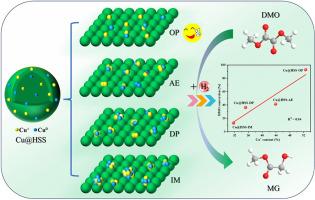
Hollow silica spheres (HSS) supported Cu catalysts have been prepared by various methods and systematically characterized. The results indicated that impregnation method (IM) exhibits inferior dispersion of copper species. Compared to the deposition-precipitation (DP) and ammonia evaporation (AE) methods, the catalysts prepared by the one-pot (OP) method exhibit superior catalytic activity, evidenced by their MG yield being more than twice that achieved by the other two methods. This exceptional performance is attributed to the spatial confinement effect of HSS and the strong interaction between the Cu species and the silica support, which not only improves the dispersion of copper, reduces the size of Cu particles, but also enhances the amount of Cu+ species. Meanwhile, the positive correlation between the conversion of DMO and the amount of Cu+, and the formation of Cu+ species within the catalyst enhances the activation of the C-O and C=O bonds in DMO, leading to a marked enhancement in the catalytic performance during the hydrogenation.
期刊介绍:
Microporous and Mesoporous Materials covers novel and significant aspects of porous solids classified as either microporous (pore size up to 2 nm) or mesoporous (pore size 2 to 50 nm). The porosity should have a specific impact on the material properties or application. Typical examples are zeolites and zeolite-like materials, pillared materials, clathrasils and clathrates, carbon molecular sieves, ordered mesoporous materials, organic/inorganic porous hybrid materials, or porous metal oxides. Both natural and synthetic porous materials are within the scope of the journal.
Topics which are particularly of interest include:
All aspects of natural microporous and mesoporous solids
The synthesis of crystalline or amorphous porous materials
The physico-chemical characterization of microporous and mesoporous solids, especially spectroscopic and microscopic
The modification of microporous and mesoporous solids, for example by ion exchange or solid-state reactions
All topics related to diffusion of mobile species in the pores of microporous and mesoporous materials
Adsorption (and other separation techniques) using microporous or mesoporous adsorbents
Catalysis by microporous and mesoporous materials
Host/guest interactions
Theoretical chemistry and modelling of host/guest interactions
All topics related to the application of microporous and mesoporous materials in industrial catalysis, separation technology, environmental protection, electrochemistry, membranes, sensors, optical devices, etc.




 京公网安备 11010802042870号
京ICP备2023020795号-1
京公网安备 11010802042870号
京ICP备2023020795号-1

 分享
分享
 求助内容:
求助内容: 应助结果提醒方式:
 扫码关注我们
