Quanhong Zhu, Hao Guan, Donghui Liu, Yalong Cao, Hongbing Song
{"title":"原煤连续干选过程中充填颗粒经不同长度侧孔重力排出","authors":"Quanhong Zhu, Hao Guan, Donghui Liu, Yalong Cao, Hongbing Song","doi":"10.1016/j.powtec.2025.120632","DOIUrl":null,"url":null,"abstract":"<div><div>For coal dry beneficiation in air-fluidized beds, the sorted gangue particles can be discharged continuously from a side orifice underneath the gas distributor. The mass discharge rate (<em>q</em><sub>m</sub>) was found to decrease with <em>l</em><sub>o</sub> (orifice length) increasing from 0.003 to 0.010 m. The Beverloo equation worked well in correlating <em>q</em><sub>m</sub> and <em>d</em><sub>o</sub> (orifice diameter) at all levels of <em>l</em><sub>o</sub>. The independence of <em>C</em> and <em>k</em> on <em>d</em><sub>o</sub> was demonstrated by good linearity between <span><math><msubsup><mi>q</mi><mi>m</mi><mn>0.25</mn></msubsup></math></span>and <em>d</em><sub>o</sub>. <em>C</em> was fitted as ∼0.20, irrelevant to <em>l</em><sub>o</sub> or particle type. <em>k</em> was derived as >10, differing significantly from <2 for bottom orifices. The greater <em>k</em> was revealed to arise from a thick region with retarded particle flow at bottom of side orifices. Such a stagnant zone also explained why <em>k</em> increased with increasing <em>l</em><sub>o</sub> and <em>ρ</em><sub>b</sub> (bulk density) or decreasing <em>d</em><sub>p</sub> (particle size). <em>l</em><sub>o</sub> is promising for adjusting <em>q</em><sub>m</sub> and exploring the clogging/jamming phenomenon.</div></div>","PeriodicalId":407,"journal":{"name":"Powder Technology","volume":"453 ","pages":"Article 120632"},"PeriodicalIF":5.5000,"publicationDate":"2025-03-15","publicationTypes":"Journal Article","fieldsOfStudy":null,"isOpenAccess":false,"openAccessPdf":"","citationCount":"0","resultStr":"{\"title\":\"Gravitational discharge of packed particles through side orifices with different lengths for continuous dry beneficiation of raw coal in fluidized beds\",\"authors\":\"Quanhong Zhu, Hao Guan, Donghui Liu, Yalong Cao, Hongbing Song\",\"doi\":\"10.1016/j.powtec.2025.120632\",\"DOIUrl\":null,\"url\":null,\"abstract\":\"<div><div>For coal dry beneficiation in air-fluidized beds, the sorted gangue particles can be discharged continuously from a side orifice underneath the gas distributor. The mass discharge rate (<em>q</em><sub>m</sub>) was found to decrease with <em>l</em><sub>o</sub> (orifice length) increasing from 0.003 to 0.010 m. The Beverloo equation worked well in correlating <em>q</em><sub>m</sub> and <em>d</em><sub>o</sub> (orifice diameter) at all levels of <em>l</em><sub>o</sub>. The independence of <em>C</em> and <em>k</em> on <em>d</em><sub>o</sub> was demonstrated by good linearity between <span><math><msubsup><mi>q</mi><mi>m</mi><mn>0.25</mn></msubsup></math></span>and <em>d</em><sub>o</sub>. <em>C</em> was fitted as ∼0.20, irrelevant to <em>l</em><sub>o</sub> or particle type. <em>k</em> was derived as >10, differing significantly from <2 for bottom orifices. The greater <em>k</em> was revealed to arise from a thick region with retarded particle flow at bottom of side orifices. Such a stagnant zone also explained why <em>k</em> increased with increasing <em>l</em><sub>o</sub> and <em>ρ</em><sub>b</sub> (bulk density) or decreasing <em>d</em><sub>p</sub> (particle size). <em>l</em><sub>o</sub> is promising for adjusting <em>q</em><sub>m</sub> and exploring the clogging/jamming phenomenon.</div></div>\",\"PeriodicalId\":407,\"journal\":{\"name\":\"Powder Technology\",\"volume\":\"453 \",\"pages\":\"Article 120632\"},\"PeriodicalIF\":5.5000,\"publicationDate\":\"2025-03-15\",\"publicationTypes\":\"Journal Article\",\"fieldsOfStudy\":null,\"isOpenAccess\":false,\"openAccessPdf\":\"\",\"citationCount\":\"0\",\"resultStr\":null,\"platform\":\"Semanticscholar\",\"paperid\":null,\"PeriodicalName\":\"Powder Technology\",\"FirstCategoryId\":\"5\",\"ListUrlMain\":\"https://www.sciencedirect.com/science/article/pii/S0032591025000270\",\"RegionNum\":2,\"RegionCategory\":\"工程技术\",\"ArticlePicture\":[],\"TitleCN\":null,\"AbstractTextCN\":null,\"PMCID\":null,\"EPubDate\":\"2025/1/7 0:00:00\",\"PubModel\":\"Epub\",\"JCR\":\"Q2\",\"JCRName\":\"ENGINEERING, CHEMICAL\",\"Score\":null,\"Total\":0}","platform":"Semanticscholar","paperid":null,"PeriodicalName":"Powder Technology","FirstCategoryId":"5","ListUrlMain":"https://www.sciencedirect.com/science/article/pii/S0032591025000270","RegionNum":2,"RegionCategory":"工程技术","ArticlePicture":[],"TitleCN":null,"AbstractTextCN":null,"PMCID":null,"EPubDate":"2025/1/7 0:00:00","PubModel":"Epub","JCR":"Q2","JCRName":"ENGINEERING, CHEMICAL","Score":null,"Total":0}
Gravitational discharge of packed particles through side orifices with different lengths for continuous dry beneficiation of raw coal in fluidized beds
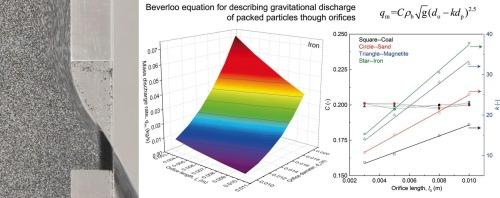
For coal dry beneficiation in air-fluidized beds, the sorted gangue particles can be discharged continuously from a side orifice underneath the gas distributor. The mass discharge rate (qm) was found to decrease with lo (orifice length) increasing from 0.003 to 0.010 m. The Beverloo equation worked well in correlating qm and do (orifice diameter) at all levels of lo. The independence of C and k on do was demonstrated by good linearity between and do. C was fitted as ∼0.20, irrelevant to lo or particle type. k was derived as >10, differing significantly from <2 for bottom orifices. The greater k was revealed to arise from a thick region with retarded particle flow at bottom of side orifices. Such a stagnant zone also explained why k increased with increasing lo and ρb (bulk density) or decreasing dp (particle size). lo is promising for adjusting qm and exploring the clogging/jamming phenomenon.
期刊介绍:
Powder Technology is an International Journal on the Science and Technology of Wet and Dry Particulate Systems. Powder Technology publishes papers on all aspects of the formation of particles and their characterisation and on the study of systems containing particulate solids. No limitation is imposed on the size of the particles, which may range from nanometre scale, as in pigments or aerosols, to that of mined or quarried materials. The following list of topics is not intended to be comprehensive, but rather to indicate typical subjects which fall within the scope of the journal's interests:
Formation and synthesis of particles by precipitation and other methods.
Modification of particles by agglomeration, coating, comminution and attrition.
Characterisation of the size, shape, surface area, pore structure and strength of particles and agglomerates (including the origins and effects of inter particle forces).
Packing, failure, flow and permeability of assemblies of particles.
Particle-particle interactions and suspension rheology.
Handling and processing operations such as slurry flow, fluidization, pneumatic conveying.
Interactions between particles and their environment, including delivery of particulate products to the body.
Applications of particle technology in production of pharmaceuticals, chemicals, foods, pigments, structural, and functional materials and in environmental and energy related matters.
For materials-oriented contributions we are looking for articles revealing the effect of particle/powder characteristics (size, morphology and composition, in that order) on material performance or functionality and, ideally, comparison to any industrial standard.




 京公网安备 11010802042870号
京ICP备2023020795号-1
京公网安备 11010802042870号
京ICP备2023020795号-1

 分享
分享
 求助内容:
求助内容: 应助结果提醒方式:
 扫码关注我们
