Jie Ma , Liping Zhen , Huijun Yao , Dan Mo , Youmei Sun , Zhengguo Hu , Jie Liu , Jinglai Duan
{"title":"通过层层接枝聚亚胺对聚对苯二甲酸乙二醇酯膜进行可调亲水性改性","authors":"Jie Ma , Liping Zhen , Huijun Yao , Dan Mo , Youmei Sun , Zhengguo Hu , Jie Liu , Jinglai Duan","doi":"10.1016/j.reactfunctpolym.2025.106151","DOIUrl":null,"url":null,"abstract":"<div><div>Hydrophilicity is an important property for membranes as it influences the application scope and effectiveness of separation process, and various surface modification methods have been developed targeting to an enhanced hydrophilicity. However, few work focuses on hydrophilicity tunability, and many researches can only obtain limited wettability improvement. Here, a novel surface modification method is reported. In this method, surface functional groups on polyethylene terephthalate membrane are activated and hydrophilic polyethylenimine chains can be grafted to the membrane in a layer-by-layer manner. The membrane hydrophilicity is thus tunable in a wide range through adjusting the number of grafting steps, and a water contact angle decrease of 54<sup>o</sup> that exceeds most of other grafting modification methods is achieved. Optimal membrane hydrophilicity corresponding to a contact angle of 60<sup>o</sup> is found through the screening for the highest water permeability, and a water permeability improvement of ∼29 % is observed for modified PET track-etched membranes with different parameters.</div></div>","PeriodicalId":20916,"journal":{"name":"Reactive & Functional Polymers","volume":"208 ","pages":"Article 106151"},"PeriodicalIF":5.1000,"publicationDate":"2025-03-01","publicationTypes":"Journal Article","fieldsOfStudy":null,"isOpenAccess":false,"openAccessPdf":"","citationCount":"0","resultStr":"{\"title\":\"Tunable hydrophilic modification of polyethylene terephthalate membrane via layer-by-layer polyethylenimine grafting\",\"authors\":\"Jie Ma , Liping Zhen , Huijun Yao , Dan Mo , Youmei Sun , Zhengguo Hu , Jie Liu , Jinglai Duan\",\"doi\":\"10.1016/j.reactfunctpolym.2025.106151\",\"DOIUrl\":null,\"url\":null,\"abstract\":\"<div><div>Hydrophilicity is an important property for membranes as it influences the application scope and effectiveness of separation process, and various surface modification methods have been developed targeting to an enhanced hydrophilicity. However, few work focuses on hydrophilicity tunability, and many researches can only obtain limited wettability improvement. Here, a novel surface modification method is reported. In this method, surface functional groups on polyethylene terephthalate membrane are activated and hydrophilic polyethylenimine chains can be grafted to the membrane in a layer-by-layer manner. The membrane hydrophilicity is thus tunable in a wide range through adjusting the number of grafting steps, and a water contact angle decrease of 54<sup>o</sup> that exceeds most of other grafting modification methods is achieved. Optimal membrane hydrophilicity corresponding to a contact angle of 60<sup>o</sup> is found through the screening for the highest water permeability, and a water permeability improvement of ∼29 % is observed for modified PET track-etched membranes with different parameters.</div></div>\",\"PeriodicalId\":20916,\"journal\":{\"name\":\"Reactive & Functional Polymers\",\"volume\":\"208 \",\"pages\":\"Article 106151\"},\"PeriodicalIF\":5.1000,\"publicationDate\":\"2025-03-01\",\"publicationTypes\":\"Journal Article\",\"fieldsOfStudy\":null,\"isOpenAccess\":false,\"openAccessPdf\":\"\",\"citationCount\":\"0\",\"resultStr\":null,\"platform\":\"Semanticscholar\",\"paperid\":null,\"PeriodicalName\":\"Reactive & Functional Polymers\",\"FirstCategoryId\":\"5\",\"ListUrlMain\":\"https://www.sciencedirect.com/science/article/pii/S1381514825000033\",\"RegionNum\":3,\"RegionCategory\":\"工程技术\",\"ArticlePicture\":[],\"TitleCN\":null,\"AbstractTextCN\":null,\"PMCID\":null,\"EPubDate\":\"2025/1/3 0:00:00\",\"PubModel\":\"Epub\",\"JCR\":\"Q1\",\"JCRName\":\"CHEMISTRY, APPLIED\",\"Score\":null,\"Total\":0}","platform":"Semanticscholar","paperid":null,"PeriodicalName":"Reactive & Functional Polymers","FirstCategoryId":"5","ListUrlMain":"https://www.sciencedirect.com/science/article/pii/S1381514825000033","RegionNum":3,"RegionCategory":"工程技术","ArticlePicture":[],"TitleCN":null,"AbstractTextCN":null,"PMCID":null,"EPubDate":"2025/1/3 0:00:00","PubModel":"Epub","JCR":"Q1","JCRName":"CHEMISTRY, APPLIED","Score":null,"Total":0}
Tunable hydrophilic modification of polyethylene terephthalate membrane via layer-by-layer polyethylenimine grafting
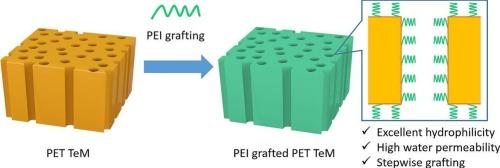
Hydrophilicity is an important property for membranes as it influences the application scope and effectiveness of separation process, and various surface modification methods have been developed targeting to an enhanced hydrophilicity. However, few work focuses on hydrophilicity tunability, and many researches can only obtain limited wettability improvement. Here, a novel surface modification method is reported. In this method, surface functional groups on polyethylene terephthalate membrane are activated and hydrophilic polyethylenimine chains can be grafted to the membrane in a layer-by-layer manner. The membrane hydrophilicity is thus tunable in a wide range through adjusting the number of grafting steps, and a water contact angle decrease of 54o that exceeds most of other grafting modification methods is achieved. Optimal membrane hydrophilicity corresponding to a contact angle of 60o is found through the screening for the highest water permeability, and a water permeability improvement of ∼29 % is observed for modified PET track-etched membranes with different parameters.
期刊介绍:
Reactive & Functional Polymers provides a forum to disseminate original ideas, concepts and developments in the science and technology of polymers with functional groups, which impart specific chemical reactivity or physical, chemical, structural, biological, and pharmacological functionality. The scope covers organic polymers, acting for instance as reagents, catalysts, templates, ion-exchangers, selective sorbents, chelating or antimicrobial agents, drug carriers, sensors, membranes, and hydrogels. This also includes reactive cross-linkable prepolymers and high-performance thermosetting polymers, natural or degradable polymers, conducting polymers, and porous polymers.
Original research articles must contain thorough molecular and material characterization data on synthesis of the above polymers in combination with their applications. Applications include but are not limited to catalysis, water or effluent treatment, separations and recovery, electronics and information storage, energy conversion, encapsulation, or adhesion.




 京公网安备 11010802042870号
京ICP备2023020795号-1
京公网安备 11010802042870号
京ICP备2023020795号-1

 分享
分享
 求助内容:
求助内容: 应助结果提醒方式:
 扫码关注我们
