{"title":"化学蚀刻制备室温下高热电系数β-Zn4Sb3薄膜","authors":"Avinash Kumar , Janpreet Singh , S.K. Tripathi","doi":"10.1016/j.materresbull.2024.113281","DOIUrl":null,"url":null,"abstract":"<div><div>In this work, Seebeck coefficient (S) and Power factor (PF) of thermoelectric (TE) material β-Zn<sub>4</sub>Sb<sub>3</sub> thin films were enhanced significantly via chemical etching strategy. β-Zn<sub>4</sub>Sb<sub>3</sub> was synthesized using melt-quench method and thin films were deposited using thermal evaporation technique. Dip method of wet chemical etching in 0.025 M KOH solution was used to prepare thin film samples for various etching time periods. All thin film samples were annealed at 383 K and thermoelectric properties of samples were determined at room temperature (303 K). A maximum S value of 422 µVK<sup>-1</sup> and PF value of 1091.65 µWm<sup>-1</sup>K<sup>-2</sup> were obtained at room temperature for 8 minutes (Min) etching time which were enhanced by 62 %, 89 % respectively compared to without etched sample (As). Enhancement in S value is attributed to combination of surface scattering and energy filtering effects. Maximum electrical conductivity (σ) value of 9.20 <span><math><mrow><mo>×</mo><msup><mrow><mn>10</mn></mrow><mn>3</mn></msup></mrow></math></span> Sm<sup>-1</sup> was obtained for 2 Min thin film. Optical properties were studied using UV–Vis spectroscopy (UV–Vis) and Photoluminescence spectroscopy (PL). Band gap determined from UV–Vis spectra is increasing in trend with etching time due to quantum confinement effects. PL spectra depicted increase in surface defects states with etching time. Structural and morphological properties were analyzed using X-ray diffraction (XRD) and Field Emission Scanning Electron Microscope (FESEM) respectively. FESEM analysis supported with XRD and PL analysis revealed increase in porosity, surface defects, pore sizes with etching time. Average film thickness of 175 nm was determined using cross sectional FESEM. Thin films surface topography and roughness with etching durations were investigated using Atomic Force Microscope (AFM).</div></div>","PeriodicalId":18265,"journal":{"name":"Materials Research Bulletin","volume":"184 ","pages":"Article 113281"},"PeriodicalIF":5.7000,"publicationDate":"2025-04-01","publicationTypes":"Journal Article","fieldsOfStudy":null,"isOpenAccess":false,"openAccessPdf":"","citationCount":"0","resultStr":"{\"title\":\"High thermoelectric coefficients of β-Zn4Sb3 thin films at room temperature via chemical etching\",\"authors\":\"Avinash Kumar , Janpreet Singh , S.K. Tripathi\",\"doi\":\"10.1016/j.materresbull.2024.113281\",\"DOIUrl\":null,\"url\":null,\"abstract\":\"<div><div>In this work, Seebeck coefficient (S) and Power factor (PF) of thermoelectric (TE) material β-Zn<sub>4</sub>Sb<sub>3</sub> thin films were enhanced significantly via chemical etching strategy. β-Zn<sub>4</sub>Sb<sub>3</sub> was synthesized using melt-quench method and thin films were deposited using thermal evaporation technique. Dip method of wet chemical etching in 0.025 M KOH solution was used to prepare thin film samples for various etching time periods. All thin film samples were annealed at 383 K and thermoelectric properties of samples were determined at room temperature (303 K). A maximum S value of 422 µVK<sup>-1</sup> and PF value of 1091.65 µWm<sup>-1</sup>K<sup>-2</sup> were obtained at room temperature for 8 minutes (Min) etching time which were enhanced by 62 %, 89 % respectively compared to without etched sample (As). Enhancement in S value is attributed to combination of surface scattering and energy filtering effects. Maximum electrical conductivity (σ) value of 9.20 <span><math><mrow><mo>×</mo><msup><mrow><mn>10</mn></mrow><mn>3</mn></msup></mrow></math></span> Sm<sup>-1</sup> was obtained for 2 Min thin film. Optical properties were studied using UV–Vis spectroscopy (UV–Vis) and Photoluminescence spectroscopy (PL). Band gap determined from UV–Vis spectra is increasing in trend with etching time due to quantum confinement effects. PL spectra depicted increase in surface defects states with etching time. Structural and morphological properties were analyzed using X-ray diffraction (XRD) and Field Emission Scanning Electron Microscope (FESEM) respectively. FESEM analysis supported with XRD and PL analysis revealed increase in porosity, surface defects, pore sizes with etching time. Average film thickness of 175 nm was determined using cross sectional FESEM. Thin films surface topography and roughness with etching durations were investigated using Atomic Force Microscope (AFM).</div></div>\",\"PeriodicalId\":18265,\"journal\":{\"name\":\"Materials Research Bulletin\",\"volume\":\"184 \",\"pages\":\"Article 113281\"},\"PeriodicalIF\":5.7000,\"publicationDate\":\"2025-04-01\",\"publicationTypes\":\"Journal Article\",\"fieldsOfStudy\":null,\"isOpenAccess\":false,\"openAccessPdf\":\"\",\"citationCount\":\"0\",\"resultStr\":null,\"platform\":\"Semanticscholar\",\"paperid\":null,\"PeriodicalName\":\"Materials Research Bulletin\",\"FirstCategoryId\":\"88\",\"ListUrlMain\":\"https://www.sciencedirect.com/science/article/pii/S0025540824006093\",\"RegionNum\":3,\"RegionCategory\":\"材料科学\",\"ArticlePicture\":[],\"TitleCN\":null,\"AbstractTextCN\":null,\"PMCID\":null,\"EPubDate\":\"2024/12/28 0:00:00\",\"PubModel\":\"Epub\",\"JCR\":\"Q2\",\"JCRName\":\"MATERIALS SCIENCE, MULTIDISCIPLINARY\",\"Score\":null,\"Total\":0}","platform":"Semanticscholar","paperid":null,"PeriodicalName":"Materials Research Bulletin","FirstCategoryId":"88","ListUrlMain":"https://www.sciencedirect.com/science/article/pii/S0025540824006093","RegionNum":3,"RegionCategory":"材料科学","ArticlePicture":[],"TitleCN":null,"AbstractTextCN":null,"PMCID":null,"EPubDate":"2024/12/28 0:00:00","PubModel":"Epub","JCR":"Q2","JCRName":"MATERIALS SCIENCE, MULTIDISCIPLINARY","Score":null,"Total":0}
High thermoelectric coefficients of β-Zn4Sb3 thin films at room temperature via chemical etching
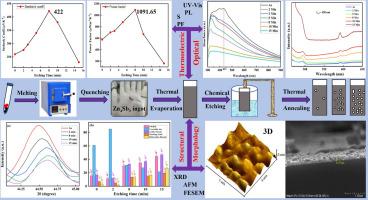
In this work, Seebeck coefficient (S) and Power factor (PF) of thermoelectric (TE) material β-Zn4Sb3 thin films were enhanced significantly via chemical etching strategy. β-Zn4Sb3 was synthesized using melt-quench method and thin films were deposited using thermal evaporation technique. Dip method of wet chemical etching in 0.025 M KOH solution was used to prepare thin film samples for various etching time periods. All thin film samples were annealed at 383 K and thermoelectric properties of samples were determined at room temperature (303 K). A maximum S value of 422 µVK-1 and PF value of 1091.65 µWm-1K-2 were obtained at room temperature for 8 minutes (Min) etching time which were enhanced by 62 %, 89 % respectively compared to without etched sample (As). Enhancement in S value is attributed to combination of surface scattering and energy filtering effects. Maximum electrical conductivity (σ) value of 9.20 Sm-1 was obtained for 2 Min thin film. Optical properties were studied using UV–Vis spectroscopy (UV–Vis) and Photoluminescence spectroscopy (PL). Band gap determined from UV–Vis spectra is increasing in trend with etching time due to quantum confinement effects. PL spectra depicted increase in surface defects states with etching time. Structural and morphological properties were analyzed using X-ray diffraction (XRD) and Field Emission Scanning Electron Microscope (FESEM) respectively. FESEM analysis supported with XRD and PL analysis revealed increase in porosity, surface defects, pore sizes with etching time. Average film thickness of 175 nm was determined using cross sectional FESEM. Thin films surface topography and roughness with etching durations were investigated using Atomic Force Microscope (AFM).
期刊介绍:
Materials Research Bulletin is an international journal reporting high-impact research on processing-structure-property relationships in functional materials and nanomaterials with interesting electronic, magnetic, optical, thermal, mechanical or catalytic properties. Papers purely on thermodynamics or theoretical calculations (e.g., density functional theory) do not fall within the scope of the journal unless they also demonstrate a clear link to physical properties. Topics covered include functional materials (e.g., dielectrics, pyroelectrics, piezoelectrics, ferroelectrics, relaxors, thermoelectrics, etc.); electrochemistry and solid-state ionics (e.g., photovoltaics, batteries, sensors, and fuel cells); nanomaterials, graphene, and nanocomposites; luminescence and photocatalysis; crystal-structure and defect-structure analysis; novel electronics; non-crystalline solids; flexible electronics; protein-material interactions; and polymeric ion-exchange membranes.




 京公网安备 11010802042870号
京ICP备2023020795号-1
京公网安备 11010802042870号
京ICP备2023020795号-1

 分享
分享
 求助内容:
求助内容: 应助结果提醒方式:
 扫码关注我们
