{"title":"聚苯胺- v2o5纳米复合材料在有机染料降解中的光催化效果及作为超级电容器电极材料的应用","authors":"Debashish Nayak , Tusharkanta Nayak , Smita Mohanty , Akshaya K. Palai , Ram Bilash Choudhary , Rohit Kandulna","doi":"10.1016/j.materresbull.2024.113277","DOIUrl":null,"url":null,"abstract":"<div><div>An advanced hybrid Polyaniline-V<span><math><msub><mrow></mrow><mrow><mn>2</mn></mrow></msub></math></span>O<span><math><msub><mrow></mrow><mrow><mn>5</mn></mrow></msub></math></span> (PSVO) nanocomposite with a unique structure was successfully synthesized via chemical in-situ oxidation polymerization. Small particles are distributed throughout the nanofibers framework, improving the charge transfer characteristics of PSVO, as shown by field emission scanning electron microscope (FESEM) and transmission electron microscope (TEM). The PSVO nanocomposite demonstrated exceptional photocatalytic efficacy under sunlight, effectively degrading a range of organic dyes: methylene blue (MB), methyl orange (MO), malachite green (MG), and rhodamine B (RhB) in different water sources, including river, tap, and stagnant water, with degradation efficiencies of 92.51%, 95.18%, 90.61%, and 97.42%, respectively. The integration of V<span><math><msub><mrow></mrow><mrow><mn>2</mn></mrow></msub></math></span>O<span><math><msub><mrow></mrow><mrow><mn>5</mn></mrow></msub></math></span> significantly enhanced redox activity and charge storage, elevating the material’s electrochemical performance. The optimized PSVO sample with 10% V<span><math><msub><mrow></mrow><mrow><mn>2</mn></mrow></msub></math></span>O<span><math><msub><mrow></mrow><mrow><mn>5</mn></mrow></msub></math></span> content achieved an impressive specific capacitance of 1027.87 F g<sup>−1</sup> at a current density of 1 A g<sup>−1</sup> with energy density of 91.33 Wh/kg and power density of 400 W/kg. These attributes make the PSVO nanocomposite an outstanding candidate for applications in high-performance supercapacitors and efficient water purification.</div></div>","PeriodicalId":18265,"journal":{"name":"Materials Research Bulletin","volume":"184 ","pages":"Article 113277"},"PeriodicalIF":5.7000,"publicationDate":"2025-04-01","publicationTypes":"Journal Article","fieldsOfStudy":null,"isOpenAccess":false,"openAccessPdf":"","citationCount":"0","resultStr":"{\"title\":\"Polyaniline-V2O5 nanocomposite for photocatalytic efficacy in organic dye degradation and as electrode materials for supercapacitor applications\",\"authors\":\"Debashish Nayak , Tusharkanta Nayak , Smita Mohanty , Akshaya K. Palai , Ram Bilash Choudhary , Rohit Kandulna\",\"doi\":\"10.1016/j.materresbull.2024.113277\",\"DOIUrl\":null,\"url\":null,\"abstract\":\"<div><div>An advanced hybrid Polyaniline-V<span><math><msub><mrow></mrow><mrow><mn>2</mn></mrow></msub></math></span>O<span><math><msub><mrow></mrow><mrow><mn>5</mn></mrow></msub></math></span> (PSVO) nanocomposite with a unique structure was successfully synthesized via chemical in-situ oxidation polymerization. Small particles are distributed throughout the nanofibers framework, improving the charge transfer characteristics of PSVO, as shown by field emission scanning electron microscope (FESEM) and transmission electron microscope (TEM). The PSVO nanocomposite demonstrated exceptional photocatalytic efficacy under sunlight, effectively degrading a range of organic dyes: methylene blue (MB), methyl orange (MO), malachite green (MG), and rhodamine B (RhB) in different water sources, including river, tap, and stagnant water, with degradation efficiencies of 92.51%, 95.18%, 90.61%, and 97.42%, respectively. The integration of V<span><math><msub><mrow></mrow><mrow><mn>2</mn></mrow></msub></math></span>O<span><math><msub><mrow></mrow><mrow><mn>5</mn></mrow></msub></math></span> significantly enhanced redox activity and charge storage, elevating the material’s electrochemical performance. The optimized PSVO sample with 10% V<span><math><msub><mrow></mrow><mrow><mn>2</mn></mrow></msub></math></span>O<span><math><msub><mrow></mrow><mrow><mn>5</mn></mrow></msub></math></span> content achieved an impressive specific capacitance of 1027.87 F g<sup>−1</sup> at a current density of 1 A g<sup>−1</sup> with energy density of 91.33 Wh/kg and power density of 400 W/kg. These attributes make the PSVO nanocomposite an outstanding candidate for applications in high-performance supercapacitors and efficient water purification.</div></div>\",\"PeriodicalId\":18265,\"journal\":{\"name\":\"Materials Research Bulletin\",\"volume\":\"184 \",\"pages\":\"Article 113277\"},\"PeriodicalIF\":5.7000,\"publicationDate\":\"2025-04-01\",\"publicationTypes\":\"Journal Article\",\"fieldsOfStudy\":null,\"isOpenAccess\":false,\"openAccessPdf\":\"\",\"citationCount\":\"0\",\"resultStr\":null,\"platform\":\"Semanticscholar\",\"paperid\":null,\"PeriodicalName\":\"Materials Research Bulletin\",\"FirstCategoryId\":\"88\",\"ListUrlMain\":\"https://www.sciencedirect.com/science/article/pii/S0025540824006056\",\"RegionNum\":3,\"RegionCategory\":\"材料科学\",\"ArticlePicture\":[],\"TitleCN\":null,\"AbstractTextCN\":null,\"PMCID\":null,\"EPubDate\":\"2024/12/31 0:00:00\",\"PubModel\":\"Epub\",\"JCR\":\"Q2\",\"JCRName\":\"MATERIALS SCIENCE, MULTIDISCIPLINARY\",\"Score\":null,\"Total\":0}","platform":"Semanticscholar","paperid":null,"PeriodicalName":"Materials Research Bulletin","FirstCategoryId":"88","ListUrlMain":"https://www.sciencedirect.com/science/article/pii/S0025540824006056","RegionNum":3,"RegionCategory":"材料科学","ArticlePicture":[],"TitleCN":null,"AbstractTextCN":null,"PMCID":null,"EPubDate":"2024/12/31 0:00:00","PubModel":"Epub","JCR":"Q2","JCRName":"MATERIALS SCIENCE, MULTIDISCIPLINARY","Score":null,"Total":0}
引用次数: 0
摘要
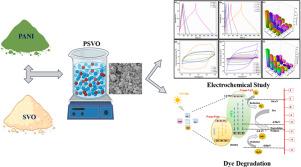
采用原位氧化聚合法制备了具有独特结构的聚苯胺- v2o5 (PSVO)纳米复合材料。场发射扫描电镜(FESEM)和透射电镜(TEM)显示,小颗粒分布在纳米纤维框架中,改善了PSVO的电荷转移特性。PSVO纳米复合材料在阳光下表现出优异的光催化效果,能有效降解河流、自来水和死水中的亚甲基蓝(MB)、甲基橙(MO)、孔雀石绿(MG)和罗丹明B (RhB)等多种有机染料,降解效率分别为92.51%、95.18%、90.61%和97.42%。V2O5的加入显著增强了材料的氧化还原活性和电荷存储能力,提高了材料的电化学性能。优化后的V2O5含量为10%的PSVO样品在电流密度为1 a g−1、能量密度为91.33 Wh/kg、功率密度为400 W/kg时,比电容达到1027.87 F g−1。这些特性使PSVO纳米复合材料成为高性能超级电容器和高效水净化应用的杰出候选者。
Polyaniline-V2O5 nanocomposite for photocatalytic efficacy in organic dye degradation and as electrode materials for supercapacitor applications
An advanced hybrid Polyaniline-VO (PSVO) nanocomposite with a unique structure was successfully synthesized via chemical in-situ oxidation polymerization. Small particles are distributed throughout the nanofibers framework, improving the charge transfer characteristics of PSVO, as shown by field emission scanning electron microscope (FESEM) and transmission electron microscope (TEM). The PSVO nanocomposite demonstrated exceptional photocatalytic efficacy under sunlight, effectively degrading a range of organic dyes: methylene blue (MB), methyl orange (MO), malachite green (MG), and rhodamine B (RhB) in different water sources, including river, tap, and stagnant water, with degradation efficiencies of 92.51%, 95.18%, 90.61%, and 97.42%, respectively. The integration of VO significantly enhanced redox activity and charge storage, elevating the material’s electrochemical performance. The optimized PSVO sample with 10% VO content achieved an impressive specific capacitance of 1027.87 F g−1 at a current density of 1 A g−1 with energy density of 91.33 Wh/kg and power density of 400 W/kg. These attributes make the PSVO nanocomposite an outstanding candidate for applications in high-performance supercapacitors and efficient water purification.
期刊介绍:
Materials Research Bulletin is an international journal reporting high-impact research on processing-structure-property relationships in functional materials and nanomaterials with interesting electronic, magnetic, optical, thermal, mechanical or catalytic properties. Papers purely on thermodynamics or theoretical calculations (e.g., density functional theory) do not fall within the scope of the journal unless they also demonstrate a clear link to physical properties. Topics covered include functional materials (e.g., dielectrics, pyroelectrics, piezoelectrics, ferroelectrics, relaxors, thermoelectrics, etc.); electrochemistry and solid-state ionics (e.g., photovoltaics, batteries, sensors, and fuel cells); nanomaterials, graphene, and nanocomposites; luminescence and photocatalysis; crystal-structure and defect-structure analysis; novel electronics; non-crystalline solids; flexible electronics; protein-material interactions; and polymeric ion-exchange membranes.




 京公网安备 11010802042870号
京ICP备2023020795号-1
京公网安备 11010802042870号
京ICP备2023020795号-1

 分享
分享
 求助内容:
求助内容: 应助结果提醒方式:
 扫码关注我们
