Fabiano R. Praxedes , Marcos A.L. Nobre , Silvania Lanfredi , Po S. Poon , Juan Matos
{"title":"掺钨铌酸钾钠基钙钛矿结构性质和W/Nb比对光催化活性的影响","authors":"Fabiano R. Praxedes , Marcos A.L. Nobre , Silvania Lanfredi , Po S. Poon , Juan Matos","doi":"10.1016/j.materresbull.2024.113256","DOIUrl":null,"url":null,"abstract":"<div><div>A key challenge in photocatalytic pollutant degradation lies in enhancing the efficiency of perovskite-based catalysts prepared under mild experimental conditions. The incorporation of tungsten (W) into nanostructured hollow particles of alkali niobates was studied as a strategy to improve photocatalytic activity. X-ray diffraction (XRD), transmission electron microscopy (TEM), energy-dispersive X-ray spectroscopy (EDS), N<sub>2</sub> adsorption/desorption isotherms, Raman and UV–Vis spectroscopies confirmed the successful formation of W-doped K<sub>0.5</sub>Na<sub>0.5</sub>NbO<sub>3</sub> hollow spherical particles with a monoclinic perovskite structure. Detailed analysis by Rietveld refinement revealed improved octahedral distortion induced by W doping. The photocatalytic activity was evaluated using the molecular density of adsorbed azo dye and the first-order apparent rate-constant, revealing that W-doped samples demonstrated significantly higher activity (3.31×10<sup>–2</sup> molecules·nm<sup>–2</sup>·min<sup>–1</sup>) compared to the host structure (1.05×10<sup>–2</sup> molecules·nm<sup>–2</sup>·min<sup>–1</sup>). Based on scavenger tests and mass spectroscopy analysis, a mechanism for the photocatalytic oxidation of the azo dye is proposed.</div></div>","PeriodicalId":18265,"journal":{"name":"Materials Research Bulletin","volume":"184 ","pages":"Article 113256"},"PeriodicalIF":5.7000,"publicationDate":"2025-04-01","publicationTypes":"Journal Article","fieldsOfStudy":null,"isOpenAccess":false,"openAccessPdf":"","citationCount":"0","resultStr":"{\"title\":\"Influence of the structural properties and W/Nb ratio upon the photocatalytic activity of tungsten-doped potassium sodium niobate-based perovskites\",\"authors\":\"Fabiano R. Praxedes , Marcos A.L. Nobre , Silvania Lanfredi , Po S. Poon , Juan Matos\",\"doi\":\"10.1016/j.materresbull.2024.113256\",\"DOIUrl\":null,\"url\":null,\"abstract\":\"<div><div>A key challenge in photocatalytic pollutant degradation lies in enhancing the efficiency of perovskite-based catalysts prepared under mild experimental conditions. The incorporation of tungsten (W) into nanostructured hollow particles of alkali niobates was studied as a strategy to improve photocatalytic activity. X-ray diffraction (XRD), transmission electron microscopy (TEM), energy-dispersive X-ray spectroscopy (EDS), N<sub>2</sub> adsorption/desorption isotherms, Raman and UV–Vis spectroscopies confirmed the successful formation of W-doped K<sub>0.5</sub>Na<sub>0.5</sub>NbO<sub>3</sub> hollow spherical particles with a monoclinic perovskite structure. Detailed analysis by Rietveld refinement revealed improved octahedral distortion induced by W doping. The photocatalytic activity was evaluated using the molecular density of adsorbed azo dye and the first-order apparent rate-constant, revealing that W-doped samples demonstrated significantly higher activity (3.31×10<sup>–2</sup> molecules·nm<sup>–2</sup>·min<sup>–1</sup>) compared to the host structure (1.05×10<sup>–2</sup> molecules·nm<sup>–2</sup>·min<sup>–1</sup>). Based on scavenger tests and mass spectroscopy analysis, a mechanism for the photocatalytic oxidation of the azo dye is proposed.</div></div>\",\"PeriodicalId\":18265,\"journal\":{\"name\":\"Materials Research Bulletin\",\"volume\":\"184 \",\"pages\":\"Article 113256\"},\"PeriodicalIF\":5.7000,\"publicationDate\":\"2025-04-01\",\"publicationTypes\":\"Journal Article\",\"fieldsOfStudy\":null,\"isOpenAccess\":false,\"openAccessPdf\":\"\",\"citationCount\":\"0\",\"resultStr\":null,\"platform\":\"Semanticscholar\",\"paperid\":null,\"PeriodicalName\":\"Materials Research Bulletin\",\"FirstCategoryId\":\"88\",\"ListUrlMain\":\"https://www.sciencedirect.com/science/article/pii/S0025540824005841\",\"RegionNum\":3,\"RegionCategory\":\"材料科学\",\"ArticlePicture\":[],\"TitleCN\":null,\"AbstractTextCN\":null,\"PMCID\":null,\"EPubDate\":\"2024/12/9 0:00:00\",\"PubModel\":\"Epub\",\"JCR\":\"Q2\",\"JCRName\":\"MATERIALS SCIENCE, MULTIDISCIPLINARY\",\"Score\":null,\"Total\":0}","platform":"Semanticscholar","paperid":null,"PeriodicalName":"Materials Research Bulletin","FirstCategoryId":"88","ListUrlMain":"https://www.sciencedirect.com/science/article/pii/S0025540824005841","RegionNum":3,"RegionCategory":"材料科学","ArticlePicture":[],"TitleCN":null,"AbstractTextCN":null,"PMCID":null,"EPubDate":"2024/12/9 0:00:00","PubModel":"Epub","JCR":"Q2","JCRName":"MATERIALS SCIENCE, MULTIDISCIPLINARY","Score":null,"Total":0}
Influence of the structural properties and W/Nb ratio upon the photocatalytic activity of tungsten-doped potassium sodium niobate-based perovskites
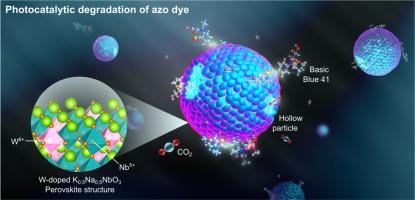
A key challenge in photocatalytic pollutant degradation lies in enhancing the efficiency of perovskite-based catalysts prepared under mild experimental conditions. The incorporation of tungsten (W) into nanostructured hollow particles of alkali niobates was studied as a strategy to improve photocatalytic activity. X-ray diffraction (XRD), transmission electron microscopy (TEM), energy-dispersive X-ray spectroscopy (EDS), N2 adsorption/desorption isotherms, Raman and UV–Vis spectroscopies confirmed the successful formation of W-doped K0.5Na0.5NbO3 hollow spherical particles with a monoclinic perovskite structure. Detailed analysis by Rietveld refinement revealed improved octahedral distortion induced by W doping. The photocatalytic activity was evaluated using the molecular density of adsorbed azo dye and the first-order apparent rate-constant, revealing that W-doped samples demonstrated significantly higher activity (3.31×10⁻² molecules·nm–2·min–1) compared to the host structure (1.05×10⁻² molecules·nm–2·min–1). Based on scavenger tests and mass spectroscopy analysis, a mechanism for the photocatalytic oxidation of the azo dye is proposed.
期刊介绍:
Materials Research Bulletin is an international journal reporting high-impact research on processing-structure-property relationships in functional materials and nanomaterials with interesting electronic, magnetic, optical, thermal, mechanical or catalytic properties. Papers purely on thermodynamics or theoretical calculations (e.g., density functional theory) do not fall within the scope of the journal unless they also demonstrate a clear link to physical properties. Topics covered include functional materials (e.g., dielectrics, pyroelectrics, piezoelectrics, ferroelectrics, relaxors, thermoelectrics, etc.); electrochemistry and solid-state ionics (e.g., photovoltaics, batteries, sensors, and fuel cells); nanomaterials, graphene, and nanocomposites; luminescence and photocatalysis; crystal-structure and defect-structure analysis; novel electronics; non-crystalline solids; flexible electronics; protein-material interactions; and polymeric ion-exchange membranes.




 京公网安备 11010802042870号
京ICP备2023020795号-1
京公网安备 11010802042870号
京ICP备2023020795号-1

 分享
分享
 求助内容:
求助内容: 应助结果提醒方式:
 扫码关注我们
