{"title":"本地苹果品种与西班牙市售苹果品种的价值鉴定:HPLC-MS/MS法测定的酚类化合物、细胞毒性及对一氧化氮自由基和脂氧合酶抑制的生物学潜力","authors":"Adrián Millán-Laleona , Pilar Cebollada , Giovanni Caprioli , Diletta Piatti , Filippo Maggi , Ana Pina , Carlota Gómez-Rincón , Víctor López","doi":"10.1016/j.jff.2024.106631","DOIUrl":null,"url":null,"abstract":"<div><div>Sustainability in the fruit industry and protection of local cultivars are nowadays important tasks for consumers and authorities. Phenolic compounds are interesting to explore because they play an important role in fruit-related health benefits. The phenolic profile of the regional and commercial Spanish apple cultivars was performed by high performance liquid chromatography-tandem mass spectrometry (HPLC-MS/MS). For a deeper understanding of their anti-inflammatory and antioxidant potential, the 5-lipoxigenase inhibition and NO<sup>−</sup> scavenging were evaluated. Moreover, cellular viability was determined to perform MTT assay in HepG2 and HeLa cell lines to discard cytotoxicity. The results showed that procyanidin B2 (PB2), 3-caffeoylquinic acid, epicatechin and 4-hydroxy benzoic acid were the most abundant phenolic compounds. Autochthonous apple cultivars showed better 5-LOX/NO<sup>−</sup> inhibition and nontoxic effects in the tested cell lines with an interesting profile of phenolic compounds. Local autochthonous apples can be considered a better source of bioactive compounds than the commercial samples.</div></div>","PeriodicalId":360,"journal":{"name":"Journal of Functional Foods","volume":"124 ","pages":"Article 106631"},"PeriodicalIF":4.0000,"publicationDate":"2025-01-01","publicationTypes":"Journal Article","fieldsOfStudy":null,"isOpenAccess":false,"openAccessPdf":"","citationCount":"0","resultStr":"{\"title\":\"Valorization of local regional apple (Malus domestica Borkh.) cultivars versus commercial samples from Spain: Phenolic compounds by HPLC-MS/MS, cytotoxicity and biological potential on nitric oxide radicals and lipoxygenase inhibition\",\"authors\":\"Adrián Millán-Laleona , Pilar Cebollada , Giovanni Caprioli , Diletta Piatti , Filippo Maggi , Ana Pina , Carlota Gómez-Rincón , Víctor López\",\"doi\":\"10.1016/j.jff.2024.106631\",\"DOIUrl\":null,\"url\":null,\"abstract\":\"<div><div>Sustainability in the fruit industry and protection of local cultivars are nowadays important tasks for consumers and authorities. Phenolic compounds are interesting to explore because they play an important role in fruit-related health benefits. The phenolic profile of the regional and commercial Spanish apple cultivars was performed by high performance liquid chromatography-tandem mass spectrometry (HPLC-MS/MS). For a deeper understanding of their anti-inflammatory and antioxidant potential, the 5-lipoxigenase inhibition and NO<sup>−</sup> scavenging were evaluated. Moreover, cellular viability was determined to perform MTT assay in HepG2 and HeLa cell lines to discard cytotoxicity. The results showed that procyanidin B2 (PB2), 3-caffeoylquinic acid, epicatechin and 4-hydroxy benzoic acid were the most abundant phenolic compounds. Autochthonous apple cultivars showed better 5-LOX/NO<sup>−</sup> inhibition and nontoxic effects in the tested cell lines with an interesting profile of phenolic compounds. Local autochthonous apples can be considered a better source of bioactive compounds than the commercial samples.</div></div>\",\"PeriodicalId\":360,\"journal\":{\"name\":\"Journal of Functional Foods\",\"volume\":\"124 \",\"pages\":\"Article 106631\"},\"PeriodicalIF\":4.0000,\"publicationDate\":\"2025-01-01\",\"publicationTypes\":\"Journal Article\",\"fieldsOfStudy\":null,\"isOpenAccess\":false,\"openAccessPdf\":\"\",\"citationCount\":\"0\",\"resultStr\":null,\"platform\":\"Semanticscholar\",\"paperid\":null,\"PeriodicalName\":\"Journal of Functional Foods\",\"FirstCategoryId\":\"97\",\"ListUrlMain\":\"https://www.sciencedirect.com/science/article/pii/S1756464624006340\",\"RegionNum\":2,\"RegionCategory\":\"农林科学\",\"ArticlePicture\":[],\"TitleCN\":null,\"AbstractTextCN\":null,\"PMCID\":null,\"EPubDate\":\"2024/12/18 0:00:00\",\"PubModel\":\"Epub\",\"JCR\":\"Q2\",\"JCRName\":\"FOOD SCIENCE & TECHNOLOGY\",\"Score\":null,\"Total\":0}","platform":"Semanticscholar","paperid":null,"PeriodicalName":"Journal of Functional Foods","FirstCategoryId":"97","ListUrlMain":"https://www.sciencedirect.com/science/article/pii/S1756464624006340","RegionNum":2,"RegionCategory":"农林科学","ArticlePicture":[],"TitleCN":null,"AbstractTextCN":null,"PMCID":null,"EPubDate":"2024/12/18 0:00:00","PubModel":"Epub","JCR":"Q2","JCRName":"FOOD SCIENCE & TECHNOLOGY","Score":null,"Total":0}
Valorization of local regional apple (Malus domestica Borkh.) cultivars versus commercial samples from Spain: Phenolic compounds by HPLC-MS/MS, cytotoxicity and biological potential on nitric oxide radicals and lipoxygenase inhibition
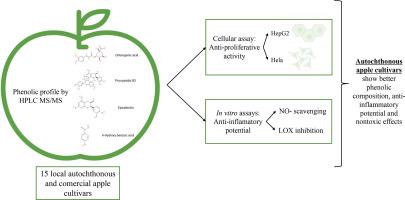
Sustainability in the fruit industry and protection of local cultivars are nowadays important tasks for consumers and authorities. Phenolic compounds are interesting to explore because they play an important role in fruit-related health benefits. The phenolic profile of the regional and commercial Spanish apple cultivars was performed by high performance liquid chromatography-tandem mass spectrometry (HPLC-MS/MS). For a deeper understanding of their anti-inflammatory and antioxidant potential, the 5-lipoxigenase inhibition and NO− scavenging were evaluated. Moreover, cellular viability was determined to perform MTT assay in HepG2 and HeLa cell lines to discard cytotoxicity. The results showed that procyanidin B2 (PB2), 3-caffeoylquinic acid, epicatechin and 4-hydroxy benzoic acid were the most abundant phenolic compounds. Autochthonous apple cultivars showed better 5-LOX/NO− inhibition and nontoxic effects in the tested cell lines with an interesting profile of phenolic compounds. Local autochthonous apples can be considered a better source of bioactive compounds than the commercial samples.
期刊介绍:
Journal of Functional Foods continues with the same aims and scope, editorial team, submission system and rigorous peer review. We give authors the possibility to publish their top-quality papers in a well-established leading journal in the food and nutrition fields. The Journal will keep its rigorous criteria to screen high impact research addressing relevant scientific topics and performed by sound methodologies.
The Journal of Functional Foods aims to bring together the results of fundamental and applied research into healthy foods and biologically active food ingredients.
The Journal is centered in the specific area at the boundaries among food technology, nutrition and health welcoming papers having a good interdisciplinary approach. The Journal will cover the fields of plant bioactives; dietary fibre, probiotics; functional lipids; bioactive peptides; vitamins, minerals and botanicals and other dietary supplements. Nutritional and technological aspects related to the development of functional foods and beverages are of core interest to the journal. Experimental works dealing with food digestion, bioavailability of food bioactives and on the mechanisms by which foods and their components are able to modulate physiological parameters connected with disease prevention are of particular interest as well as those dealing with personalized nutrition and nutritional needs in pathological subjects.




 京公网安备 11010802042870号
京ICP备2023020795号-1
京公网安备 11010802042870号
京ICP备2023020795号-1

 分享
分享
 求助内容:
求助内容: 应助结果提醒方式:
 扫码关注我们
