Jiahao Ying , Shijie Li , Anna Ying , Yindong Ding , Xiaoyin Zhu , Jiahao Lin , Kehe Yu
{"title":"芹菜素通过SIRT1/mTOR途径介导的线粒体自噬抑制骨关节炎的热凋亡,从而抑制骨关节炎的进展","authors":"Jiahao Ying , Shijie Li , Anna Ying , Yindong Ding , Xiaoyin Zhu , Jiahao Lin , Kehe Yu","doi":"10.1016/j.jff.2024.106623","DOIUrl":null,"url":null,"abstract":"<div><div>Exploring the therapeutic effects and underlying mechanisms of Apigenin (Api) in managing osteoarthritis (OA) was the primary focus of this research. In this research, X-ray and Safranin-O staining were employed to evaluate the imageology and histomorphology differences in the knee joints of mice in vivo. Techniques such as Western blot analysis, Enzyme-linked Immunosorbent Assay (ELISA), and immunofluorescence staining were applied to examine protein level changes in vitro experiments. In vitro assays indicated that Api significantly reduces the levels of pro-inflammatory mediators and prevents the degradation of the ECM. By promoting SIRT1/mTOR pathway-mediated mitophagy, Api shields chondrocytes from pyroptosis. Further, animal studies demonstrated that Api effectively alleviates the progression of OA by enhancing mitophagy, inhibiting chondrocyte pyroptosis and ECM degradation. Consequently, Api is recognized as an effective and promising therapeutic candidate for the management and treatment of OA.</div></div>","PeriodicalId":360,"journal":{"name":"Journal of Functional Foods","volume":"124 ","pages":"Article 106623"},"PeriodicalIF":4.0000,"publicationDate":"2025-01-01","publicationTypes":"Journal Article","fieldsOfStudy":null,"isOpenAccess":false,"openAccessPdf":"","citationCount":"0","resultStr":"{\"title\":\"Apigenin suppresses osteoarthritis progression by inhibiting pyroptosis via SIRT1/mTOR pathway-mediated mitophagy\",\"authors\":\"Jiahao Ying , Shijie Li , Anna Ying , Yindong Ding , Xiaoyin Zhu , Jiahao Lin , Kehe Yu\",\"doi\":\"10.1016/j.jff.2024.106623\",\"DOIUrl\":null,\"url\":null,\"abstract\":\"<div><div>Exploring the therapeutic effects and underlying mechanisms of Apigenin (Api) in managing osteoarthritis (OA) was the primary focus of this research. In this research, X-ray and Safranin-O staining were employed to evaluate the imageology and histomorphology differences in the knee joints of mice in vivo. Techniques such as Western blot analysis, Enzyme-linked Immunosorbent Assay (ELISA), and immunofluorescence staining were applied to examine protein level changes in vitro experiments. In vitro assays indicated that Api significantly reduces the levels of pro-inflammatory mediators and prevents the degradation of the ECM. By promoting SIRT1/mTOR pathway-mediated mitophagy, Api shields chondrocytes from pyroptosis. Further, animal studies demonstrated that Api effectively alleviates the progression of OA by enhancing mitophagy, inhibiting chondrocyte pyroptosis and ECM degradation. Consequently, Api is recognized as an effective and promising therapeutic candidate for the management and treatment of OA.</div></div>\",\"PeriodicalId\":360,\"journal\":{\"name\":\"Journal of Functional Foods\",\"volume\":\"124 \",\"pages\":\"Article 106623\"},\"PeriodicalIF\":4.0000,\"publicationDate\":\"2025-01-01\",\"publicationTypes\":\"Journal Article\",\"fieldsOfStudy\":null,\"isOpenAccess\":false,\"openAccessPdf\":\"\",\"citationCount\":\"0\",\"resultStr\":null,\"platform\":\"Semanticscholar\",\"paperid\":null,\"PeriodicalName\":\"Journal of Functional Foods\",\"FirstCategoryId\":\"97\",\"ListUrlMain\":\"https://www.sciencedirect.com/science/article/pii/S1756464624006261\",\"RegionNum\":2,\"RegionCategory\":\"农林科学\",\"ArticlePicture\":[],\"TitleCN\":null,\"AbstractTextCN\":null,\"PMCID\":null,\"EPubDate\":\"2024/12/20 0:00:00\",\"PubModel\":\"Epub\",\"JCR\":\"Q2\",\"JCRName\":\"FOOD SCIENCE & TECHNOLOGY\",\"Score\":null,\"Total\":0}","platform":"Semanticscholar","paperid":null,"PeriodicalName":"Journal of Functional Foods","FirstCategoryId":"97","ListUrlMain":"https://www.sciencedirect.com/science/article/pii/S1756464624006261","RegionNum":2,"RegionCategory":"农林科学","ArticlePicture":[],"TitleCN":null,"AbstractTextCN":null,"PMCID":null,"EPubDate":"2024/12/20 0:00:00","PubModel":"Epub","JCR":"Q2","JCRName":"FOOD SCIENCE & TECHNOLOGY","Score":null,"Total":0}
Apigenin suppresses osteoarthritis progression by inhibiting pyroptosis via SIRT1/mTOR pathway-mediated mitophagy
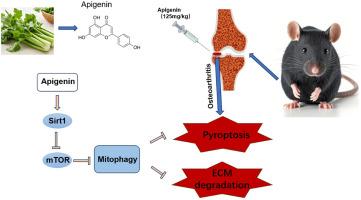
Exploring the therapeutic effects and underlying mechanisms of Apigenin (Api) in managing osteoarthritis (OA) was the primary focus of this research. In this research, X-ray and Safranin-O staining were employed to evaluate the imageology and histomorphology differences in the knee joints of mice in vivo. Techniques such as Western blot analysis, Enzyme-linked Immunosorbent Assay (ELISA), and immunofluorescence staining were applied to examine protein level changes in vitro experiments. In vitro assays indicated that Api significantly reduces the levels of pro-inflammatory mediators and prevents the degradation of the ECM. By promoting SIRT1/mTOR pathway-mediated mitophagy, Api shields chondrocytes from pyroptosis. Further, animal studies demonstrated that Api effectively alleviates the progression of OA by enhancing mitophagy, inhibiting chondrocyte pyroptosis and ECM degradation. Consequently, Api is recognized as an effective and promising therapeutic candidate for the management and treatment of OA.
期刊介绍:
Journal of Functional Foods continues with the same aims and scope, editorial team, submission system and rigorous peer review. We give authors the possibility to publish their top-quality papers in a well-established leading journal in the food and nutrition fields. The Journal will keep its rigorous criteria to screen high impact research addressing relevant scientific topics and performed by sound methodologies.
The Journal of Functional Foods aims to bring together the results of fundamental and applied research into healthy foods and biologically active food ingredients.
The Journal is centered in the specific area at the boundaries among food technology, nutrition and health welcoming papers having a good interdisciplinary approach. The Journal will cover the fields of plant bioactives; dietary fibre, probiotics; functional lipids; bioactive peptides; vitamins, minerals and botanicals and other dietary supplements. Nutritional and technological aspects related to the development of functional foods and beverages are of core interest to the journal. Experimental works dealing with food digestion, bioavailability of food bioactives and on the mechanisms by which foods and their components are able to modulate physiological parameters connected with disease prevention are of particular interest as well as those dealing with personalized nutrition and nutritional needs in pathological subjects.




 京公网安备 11010802042870号
京ICP备2023020795号-1
京公网安备 11010802042870号
京ICP备2023020795号-1

 分享
分享
 求助内容:
求助内容: 应助结果提醒方式:
 扫码关注我们
