{"title":"婴儿粪便源性肠球菌抑制产肠毒素大肠杆菌的抑菌潜力及其机制","authors":"Xi Lu , Wei Sang , Lei Pan","doi":"10.1016/j.jff.2025.106659","DOIUrl":null,"url":null,"abstract":"<div><div>Enterotoxigenic <em>Escherichia coli</em> (ETEC) is a leading cause of diarrhea in infants and travelers. However, antibiotic treatment is challenged by growing resistance. This study investigated the potential of <em>Enterococcus faecalis</em>, an early colonizer of the infant gut, as a probiotic to combat ETEC. From 125 healthy infant feces, 54 <em>E. faecalis</em> strains were isolated and evaluated for safety and function. <em>E. faecalis</em> LX25 and LX39 showed significant inhibition of ETEC growth, virulence gene (<em>eltA</em> and <em>stA</em>) expression (<em>P</em> < 0.05) and disrupted biofilm formation. Notably, LX39's cell-free supernatant (CFS) increased reactive oxygen species in ETEC, leading to cellular damage. HPLC revealed the three most concentrated organic acids, lactic (10.31 mg/mL), acetic (1.72 mg/mL) and citric acids (1.58 mg/mL) in LX39's CFS, which exceeding or approaching the MIC for ETEC. These findings indicate that <em>E. faecalis</em> LX39 could serve as effective probiotics candidates to inhibit ETEC, highlighting their potential in managing intestinal pathogen infection.</div></div>","PeriodicalId":360,"journal":{"name":"Journal of Functional Foods","volume":"124 ","pages":"Article 106659"},"PeriodicalIF":4.0000,"publicationDate":"2025-01-01","publicationTypes":"Journal Article","fieldsOfStudy":null,"isOpenAccess":false,"openAccessPdf":"","citationCount":"0","resultStr":"{\"title\":\"Antimicrobial potential and mechanism of infant feces-derived Enterococcus faecalis in inhibiting Enterotoxigenic Escherichia coli\",\"authors\":\"Xi Lu , Wei Sang , Lei Pan\",\"doi\":\"10.1016/j.jff.2025.106659\",\"DOIUrl\":null,\"url\":null,\"abstract\":\"<div><div>Enterotoxigenic <em>Escherichia coli</em> (ETEC) is a leading cause of diarrhea in infants and travelers. However, antibiotic treatment is challenged by growing resistance. This study investigated the potential of <em>Enterococcus faecalis</em>, an early colonizer of the infant gut, as a probiotic to combat ETEC. From 125 healthy infant feces, 54 <em>E. faecalis</em> strains were isolated and evaluated for safety and function. <em>E. faecalis</em> LX25 and LX39 showed significant inhibition of ETEC growth, virulence gene (<em>eltA</em> and <em>stA</em>) expression (<em>P</em> < 0.05) and disrupted biofilm formation. Notably, LX39's cell-free supernatant (CFS) increased reactive oxygen species in ETEC, leading to cellular damage. HPLC revealed the three most concentrated organic acids, lactic (10.31 mg/mL), acetic (1.72 mg/mL) and citric acids (1.58 mg/mL) in LX39's CFS, which exceeding or approaching the MIC for ETEC. These findings indicate that <em>E. faecalis</em> LX39 could serve as effective probiotics candidates to inhibit ETEC, highlighting their potential in managing intestinal pathogen infection.</div></div>\",\"PeriodicalId\":360,\"journal\":{\"name\":\"Journal of Functional Foods\",\"volume\":\"124 \",\"pages\":\"Article 106659\"},\"PeriodicalIF\":4.0000,\"publicationDate\":\"2025-01-01\",\"publicationTypes\":\"Journal Article\",\"fieldsOfStudy\":null,\"isOpenAccess\":false,\"openAccessPdf\":\"\",\"citationCount\":\"0\",\"resultStr\":null,\"platform\":\"Semanticscholar\",\"paperid\":null,\"PeriodicalName\":\"Journal of Functional Foods\",\"FirstCategoryId\":\"97\",\"ListUrlMain\":\"https://www.sciencedirect.com/science/article/pii/S1756464625000015\",\"RegionNum\":2,\"RegionCategory\":\"农林科学\",\"ArticlePicture\":[],\"TitleCN\":null,\"AbstractTextCN\":null,\"PMCID\":null,\"EPubDate\":\"2025/1/7 0:00:00\",\"PubModel\":\"Epub\",\"JCR\":\"Q2\",\"JCRName\":\"FOOD SCIENCE & TECHNOLOGY\",\"Score\":null,\"Total\":0}","platform":"Semanticscholar","paperid":null,"PeriodicalName":"Journal of Functional Foods","FirstCategoryId":"97","ListUrlMain":"https://www.sciencedirect.com/science/article/pii/S1756464625000015","RegionNum":2,"RegionCategory":"农林科学","ArticlePicture":[],"TitleCN":null,"AbstractTextCN":null,"PMCID":null,"EPubDate":"2025/1/7 0:00:00","PubModel":"Epub","JCR":"Q2","JCRName":"FOOD SCIENCE & TECHNOLOGY","Score":null,"Total":0}
Antimicrobial potential and mechanism of infant feces-derived Enterococcus faecalis in inhibiting Enterotoxigenic Escherichia coli
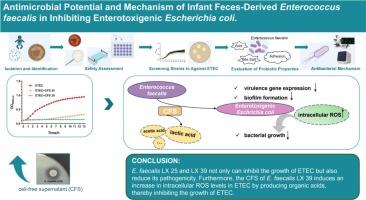
Enterotoxigenic Escherichia coli (ETEC) is a leading cause of diarrhea in infants and travelers. However, antibiotic treatment is challenged by growing resistance. This study investigated the potential of Enterococcus faecalis, an early colonizer of the infant gut, as a probiotic to combat ETEC. From 125 healthy infant feces, 54 E. faecalis strains were isolated and evaluated for safety and function. E. faecalis LX25 and LX39 showed significant inhibition of ETEC growth, virulence gene (eltA and stA) expression (P < 0.05) and disrupted biofilm formation. Notably, LX39's cell-free supernatant (CFS) increased reactive oxygen species in ETEC, leading to cellular damage. HPLC revealed the three most concentrated organic acids, lactic (10.31 mg/mL), acetic (1.72 mg/mL) and citric acids (1.58 mg/mL) in LX39's CFS, which exceeding or approaching the MIC for ETEC. These findings indicate that E. faecalis LX39 could serve as effective probiotics candidates to inhibit ETEC, highlighting their potential in managing intestinal pathogen infection.
期刊介绍:
Journal of Functional Foods continues with the same aims and scope, editorial team, submission system and rigorous peer review. We give authors the possibility to publish their top-quality papers in a well-established leading journal in the food and nutrition fields. The Journal will keep its rigorous criteria to screen high impact research addressing relevant scientific topics and performed by sound methodologies.
The Journal of Functional Foods aims to bring together the results of fundamental and applied research into healthy foods and biologically active food ingredients.
The Journal is centered in the specific area at the boundaries among food technology, nutrition and health welcoming papers having a good interdisciplinary approach. The Journal will cover the fields of plant bioactives; dietary fibre, probiotics; functional lipids; bioactive peptides; vitamins, minerals and botanicals and other dietary supplements. Nutritional and technological aspects related to the development of functional foods and beverages are of core interest to the journal. Experimental works dealing with food digestion, bioavailability of food bioactives and on the mechanisms by which foods and their components are able to modulate physiological parameters connected with disease prevention are of particular interest as well as those dealing with personalized nutrition and nutritional needs in pathological subjects.




 京公网安备 11010802042870号
京ICP备2023020795号-1
京公网安备 11010802042870号
京ICP备2023020795号-1

 分享
分享
 求助内容:
求助内容: 应助结果提醒方式:
 扫码关注我们
