{"title":"一种创新的太阳能蒸馏器设计与辐射冷却相结合,用于可持续的、被动的、全天的淡水收集:一项综合研究","authors":"H. Aghakhani, M. Saffar-Avval, M.R Hajmohammadi","doi":"10.1016/j.seta.2024.104130","DOIUrl":null,"url":null,"abstract":"<div><div>This study investigates the application of radiative cooling, a cutting-edge approach gaining significant attention, to enhance condensation efficiency in solar stills, addressing the limitations of these eco-friendly devices. Two designs were explored: one with an opaque, radiative cooling-coated metal chamber adjacent to the glass, and another replacing the glass with a transparent radiative cooling plate. Using a novel two-dimensional numerical and CFD method, validated by experimental results and relying solely on radiation and temperature as environmental parameters, the study evaluates these designs’ effectiveness. Additionally, the impact of single- and double-layer windshields at night was assessed, along with Atmospheric Water Harvesting using the transparent radiative cooling design. This design showed a 23.5% increase in water production and a 24.2% improvement in energy efficiency. For the chamber-based design, various geometries were analyzed using dimensionless numbers to optimize performance, yielding a 12.5% increase in production and a 2.7% rise in energy efficiency. Integrating a Parabolic Trough Collector to preheat water at the basin of the solar still amplified these gains, leading to 260.4% production and 65.3% efficiency improvements. These findings demonstrate that radiative cooling can significantly enhance sustainable solar desalination efficiency without additional energy input, offering promising potential for future research.</div></div>","PeriodicalId":56019,"journal":{"name":"Sustainable Energy Technologies and Assessments","volume":"73 ","pages":"Article 104130"},"PeriodicalIF":7.0000,"publicationDate":"2025-01-01","publicationTypes":"Journal Article","fieldsOfStudy":null,"isOpenAccess":false,"openAccessPdf":"","citationCount":"0","resultStr":"{\"title\":\"An innovative solar still design integrated with radiative cooling for sustainable, passive, all-day freshwater harvesting: A comprehensive study\",\"authors\":\"H. Aghakhani, M. Saffar-Avval, M.R Hajmohammadi\",\"doi\":\"10.1016/j.seta.2024.104130\",\"DOIUrl\":null,\"url\":null,\"abstract\":\"<div><div>This study investigates the application of radiative cooling, a cutting-edge approach gaining significant attention, to enhance condensation efficiency in solar stills, addressing the limitations of these eco-friendly devices. Two designs were explored: one with an opaque, radiative cooling-coated metal chamber adjacent to the glass, and another replacing the glass with a transparent radiative cooling plate. Using a novel two-dimensional numerical and CFD method, validated by experimental results and relying solely on radiation and temperature as environmental parameters, the study evaluates these designs’ effectiveness. Additionally, the impact of single- and double-layer windshields at night was assessed, along with Atmospheric Water Harvesting using the transparent radiative cooling design. This design showed a 23.5% increase in water production and a 24.2% improvement in energy efficiency. For the chamber-based design, various geometries were analyzed using dimensionless numbers to optimize performance, yielding a 12.5% increase in production and a 2.7% rise in energy efficiency. Integrating a Parabolic Trough Collector to preheat water at the basin of the solar still amplified these gains, leading to 260.4% production and 65.3% efficiency improvements. These findings demonstrate that radiative cooling can significantly enhance sustainable solar desalination efficiency without additional energy input, offering promising potential for future research.</div></div>\",\"PeriodicalId\":56019,\"journal\":{\"name\":\"Sustainable Energy Technologies and Assessments\",\"volume\":\"73 \",\"pages\":\"Article 104130\"},\"PeriodicalIF\":7.0000,\"publicationDate\":\"2025-01-01\",\"publicationTypes\":\"Journal Article\",\"fieldsOfStudy\":null,\"isOpenAccess\":false,\"openAccessPdf\":\"\",\"citationCount\":\"0\",\"resultStr\":null,\"platform\":\"Semanticscholar\",\"paperid\":null,\"PeriodicalName\":\"Sustainable Energy Technologies and Assessments\",\"FirstCategoryId\":\"5\",\"ListUrlMain\":\"https://www.sciencedirect.com/science/article/pii/S2213138824005265\",\"RegionNum\":2,\"RegionCategory\":\"工程技术\",\"ArticlePicture\":[],\"TitleCN\":null,\"AbstractTextCN\":null,\"PMCID\":null,\"EPubDate\":\"2024/12/18 0:00:00\",\"PubModel\":\"Epub\",\"JCR\":\"Q1\",\"JCRName\":\"ENERGY & FUELS\",\"Score\":null,\"Total\":0}","platform":"Semanticscholar","paperid":null,"PeriodicalName":"Sustainable Energy Technologies and Assessments","FirstCategoryId":"5","ListUrlMain":"https://www.sciencedirect.com/science/article/pii/S2213138824005265","RegionNum":2,"RegionCategory":"工程技术","ArticlePicture":[],"TitleCN":null,"AbstractTextCN":null,"PMCID":null,"EPubDate":"2024/12/18 0:00:00","PubModel":"Epub","JCR":"Q1","JCRName":"ENERGY & FUELS","Score":null,"Total":0}
An innovative solar still design integrated with radiative cooling for sustainable, passive, all-day freshwater harvesting: A comprehensive study
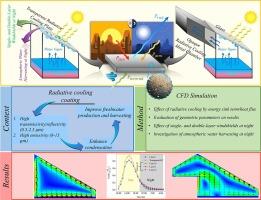
This study investigates the application of radiative cooling, a cutting-edge approach gaining significant attention, to enhance condensation efficiency in solar stills, addressing the limitations of these eco-friendly devices. Two designs were explored: one with an opaque, radiative cooling-coated metal chamber adjacent to the glass, and another replacing the glass with a transparent radiative cooling plate. Using a novel two-dimensional numerical and CFD method, validated by experimental results and relying solely on radiation and temperature as environmental parameters, the study evaluates these designs’ effectiveness. Additionally, the impact of single- and double-layer windshields at night was assessed, along with Atmospheric Water Harvesting using the transparent radiative cooling design. This design showed a 23.5% increase in water production and a 24.2% improvement in energy efficiency. For the chamber-based design, various geometries were analyzed using dimensionless numbers to optimize performance, yielding a 12.5% increase in production and a 2.7% rise in energy efficiency. Integrating a Parabolic Trough Collector to preheat water at the basin of the solar still amplified these gains, leading to 260.4% production and 65.3% efficiency improvements. These findings demonstrate that radiative cooling can significantly enhance sustainable solar desalination efficiency without additional energy input, offering promising potential for future research.
期刊介绍:
Encouraging a transition to a sustainable energy future is imperative for our world. Technologies that enable this shift in various sectors like transportation, heating, and power systems are of utmost importance. Sustainable Energy Technologies and Assessments welcomes papers focusing on a range of aspects and levels of technological advancements in energy generation and utilization. The aim is to reduce the negative environmental impact associated with energy production and consumption, spanning from laboratory experiments to real-world applications in the commercial sector.




 京公网安备 11010802042870号
京ICP备2023020795号-1
京公网安备 11010802042870号
京ICP备2023020795号-1

 分享
分享
 求助内容:
求助内容: 应助结果提醒方式:
 扫码关注我们
