Syed Sagaff Sharifah Aliya , Syd Ali Nusaibah , Murnita Mohmad Mahyudin , Mohd Rafii Yusop
{"title":"致病性、酶测定和差异代谢组学评估马来西亚橡胶树复杂圆叶斑病(CCLS)的真菌病原体的毒力","authors":"Syed Sagaff Sharifah Aliya , Syd Ali Nusaibah , Murnita Mohmad Mahyudin , Mohd Rafii Yusop","doi":"10.1016/j.pmpp.2025.102582","DOIUrl":null,"url":null,"abstract":"<div><div>The rubber tree (<em>Hevea brasiliensis</em> Muell. Arg.) is susceptible to an array of foliar diseases. A severe epidemic characterised by circular leaf spot symptoms on rubber leaves has recently infested rubber plantations in various rubber-producing countries, resulting in secondary leaf fall and a considerable production drop. This new disease is known as complex circular leaf spot disease (CCLS). The purpose of this study was to identify the causative pathogen(s) of CCLS disease using an in vivo pathogenicity test. Other than that, assessment of metabolites and leaf-degrading enzymes excreted by the causal pathogen(s) were carried out. The pathogenicity test was conducted using three-month-old rubber seedlings of clone PB 350. Microbe metabolite extraction was carried out on the potential isolated fungal pathogens, and the samples were subjected to gas chromatography-mass spectrometry (GC-MS) analysis. Four enzyme assays were also conducted: polygalacturonase (E.C. 3.2.1.15), pectin lyase (E.C. 4.2.2.10), endoglucanase (E.C. 3.2.1.4), and β-glucosidase (E.C. 3.2.1.21). Results from the pathogenicity test demonstrated that both fungi were able to initiate CCLS infections. Leaf inoculated with a spore suspension of <em>Colletotrichum siamense</em> produced the biggest mean lesion length, and the lesion resembled the symptoms of the disease in rubber plantations. Based on observations through a scanning electron microscope, the spores of <em>C. siamense</em> dominate the surface of the leaf lesions. Results from GC-MS analysis showed that microbial volatile organic compounds emitted by <em>C. siamense</em> have higher concentrations than those emitted by <em>Pestalotiopsis jesteri</em>. A total of 24 metabolites were detected in <em>C. siamense</em> and six metabolites in <em>P. jesteri</em>. In addition, <em>C. siamense</em> were also recorded to produce higher concentration of leaf degrading enzymes compared to <em>P. jesteri</em> in the enzyme assays conducted.</div></div>","PeriodicalId":20046,"journal":{"name":"Physiological and Molecular Plant Pathology","volume":"136 ","pages":"Article 102582"},"PeriodicalIF":3.6000,"publicationDate":"2025-03-01","publicationTypes":"Journal Article","fieldsOfStudy":null,"isOpenAccess":false,"openAccessPdf":"","citationCount":"0","resultStr":"{\"title\":\"Pathogenicity, enzymatic assays, and differential metabolomics to assess the virulence of fungal pathogens responsible for complex circular leaf spot (CCLS) disease of rubber trees in Malaysia\",\"authors\":\"Syed Sagaff Sharifah Aliya , Syd Ali Nusaibah , Murnita Mohmad Mahyudin , Mohd Rafii Yusop\",\"doi\":\"10.1016/j.pmpp.2025.102582\",\"DOIUrl\":null,\"url\":null,\"abstract\":\"<div><div>The rubber tree (<em>Hevea brasiliensis</em> Muell. Arg.) is susceptible to an array of foliar diseases. A severe epidemic characterised by circular leaf spot symptoms on rubber leaves has recently infested rubber plantations in various rubber-producing countries, resulting in secondary leaf fall and a considerable production drop. This new disease is known as complex circular leaf spot disease (CCLS). The purpose of this study was to identify the causative pathogen(s) of CCLS disease using an in vivo pathogenicity test. Other than that, assessment of metabolites and leaf-degrading enzymes excreted by the causal pathogen(s) were carried out. The pathogenicity test was conducted using three-month-old rubber seedlings of clone PB 350. Microbe metabolite extraction was carried out on the potential isolated fungal pathogens, and the samples were subjected to gas chromatography-mass spectrometry (GC-MS) analysis. Four enzyme assays were also conducted: polygalacturonase (E.C. 3.2.1.15), pectin lyase (E.C. 4.2.2.10), endoglucanase (E.C. 3.2.1.4), and β-glucosidase (E.C. 3.2.1.21). Results from the pathogenicity test demonstrated that both fungi were able to initiate CCLS infections. Leaf inoculated with a spore suspension of <em>Colletotrichum siamense</em> produced the biggest mean lesion length, and the lesion resembled the symptoms of the disease in rubber plantations. Based on observations through a scanning electron microscope, the spores of <em>C. siamense</em> dominate the surface of the leaf lesions. Results from GC-MS analysis showed that microbial volatile organic compounds emitted by <em>C. siamense</em> have higher concentrations than those emitted by <em>Pestalotiopsis jesteri</em>. A total of 24 metabolites were detected in <em>C. siamense</em> and six metabolites in <em>P. jesteri</em>. In addition, <em>C. siamense</em> were also recorded to produce higher concentration of leaf degrading enzymes compared to <em>P. jesteri</em> in the enzyme assays conducted.</div></div>\",\"PeriodicalId\":20046,\"journal\":{\"name\":\"Physiological and Molecular Plant Pathology\",\"volume\":\"136 \",\"pages\":\"Article 102582\"},\"PeriodicalIF\":3.6000,\"publicationDate\":\"2025-03-01\",\"publicationTypes\":\"Journal Article\",\"fieldsOfStudy\":null,\"isOpenAccess\":false,\"openAccessPdf\":\"\",\"citationCount\":\"0\",\"resultStr\":null,\"platform\":\"Semanticscholar\",\"paperid\":null,\"PeriodicalName\":\"Physiological and Molecular Plant Pathology\",\"FirstCategoryId\":\"97\",\"ListUrlMain\":\"https://www.sciencedirect.com/science/article/pii/S0885576525000219\",\"RegionNum\":3,\"RegionCategory\":\"农林科学\",\"ArticlePicture\":[],\"TitleCN\":null,\"AbstractTextCN\":null,\"PMCID\":null,\"EPubDate\":\"2025/1/16 0:00:00\",\"PubModel\":\"Epub\",\"JCR\":\"Q2\",\"JCRName\":\"PLANT SCIENCES\",\"Score\":null,\"Total\":0}","platform":"Semanticscholar","paperid":null,"PeriodicalName":"Physiological and Molecular Plant Pathology","FirstCategoryId":"97","ListUrlMain":"https://www.sciencedirect.com/science/article/pii/S0885576525000219","RegionNum":3,"RegionCategory":"农林科学","ArticlePicture":[],"TitleCN":null,"AbstractTextCN":null,"PMCID":null,"EPubDate":"2025/1/16 0:00:00","PubModel":"Epub","JCR":"Q2","JCRName":"PLANT SCIENCES","Score":null,"Total":0}
Pathogenicity, enzymatic assays, and differential metabolomics to assess the virulence of fungal pathogens responsible for complex circular leaf spot (CCLS) disease of rubber trees in Malaysia
The rubber tree (Hevea brasiliensis Muell. Arg.) is susceptible to an array of foliar diseases. A severe epidemic characterised by circular leaf spot symptoms on rubber leaves has recently infested rubber plantations in various rubber-producing countries, resulting in secondary leaf fall and a considerable production drop. This new disease is known as complex circular leaf spot disease (CCLS). The purpose of this study was to identify the causative pathogen(s) of CCLS disease using an in vivo pathogenicity test. Other than that, assessment of metabolites and leaf-degrading enzymes excreted by the causal pathogen(s) were carried out. The pathogenicity test was conducted using three-month-old rubber seedlings of clone PB 350. Microbe metabolite extraction was carried out on the potential isolated fungal pathogens, and the samples were subjected to gas chromatography-mass spectrometry (GC-MS) analysis. Four enzyme assays were also conducted: polygalacturonase (E.C. 3.2.1.15), pectin lyase (E.C. 4.2.2.10), endoglucanase (E.C. 3.2.1.4), and β-glucosidase (E.C. 3.2.1.21). Results from the pathogenicity test demonstrated that both fungi were able to initiate CCLS infections. Leaf inoculated with a spore suspension of Colletotrichum siamense produced the biggest mean lesion length, and the lesion resembled the symptoms of the disease in rubber plantations. Based on observations through a scanning electron microscope, the spores of C. siamense dominate the surface of the leaf lesions. Results from GC-MS analysis showed that microbial volatile organic compounds emitted by C. siamense have higher concentrations than those emitted by Pestalotiopsis jesteri. A total of 24 metabolites were detected in C. siamense and six metabolites in P. jesteri. In addition, C. siamense were also recorded to produce higher concentration of leaf degrading enzymes compared to P. jesteri in the enzyme assays conducted.
期刊介绍:
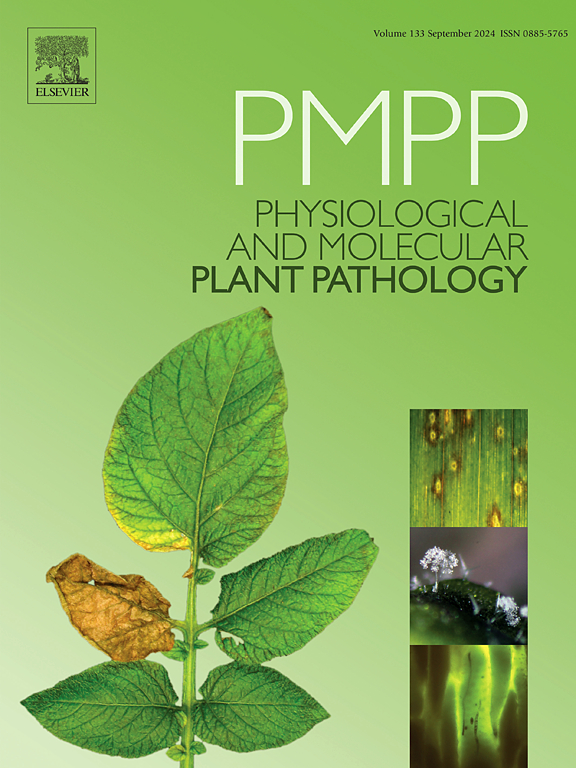
Physiological and Molecular Plant Pathology provides an International forum for original research papers, reviews, and commentaries on all aspects of the molecular biology, biochemistry, physiology, histology and cytology, genetics and evolution of plant-microbe interactions.
Papers on all kinds of infective pathogen, including viruses, prokaryotes, fungi, and nematodes, as well as mutualistic organisms such as Rhizobium and mycorrhyzal fungi, are acceptable as long as they have a bearing on the interaction between pathogen and plant.




 京公网安备 11010802042870号
京ICP备2023020795号-1
京公网安备 11010802042870号
京ICP备2023020795号-1

 分享
分享
 求助内容:
求助内容: 应助结果提醒方式:
 扫码关注我们
