Jin Gao , Md Mijanur Rahman Rajib , Kuai Dai , Kuikui Li , Yonghe Cui , Wenxia Wang , Jiangzhou Li , Heng Yin
{"title":"魔芋葡甘露聚糖低聚糖介导烟草对镰刀菌抗性调控机制的比较转录组学分析","authors":"Jin Gao , Md Mijanur Rahman Rajib , Kuai Dai , Kuikui Li , Yonghe Cui , Wenxia Wang , Jiangzhou Li , Heng Yin","doi":"10.1016/j.pmpp.2025.102585","DOIUrl":null,"url":null,"abstract":"<div><div>Oligosaccharides derived from storage polysaccharides have shown considerable potential in boosting innate immunity. In this study, konjac glucomannan oligosaccharides (KGMOS) with degree of polymerization 2–13 obtained by enzymatic hydrolysis of storage konjac glucomannans (KGM), was employed against the harmful pathogen <em>Fusarium foetens</em> in <em>Nicotiana benthamiana</em>. The application of KGMOS at concentrations ranging from 0.025 to 0.1 mg mL<sup>−1</sup> significantly inhibited the pathogen, reduced disease severity, and markedly increased the levels of H<sub>2</sub>O<sub>2</sub> and callose. Comparative transcriptomic analysis revealed that distinct DEGs in KGMOS-treated plants were involved in MAPK signaling, plant hormone signal transduction, and plant-pathogen interaction pathways. Notably, defense-related genes associated with salicylic acid (SA) and jasmonic acid/ethylene (JA/ET) pathways were upregulated. Analysis indicates that the levels of transcripts encoding <em>PR1</em>, <em>PR2</em>, <em>PR5</em> and <em>NPR1</em> were increased in plants treated with KGMOS. Meanwhile, transcription factors, enzymes, receptors and co-receptors associated with defense responses were also upregulated in KGMOS treatment. RT-qPCR further confirmed the significant upregulation of SA and JA/ET pathway genes in KGMOS-treated plants. Increased SA content (2.37-fold) in these plants suggests improved disease resistance. The study concludes that KGMOS effectively enhances resistance against <em>F</em>. <em>foetens</em>, with high efficiency at 0.025 mg mL<sup>−1</sup>, the lowest concentration assayed. These findings provided valuable insights into the potential application of KGMOS for disease management in sustainable agriculture and postharvest scenarios.</div></div>","PeriodicalId":20046,"journal":{"name":"Physiological and Molecular Plant Pathology","volume":"136 ","pages":"Article 102585"},"PeriodicalIF":3.6000,"publicationDate":"2025-03-01","publicationTypes":"Journal Article","fieldsOfStudy":null,"isOpenAccess":false,"openAccessPdf":"","citationCount":"0","resultStr":"{\"title\":\"Comparative transcriptomic analysis of the regulatory mechanisms underlying the resistance to Fusarium foetens mediated by konjac glucomannan oligosaccharides in tobacco\",\"authors\":\"Jin Gao , Md Mijanur Rahman Rajib , Kuai Dai , Kuikui Li , Yonghe Cui , Wenxia Wang , Jiangzhou Li , Heng Yin\",\"doi\":\"10.1016/j.pmpp.2025.102585\",\"DOIUrl\":null,\"url\":null,\"abstract\":\"<div><div>Oligosaccharides derived from storage polysaccharides have shown considerable potential in boosting innate immunity. In this study, konjac glucomannan oligosaccharides (KGMOS) with degree of polymerization 2–13 obtained by enzymatic hydrolysis of storage konjac glucomannans (KGM), was employed against the harmful pathogen <em>Fusarium foetens</em> in <em>Nicotiana benthamiana</em>. The application of KGMOS at concentrations ranging from 0.025 to 0.1 mg mL<sup>−1</sup> significantly inhibited the pathogen, reduced disease severity, and markedly increased the levels of H<sub>2</sub>O<sub>2</sub> and callose. Comparative transcriptomic analysis revealed that distinct DEGs in KGMOS-treated plants were involved in MAPK signaling, plant hormone signal transduction, and plant-pathogen interaction pathways. Notably, defense-related genes associated with salicylic acid (SA) and jasmonic acid/ethylene (JA/ET) pathways were upregulated. Analysis indicates that the levels of transcripts encoding <em>PR1</em>, <em>PR2</em>, <em>PR5</em> and <em>NPR1</em> were increased in plants treated with KGMOS. Meanwhile, transcription factors, enzymes, receptors and co-receptors associated with defense responses were also upregulated in KGMOS treatment. RT-qPCR further confirmed the significant upregulation of SA and JA/ET pathway genes in KGMOS-treated plants. Increased SA content (2.37-fold) in these plants suggests improved disease resistance. The study concludes that KGMOS effectively enhances resistance against <em>F</em>. <em>foetens</em>, with high efficiency at 0.025 mg mL<sup>−1</sup>, the lowest concentration assayed. These findings provided valuable insights into the potential application of KGMOS for disease management in sustainable agriculture and postharvest scenarios.</div></div>\",\"PeriodicalId\":20046,\"journal\":{\"name\":\"Physiological and Molecular Plant Pathology\",\"volume\":\"136 \",\"pages\":\"Article 102585\"},\"PeriodicalIF\":3.6000,\"publicationDate\":\"2025-03-01\",\"publicationTypes\":\"Journal Article\",\"fieldsOfStudy\":null,\"isOpenAccess\":false,\"openAccessPdf\":\"\",\"citationCount\":\"0\",\"resultStr\":null,\"platform\":\"Semanticscholar\",\"paperid\":null,\"PeriodicalName\":\"Physiological and Molecular Plant Pathology\",\"FirstCategoryId\":\"97\",\"ListUrlMain\":\"https://www.sciencedirect.com/science/article/pii/S0885576525000244\",\"RegionNum\":3,\"RegionCategory\":\"农林科学\",\"ArticlePicture\":[],\"TitleCN\":null,\"AbstractTextCN\":null,\"PMCID\":null,\"EPubDate\":\"2025/1/16 0:00:00\",\"PubModel\":\"Epub\",\"JCR\":\"Q2\",\"JCRName\":\"PLANT SCIENCES\",\"Score\":null,\"Total\":0}","platform":"Semanticscholar","paperid":null,"PeriodicalName":"Physiological and Molecular Plant Pathology","FirstCategoryId":"97","ListUrlMain":"https://www.sciencedirect.com/science/article/pii/S0885576525000244","RegionNum":3,"RegionCategory":"农林科学","ArticlePicture":[],"TitleCN":null,"AbstractTextCN":null,"PMCID":null,"EPubDate":"2025/1/16 0:00:00","PubModel":"Epub","JCR":"Q2","JCRName":"PLANT SCIENCES","Score":null,"Total":0}
引用次数: 0
摘要
从储存多糖中提取的低聚糖在增强先天免疫方面显示出相当大的潜力。本研究以贮藏的魔芋葡甘露聚糖(KGM)为原料,酶解得到聚合度为2-13的魔芋葡甘露聚糖寡糖(KGMOS),用于防治本菌中有害病原菌枯萎菌(Fusarium foetens)。0.025 ~ 0.1 mg mL - 1浓度的KGMOS可显著抑制病原菌,降低病害严重程度,并显著提高H2O2和胼胝质水平。比较转录组学分析显示,kgmos处理的植物中不同的deg参与了MAPK信号传导、植物激素信号转导和植物-病原体相互作用途径。值得注意的是,与水杨酸(SA)和茉莉酸/乙烯(JA/ET)通路相关的防御相关基因上调。分析表明,经KGMOS处理后,PR1、PR2、PR5和NPR1转录本的表达水平均有所提高。与此同时,与防御反应相关的转录因子、酶、受体和共受体也在KGMOS处理下上调。RT-qPCR进一步证实了经kgmos处理的植株中SA和JA/ET通路基因的显著上调。SA含量增加2.37倍,表明抗病性提高。研究表明,KGMOS能有效增强对f.eteens的抗性,在0.025 mg mL−1的最低浓度下具有较高的抗性。这些发现为KGMOS在可持续农业和收获后病害管理方面的潜在应用提供了有价值的见解。
Comparative transcriptomic analysis of the regulatory mechanisms underlying the resistance to Fusarium foetens mediated by konjac glucomannan oligosaccharides in tobacco
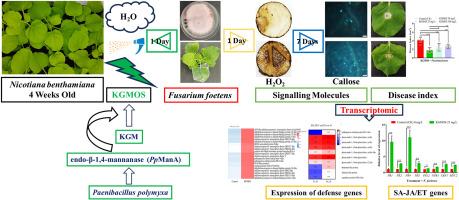
Oligosaccharides derived from storage polysaccharides have shown considerable potential in boosting innate immunity. In this study, konjac glucomannan oligosaccharides (KGMOS) with degree of polymerization 2–13 obtained by enzymatic hydrolysis of storage konjac glucomannans (KGM), was employed against the harmful pathogen Fusarium foetens in Nicotiana benthamiana. The application of KGMOS at concentrations ranging from 0.025 to 0.1 mg mL−1 significantly inhibited the pathogen, reduced disease severity, and markedly increased the levels of H2O2 and callose. Comparative transcriptomic analysis revealed that distinct DEGs in KGMOS-treated plants were involved in MAPK signaling, plant hormone signal transduction, and plant-pathogen interaction pathways. Notably, defense-related genes associated with salicylic acid (SA) and jasmonic acid/ethylene (JA/ET) pathways were upregulated. Analysis indicates that the levels of transcripts encoding PR1, PR2, PR5 and NPR1 were increased in plants treated with KGMOS. Meanwhile, transcription factors, enzymes, receptors and co-receptors associated with defense responses were also upregulated in KGMOS treatment. RT-qPCR further confirmed the significant upregulation of SA and JA/ET pathway genes in KGMOS-treated plants. Increased SA content (2.37-fold) in these plants suggests improved disease resistance. The study concludes that KGMOS effectively enhances resistance against F. foetens, with high efficiency at 0.025 mg mL−1, the lowest concentration assayed. These findings provided valuable insights into the potential application of KGMOS for disease management in sustainable agriculture and postharvest scenarios.
期刊介绍:
Physiological and Molecular Plant Pathology provides an International forum for original research papers, reviews, and commentaries on all aspects of the molecular biology, biochemistry, physiology, histology and cytology, genetics and evolution of plant-microbe interactions.
Papers on all kinds of infective pathogen, including viruses, prokaryotes, fungi, and nematodes, as well as mutualistic organisms such as Rhizobium and mycorrhyzal fungi, are acceptable as long as they have a bearing on the interaction between pathogen and plant.




 京公网安备 11010802042870号
京ICP备2023020795号-1
京公网安备 11010802042870号
京ICP备2023020795号-1

 分享
分享
 求助内容:
求助内容: 应助结果提醒方式:
 扫码关注我们
