Jian Guan , Guolei Liu , Wenguang Hu , Hongwei Liu , Paixian Fu , Yanfei Cao , Dong-Rong Liu , Dianzhong Li
{"title":"用一种新的物理数据集成设计策略实现超清洁轴承钢","authors":"Jian Guan , Guolei Liu , Wenguang Hu , Hongwei Liu , Paixian Fu , Yanfei Cao , Dong-Rong Liu , Dianzhong Li","doi":"10.1016/j.matdes.2025.113629","DOIUrl":null,"url":null,"abstract":"<div><div>The cleanliness of fabricated ingots is crucial for the quality and properties of bearing steel. To address this issue, a physical-data integrated design strategy was developed to optimize vacuum arc remelting (VAR) parameters, combining numerical simulation, machine learning (ML), and experimental validation. Initially, a multi-phase, multi-physics coupled model was developed to predict the movement and distribution of inclusions during the VAR process. Furthermore, five ML algorithms were utilized to predict the cleanliness assessment score (CAS) based on inclusion size and distribution data from various VAR processing parameters, with gradient boosting regression (GBR) showing the best performance. Finally, a systematic framework based on a genetic algorithm was proposed to select the optimal combination of CAS. Here, the ML-optimized processing parameters comprised current of 4255 A, helium pressure of 0.69 kPa, and melting rate of 2.5 kg/min. Intriguingly, the number density of small inclusions at the center of the ingot decreased by 58.2 % and that of large inclusions reduced by 13.3 %. This was mainly caused by the appropriate maximum flow velocity of 2.6–2.8 cm/s during the steady-state stage of the molten pool. This study highlights a common and novel method for fabricating bearing steel with other superalloys via a physical-data integrated strategy.</div></div>","PeriodicalId":383,"journal":{"name":"Materials & Design","volume":"250 ","pages":"Article 113629"},"PeriodicalIF":7.9000,"publicationDate":"2025-02-01","publicationTypes":"Journal Article","fieldsOfStudy":null,"isOpenAccess":false,"openAccessPdf":"","citationCount":"0","resultStr":"{\"title\":\"Toward super-clean bearing steel by a novel physical-data integrated design strategy\",\"authors\":\"Jian Guan , Guolei Liu , Wenguang Hu , Hongwei Liu , Paixian Fu , Yanfei Cao , Dong-Rong Liu , Dianzhong Li\",\"doi\":\"10.1016/j.matdes.2025.113629\",\"DOIUrl\":null,\"url\":null,\"abstract\":\"<div><div>The cleanliness of fabricated ingots is crucial for the quality and properties of bearing steel. To address this issue, a physical-data integrated design strategy was developed to optimize vacuum arc remelting (VAR) parameters, combining numerical simulation, machine learning (ML), and experimental validation. Initially, a multi-phase, multi-physics coupled model was developed to predict the movement and distribution of inclusions during the VAR process. Furthermore, five ML algorithms were utilized to predict the cleanliness assessment score (CAS) based on inclusion size and distribution data from various VAR processing parameters, with gradient boosting regression (GBR) showing the best performance. Finally, a systematic framework based on a genetic algorithm was proposed to select the optimal combination of CAS. Here, the ML-optimized processing parameters comprised current of 4255 A, helium pressure of 0.69 kPa, and melting rate of 2.5 kg/min. Intriguingly, the number density of small inclusions at the center of the ingot decreased by 58.2 % and that of large inclusions reduced by 13.3 %. This was mainly caused by the appropriate maximum flow velocity of 2.6–2.8 cm/s during the steady-state stage of the molten pool. This study highlights a common and novel method for fabricating bearing steel with other superalloys via a physical-data integrated strategy.</div></div>\",\"PeriodicalId\":383,\"journal\":{\"name\":\"Materials & Design\",\"volume\":\"250 \",\"pages\":\"Article 113629\"},\"PeriodicalIF\":7.9000,\"publicationDate\":\"2025-02-01\",\"publicationTypes\":\"Journal Article\",\"fieldsOfStudy\":null,\"isOpenAccess\":false,\"openAccessPdf\":\"\",\"citationCount\":\"0\",\"resultStr\":null,\"platform\":\"Semanticscholar\",\"paperid\":null,\"PeriodicalName\":\"Materials & Design\",\"FirstCategoryId\":\"88\",\"ListUrlMain\":\"https://www.sciencedirect.com/science/article/pii/S0264127525000498\",\"RegionNum\":2,\"RegionCategory\":\"材料科学\",\"ArticlePicture\":[],\"TitleCN\":null,\"AbstractTextCN\":null,\"PMCID\":null,\"EPubDate\":\"2025/1/15 0:00:00\",\"PubModel\":\"Epub\",\"JCR\":\"Q1\",\"JCRName\":\"MATERIALS SCIENCE, MULTIDISCIPLINARY\",\"Score\":null,\"Total\":0}","platform":"Semanticscholar","paperid":null,"PeriodicalName":"Materials & Design","FirstCategoryId":"88","ListUrlMain":"https://www.sciencedirect.com/science/article/pii/S0264127525000498","RegionNum":2,"RegionCategory":"材料科学","ArticlePicture":[],"TitleCN":null,"AbstractTextCN":null,"PMCID":null,"EPubDate":"2025/1/15 0:00:00","PubModel":"Epub","JCR":"Q1","JCRName":"MATERIALS SCIENCE, MULTIDISCIPLINARY","Score":null,"Total":0}
Toward super-clean bearing steel by a novel physical-data integrated design strategy
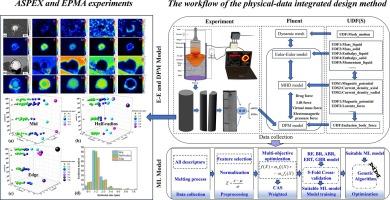
The cleanliness of fabricated ingots is crucial for the quality and properties of bearing steel. To address this issue, a physical-data integrated design strategy was developed to optimize vacuum arc remelting (VAR) parameters, combining numerical simulation, machine learning (ML), and experimental validation. Initially, a multi-phase, multi-physics coupled model was developed to predict the movement and distribution of inclusions during the VAR process. Furthermore, five ML algorithms were utilized to predict the cleanliness assessment score (CAS) based on inclusion size and distribution data from various VAR processing parameters, with gradient boosting regression (GBR) showing the best performance. Finally, a systematic framework based on a genetic algorithm was proposed to select the optimal combination of CAS. Here, the ML-optimized processing parameters comprised current of 4255 A, helium pressure of 0.69 kPa, and melting rate of 2.5 kg/min. Intriguingly, the number density of small inclusions at the center of the ingot decreased by 58.2 % and that of large inclusions reduced by 13.3 %. This was mainly caused by the appropriate maximum flow velocity of 2.6–2.8 cm/s during the steady-state stage of the molten pool. This study highlights a common and novel method for fabricating bearing steel with other superalloys via a physical-data integrated strategy.
期刊介绍:
Materials and Design is a multi-disciplinary journal that publishes original research reports, review articles, and express communications. The journal focuses on studying the structure and properties of inorganic and organic materials, advancements in synthesis, processing, characterization, and testing, the design of materials and engineering systems, and their applications in technology. It aims to bring together various aspects of materials science, engineering, physics, and chemistry.
The journal explores themes ranging from materials to design and aims to reveal the connections between natural and artificial materials, as well as experiment and modeling. Manuscripts submitted to Materials and Design should contain elements of discovery and surprise, as they often contribute new insights into the architecture and function of matter.




 京公网安备 11010802042870号
京ICP备2023020795号-1
京公网安备 11010802042870号
京ICP备2023020795号-1

 分享
分享
 求助内容:
求助内容: 应助结果提醒方式:
 扫码关注我们
