Balázs Illés , Agata Skwarek , Tamás Hurtony , Olivér Krammer , Bálint Medgyes , Krzysztof Szostak , Gábor Harsányi , András Kovács , Béla Pécz
{"title":"空间部门向无铅过渡的风险:在热真空条件下从亚微米锡层生长锡晶须","authors":"Balázs Illés , Agata Skwarek , Tamás Hurtony , Olivér Krammer , Bálint Medgyes , Krzysztof Szostak , Gábor Harsányi , András Kovács , Béla Pécz","doi":"10.1016/j.matdes.2025.113637","DOIUrl":null,"url":null,"abstract":"<div><div>Sn whisker growth was investigated from submicron Sn layers on Cu substrates in thermal vacuum conditions to compare the growth differences in ambient and space conditions. Cu substrates were covered with 500 nm thick Sn by PVD. The samples were kept at 50 °C and 8.3x10<sup>-6</sup> mbar for 1000 h in order to simulate the space conditions. Numerous Sn whiskers were found on the samples after some days of sample preparation. More but shorter whiskers with different structures were developed in a vacuum than in ambient conditions before. The vacuum-grown whiskers had segmented block-like bodies with a plain surface, while ambient-grown whiskers had a twisted body with grooves. TEM investigations found a weak correlation between the crystal structure and the shape of the different whiskers. However, it proved that the high mechanical stress of the Cu<sub>6</sub>Sn<sub>5</sub> intermetallic layer growth initiated the interface flow mechanism, which transported Cu<sub>6</sub>Sn<sub>5</sub> into the whiskers. The vacuum-grown whiskers contained approximately half the amount of Cu<sub>6</sub>Sn<sub>5</sub> inclusions than the ambient-grown ones, which could be related to the more uniform stress relaxation of the oxide-free surface in the vacuum. The higher amount Cu<sub>6</sub>Sn<sub>5</sub> inclusions could cause the twisting of the whisker bodies in ambient conditions.</div></div>","PeriodicalId":383,"journal":{"name":"Materials & Design","volume":"250 ","pages":"Article 113637"},"PeriodicalIF":7.9000,"publicationDate":"2025-02-01","publicationTypes":"Journal Article","fieldsOfStudy":null,"isOpenAccess":false,"openAccessPdf":"","citationCount":"0","resultStr":"{\"title\":\"Risk of transition to lead-free in the space sector: Sn whisker growth in thermal vacuum conditions from submicron Sn layer\",\"authors\":\"Balázs Illés , Agata Skwarek , Tamás Hurtony , Olivér Krammer , Bálint Medgyes , Krzysztof Szostak , Gábor Harsányi , András Kovács , Béla Pécz\",\"doi\":\"10.1016/j.matdes.2025.113637\",\"DOIUrl\":null,\"url\":null,\"abstract\":\"<div><div>Sn whisker growth was investigated from submicron Sn layers on Cu substrates in thermal vacuum conditions to compare the growth differences in ambient and space conditions. Cu substrates were covered with 500 nm thick Sn by PVD. The samples were kept at 50 °C and 8.3x10<sup>-6</sup> mbar for 1000 h in order to simulate the space conditions. Numerous Sn whiskers were found on the samples after some days of sample preparation. More but shorter whiskers with different structures were developed in a vacuum than in ambient conditions before. The vacuum-grown whiskers had segmented block-like bodies with a plain surface, while ambient-grown whiskers had a twisted body with grooves. TEM investigations found a weak correlation between the crystal structure and the shape of the different whiskers. However, it proved that the high mechanical stress of the Cu<sub>6</sub>Sn<sub>5</sub> intermetallic layer growth initiated the interface flow mechanism, which transported Cu<sub>6</sub>Sn<sub>5</sub> into the whiskers. The vacuum-grown whiskers contained approximately half the amount of Cu<sub>6</sub>Sn<sub>5</sub> inclusions than the ambient-grown ones, which could be related to the more uniform stress relaxation of the oxide-free surface in the vacuum. The higher amount Cu<sub>6</sub>Sn<sub>5</sub> inclusions could cause the twisting of the whisker bodies in ambient conditions.</div></div>\",\"PeriodicalId\":383,\"journal\":{\"name\":\"Materials & Design\",\"volume\":\"250 \",\"pages\":\"Article 113637\"},\"PeriodicalIF\":7.9000,\"publicationDate\":\"2025-02-01\",\"publicationTypes\":\"Journal Article\",\"fieldsOfStudy\":null,\"isOpenAccess\":false,\"openAccessPdf\":\"\",\"citationCount\":\"0\",\"resultStr\":null,\"platform\":\"Semanticscholar\",\"paperid\":null,\"PeriodicalName\":\"Materials & Design\",\"FirstCategoryId\":\"88\",\"ListUrlMain\":\"https://www.sciencedirect.com/science/article/pii/S0264127525000577\",\"RegionNum\":2,\"RegionCategory\":\"材料科学\",\"ArticlePicture\":[],\"TitleCN\":null,\"AbstractTextCN\":null,\"PMCID\":null,\"EPubDate\":\"2025/1/16 0:00:00\",\"PubModel\":\"Epub\",\"JCR\":\"Q1\",\"JCRName\":\"MATERIALS SCIENCE, MULTIDISCIPLINARY\",\"Score\":null,\"Total\":0}","platform":"Semanticscholar","paperid":null,"PeriodicalName":"Materials & Design","FirstCategoryId":"88","ListUrlMain":"https://www.sciencedirect.com/science/article/pii/S0264127525000577","RegionNum":2,"RegionCategory":"材料科学","ArticlePicture":[],"TitleCN":null,"AbstractTextCN":null,"PMCID":null,"EPubDate":"2025/1/16 0:00:00","PubModel":"Epub","JCR":"Q1","JCRName":"MATERIALS SCIENCE, MULTIDISCIPLINARY","Score":null,"Total":0}
Risk of transition to lead-free in the space sector: Sn whisker growth in thermal vacuum conditions from submicron Sn layer
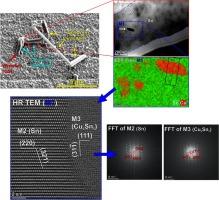
Sn whisker growth was investigated from submicron Sn layers on Cu substrates in thermal vacuum conditions to compare the growth differences in ambient and space conditions. Cu substrates were covered with 500 nm thick Sn by PVD. The samples were kept at 50 °C and 8.3x10⁻⁶ mbar for 1000 h in order to simulate the space conditions. Numerous Sn whiskers were found on the samples after some days of sample preparation. More but shorter whiskers with different structures were developed in a vacuum than in ambient conditions before. The vacuum-grown whiskers had segmented block-like bodies with a plain surface, while ambient-grown whiskers had a twisted body with grooves. TEM investigations found a weak correlation between the crystal structure and the shape of the different whiskers. However, it proved that the high mechanical stress of the Cu6Sn5 intermetallic layer growth initiated the interface flow mechanism, which transported Cu6Sn5 into the whiskers. The vacuum-grown whiskers contained approximately half the amount of Cu6Sn5 inclusions than the ambient-grown ones, which could be related to the more uniform stress relaxation of the oxide-free surface in the vacuum. The higher amount Cu6Sn5 inclusions could cause the twisting of the whisker bodies in ambient conditions.
期刊介绍:
Materials and Design is a multi-disciplinary journal that publishes original research reports, review articles, and express communications. The journal focuses on studying the structure and properties of inorganic and organic materials, advancements in synthesis, processing, characterization, and testing, the design of materials and engineering systems, and their applications in technology. It aims to bring together various aspects of materials science, engineering, physics, and chemistry.
The journal explores themes ranging from materials to design and aims to reveal the connections between natural and artificial materials, as well as experiment and modeling. Manuscripts submitted to Materials and Design should contain elements of discovery and surprise, as they often contribute new insights into the architecture and function of matter.




 京公网安备 11010802042870号
京ICP备2023020795号-1
京公网安备 11010802042870号
京ICP备2023020795号-1

 分享
分享
 求助内容:
求助内容: 应助结果提醒方式:
 扫码关注我们
