Venkat Vivek Pamarthi , Tianzhu Sun , Abhishek Das , Qamar Hayat , Alexander Griffiths , Lewis Johnson , Pasquale Franciosa
{"title":"采用尾形和轴对称静态激光束形状控制自焊接AA6082合金的组织,改善其力学性能","authors":"Venkat Vivek Pamarthi , Tianzhu Sun , Abhishek Das , Qamar Hayat , Alexander Griffiths , Lewis Johnson , Pasquale Franciosa","doi":"10.1016/j.matdes.2025.113619","DOIUrl":null,"url":null,"abstract":"<div><div>Laser beam shaping technology has advanced remote laser welding applications, yet welding AA6xxx alloys remains challenging due to their sensitivity to cracking. Recent studies on these alloys have focussed on axisymmetric shapes, with a limited understanding of molten flow dynamics and microstructural evolution in the context of non-axisymmetric shapes. This study examines the impact of tailing and axisymmetric laser beam shapes on steering microstructure, and cracking mitigation in AA6082 alloy by combining multiphysics CFD simulation and experimental observations. Two sets of beam shapes were investigated: (1) four axisymmetric core-to-ring beam shapes with varying ring diameter, and power, and (2) a tailing beam shape with a 3 mm elongated tail. The findings indicate that introducing a 580 µm ring to the core beam reduces crack formation by lowering thermal gradients; however, increasing the power of the ring beam at a constant diameter, coarsens the microstructure, producing axial columnar grains with higher crack sensitivity. Expanding the ring beam diameter to 1200 µm reduced molten flow and thermal gradients, resulting in decreased cracking and increased tensile strength by 36%, compared to the core-only shape. The tailing shape beam further lowered thermal gradients owing to the larger molten pool and elongated tail, achieving a 62% grain size reduction compared to the core-only shape.</div></div>","PeriodicalId":383,"journal":{"name":"Materials & Design","volume":"250 ","pages":"Article 113619"},"PeriodicalIF":8.2000,"publicationDate":"2025-02-01","publicationTypes":"Journal Article","fieldsOfStudy":null,"isOpenAccess":false,"openAccessPdf":"","citationCount":"0","resultStr":"{\"title\":\"Tailing and axisymmetric static laser beam shapes to steer microstructure and improve mechanical properties of autogenously laser welded AA6082 alloy\",\"authors\":\"Venkat Vivek Pamarthi , Tianzhu Sun , Abhishek Das , Qamar Hayat , Alexander Griffiths , Lewis Johnson , Pasquale Franciosa\",\"doi\":\"10.1016/j.matdes.2025.113619\",\"DOIUrl\":null,\"url\":null,\"abstract\":\"<div><div>Laser beam shaping technology has advanced remote laser welding applications, yet welding AA6xxx alloys remains challenging due to their sensitivity to cracking. Recent studies on these alloys have focussed on axisymmetric shapes, with a limited understanding of molten flow dynamics and microstructural evolution in the context of non-axisymmetric shapes. This study examines the impact of tailing and axisymmetric laser beam shapes on steering microstructure, and cracking mitigation in AA6082 alloy by combining multiphysics CFD simulation and experimental observations. Two sets of beam shapes were investigated: (1) four axisymmetric core-to-ring beam shapes with varying ring diameter, and power, and (2) a tailing beam shape with a 3 mm elongated tail. The findings indicate that introducing a 580 µm ring to the core beam reduces crack formation by lowering thermal gradients; however, increasing the power of the ring beam at a constant diameter, coarsens the microstructure, producing axial columnar grains with higher crack sensitivity. Expanding the ring beam diameter to 1200 µm reduced molten flow and thermal gradients, resulting in decreased cracking and increased tensile strength by 36%, compared to the core-only shape. The tailing shape beam further lowered thermal gradients owing to the larger molten pool and elongated tail, achieving a 62% grain size reduction compared to the core-only shape.</div></div>\",\"PeriodicalId\":383,\"journal\":{\"name\":\"Materials & Design\",\"volume\":\"250 \",\"pages\":\"Article 113619\"},\"PeriodicalIF\":8.2000,\"publicationDate\":\"2025-02-01\",\"publicationTypes\":\"Journal Article\",\"fieldsOfStudy\":null,\"isOpenAccess\":false,\"openAccessPdf\":\"\",\"citationCount\":\"0\",\"resultStr\":null,\"platform\":\"Semanticscholar\",\"paperid\":null,\"PeriodicalName\":\"Materials & Design\",\"FirstCategoryId\":\"88\",\"ListUrlMain\":\"https://www.sciencedirect.com/science/article/pii/S0264127525000395\",\"RegionNum\":2,\"RegionCategory\":\"材料科学\",\"ArticlePicture\":[],\"TitleCN\":null,\"AbstractTextCN\":null,\"PMCID\":null,\"EPubDate\":\"2025/1/15 0:00:00\",\"PubModel\":\"Epub\",\"JCR\":\"Q1\",\"JCRName\":\"MATERIALS SCIENCE, MULTIDISCIPLINARY\",\"Score\":null,\"Total\":0}","platform":"Semanticscholar","paperid":null,"PeriodicalName":"Materials & Design","FirstCategoryId":"88","ListUrlMain":"https://www.sciencedirect.com/science/article/pii/S0264127525000395","RegionNum":2,"RegionCategory":"材料科学","ArticlePicture":[],"TitleCN":null,"AbstractTextCN":null,"PMCID":null,"EPubDate":"2025/1/15 0:00:00","PubModel":"Epub","JCR":"Q1","JCRName":"MATERIALS SCIENCE, MULTIDISCIPLINARY","Score":null,"Total":0}
Tailing and axisymmetric static laser beam shapes to steer microstructure and improve mechanical properties of autogenously laser welded AA6082 alloy
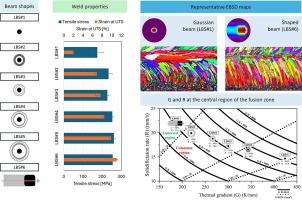
Laser beam shaping technology has advanced remote laser welding applications, yet welding AA6xxx alloys remains challenging due to their sensitivity to cracking. Recent studies on these alloys have focussed on axisymmetric shapes, with a limited understanding of molten flow dynamics and microstructural evolution in the context of non-axisymmetric shapes. This study examines the impact of tailing and axisymmetric laser beam shapes on steering microstructure, and cracking mitigation in AA6082 alloy by combining multiphysics CFD simulation and experimental observations. Two sets of beam shapes were investigated: (1) four axisymmetric core-to-ring beam shapes with varying ring diameter, and power, and (2) a tailing beam shape with a 3 mm elongated tail. The findings indicate that introducing a 580 µm ring to the core beam reduces crack formation by lowering thermal gradients; however, increasing the power of the ring beam at a constant diameter, coarsens the microstructure, producing axial columnar grains with higher crack sensitivity. Expanding the ring beam diameter to 1200 µm reduced molten flow and thermal gradients, resulting in decreased cracking and increased tensile strength by 36%, compared to the core-only shape. The tailing shape beam further lowered thermal gradients owing to the larger molten pool and elongated tail, achieving a 62% grain size reduction compared to the core-only shape.
期刊介绍:
Materials and Design is a multi-disciplinary journal that publishes original research reports, review articles, and express communications. The journal focuses on studying the structure and properties of inorganic and organic materials, advancements in synthesis, processing, characterization, and testing, the design of materials and engineering systems, and their applications in technology. It aims to bring together various aspects of materials science, engineering, physics, and chemistry.
The journal explores themes ranging from materials to design and aims to reveal the connections between natural and artificial materials, as well as experiment and modeling. Manuscripts submitted to Materials and Design should contain elements of discovery and surprise, as they often contribute new insights into the architecture and function of matter.




 京公网安备 11010802042870号
京ICP备2023020795号-1
京公网安备 11010802042870号
京ICP备2023020795号-1

 分享
分享
 求助内容:
求助内容: 应助结果提醒方式:
 扫码关注我们
