{"title":"研究了烧结添加剂和加热制度对工业废料中玻璃陶瓷支撑剂性能的影响","authors":"Jincai Zhang , Yueting Fan , Xubo Zhai , Vishnu Vijay Kumar","doi":"10.1016/j.matdes.2025.113634","DOIUrl":null,"url":null,"abstract":"<div><div>This article aims to explore a simple and effective method of preparation industry solid waste based ceramic proppant and elucidate the sintering mechanism for prompting further study in the future. Glass-ceramic-based proppants were successfully fabricated using fly ash and kaolin, as main raw, matching other raws and additive such as TiO<sub>2</sub> and Fe<sub>2</sub>O<sub>3,</sub> in lab. The results showed that the proppants had the optimum overall performances when the total content of SiO<sub>2</sub> and Al<sub>2</sub>O<sub>3</sub> was at 85 %, their molar ratio was 1, with a sintering temperature of 1250℃. The heating rate and the holding time were 2.5℃/min and 90 min, respectively, with the addition of 3 % TiO<sub>2</sub> and 5 % Fe<sub>2</sub>O<sub>3</sub>. The cylinder compressive strength of the samples increased 73.33 % by following step-by-step optimizations than origin sample. Furthermore, the sintering mechanism was elucidated and all possible chemical reaction were explored at the high temperature sintering process. The additives such as TiO<sub>2</sub> and Fe<sub>2</sub>O<sub>3</sub> prompt the crystal melting and amorphous as well as mullite formation, which made raw solid particle set change into a glass–ceramic-based whole body. New finding indicates the new phase formation and their content inside proppant body have an important contribution to the enhance of the cylinder compressive strength.</div></div>","PeriodicalId":383,"journal":{"name":"Materials & Design","volume":"250 ","pages":"Article 113634"},"PeriodicalIF":7.9000,"publicationDate":"2025-02-01","publicationTypes":"Journal Article","fieldsOfStudy":null,"isOpenAccess":false,"openAccessPdf":"","citationCount":"0","resultStr":"{\"title\":\"Investigating the effects of sintering additives and heating regimes on the performances of glass–ceramic proppants derived from industrial wastes\",\"authors\":\"Jincai Zhang , Yueting Fan , Xubo Zhai , Vishnu Vijay Kumar\",\"doi\":\"10.1016/j.matdes.2025.113634\",\"DOIUrl\":null,\"url\":null,\"abstract\":\"<div><div>This article aims to explore a simple and effective method of preparation industry solid waste based ceramic proppant and elucidate the sintering mechanism for prompting further study in the future. Glass-ceramic-based proppants were successfully fabricated using fly ash and kaolin, as main raw, matching other raws and additive such as TiO<sub>2</sub> and Fe<sub>2</sub>O<sub>3,</sub> in lab. The results showed that the proppants had the optimum overall performances when the total content of SiO<sub>2</sub> and Al<sub>2</sub>O<sub>3</sub> was at 85 %, their molar ratio was 1, with a sintering temperature of 1250℃. The heating rate and the holding time were 2.5℃/min and 90 min, respectively, with the addition of 3 % TiO<sub>2</sub> and 5 % Fe<sub>2</sub>O<sub>3</sub>. The cylinder compressive strength of the samples increased 73.33 % by following step-by-step optimizations than origin sample. Furthermore, the sintering mechanism was elucidated and all possible chemical reaction were explored at the high temperature sintering process. The additives such as TiO<sub>2</sub> and Fe<sub>2</sub>O<sub>3</sub> prompt the crystal melting and amorphous as well as mullite formation, which made raw solid particle set change into a glass–ceramic-based whole body. New finding indicates the new phase formation and their content inside proppant body have an important contribution to the enhance of the cylinder compressive strength.</div></div>\",\"PeriodicalId\":383,\"journal\":{\"name\":\"Materials & Design\",\"volume\":\"250 \",\"pages\":\"Article 113634\"},\"PeriodicalIF\":7.9000,\"publicationDate\":\"2025-02-01\",\"publicationTypes\":\"Journal Article\",\"fieldsOfStudy\":null,\"isOpenAccess\":false,\"openAccessPdf\":\"\",\"citationCount\":\"0\",\"resultStr\":null,\"platform\":\"Semanticscholar\",\"paperid\":null,\"PeriodicalName\":\"Materials & Design\",\"FirstCategoryId\":\"88\",\"ListUrlMain\":\"https://www.sciencedirect.com/science/article/pii/S0264127525000541\",\"RegionNum\":2,\"RegionCategory\":\"材料科学\",\"ArticlePicture\":[],\"TitleCN\":null,\"AbstractTextCN\":null,\"PMCID\":null,\"EPubDate\":\"2025/1/21 0:00:00\",\"PubModel\":\"Epub\",\"JCR\":\"Q1\",\"JCRName\":\"MATERIALS SCIENCE, MULTIDISCIPLINARY\",\"Score\":null,\"Total\":0}","platform":"Semanticscholar","paperid":null,"PeriodicalName":"Materials & Design","FirstCategoryId":"88","ListUrlMain":"https://www.sciencedirect.com/science/article/pii/S0264127525000541","RegionNum":2,"RegionCategory":"材料科学","ArticlePicture":[],"TitleCN":null,"AbstractTextCN":null,"PMCID":null,"EPubDate":"2025/1/21 0:00:00","PubModel":"Epub","JCR":"Q1","JCRName":"MATERIALS SCIENCE, MULTIDISCIPLINARY","Score":null,"Total":0}
Investigating the effects of sintering additives and heating regimes on the performances of glass–ceramic proppants derived from industrial wastes
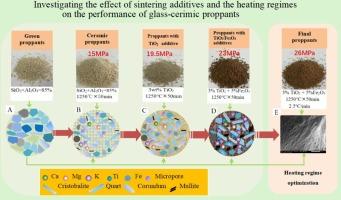
This article aims to explore a simple and effective method of preparation industry solid waste based ceramic proppant and elucidate the sintering mechanism for prompting further study in the future. Glass-ceramic-based proppants were successfully fabricated using fly ash and kaolin, as main raw, matching other raws and additive such as TiO2 and Fe2O3, in lab. The results showed that the proppants had the optimum overall performances when the total content of SiO2 and Al2O3 was at 85 %, their molar ratio was 1, with a sintering temperature of 1250℃. The heating rate and the holding time were 2.5℃/min and 90 min, respectively, with the addition of 3 % TiO2 and 5 % Fe2O3. The cylinder compressive strength of the samples increased 73.33 % by following step-by-step optimizations than origin sample. Furthermore, the sintering mechanism was elucidated and all possible chemical reaction were explored at the high temperature sintering process. The additives such as TiO2 and Fe2O3 prompt the crystal melting and amorphous as well as mullite formation, which made raw solid particle set change into a glass–ceramic-based whole body. New finding indicates the new phase formation and their content inside proppant body have an important contribution to the enhance of the cylinder compressive strength.
期刊介绍:
Materials and Design is a multi-disciplinary journal that publishes original research reports, review articles, and express communications. The journal focuses on studying the structure and properties of inorganic and organic materials, advancements in synthesis, processing, characterization, and testing, the design of materials and engineering systems, and their applications in technology. It aims to bring together various aspects of materials science, engineering, physics, and chemistry.
The journal explores themes ranging from materials to design and aims to reveal the connections between natural and artificial materials, as well as experiment and modeling. Manuscripts submitted to Materials and Design should contain elements of discovery and surprise, as they often contribute new insights into the architecture and function of matter.




 京公网安备 11010802042870号
京ICP备2023020795号-1
京公网安备 11010802042870号
京ICP备2023020795号-1

 分享
分享
 求助内容:
求助内容: 应助结果提醒方式:
 扫码关注我们
