Yongguang Zhai , Yasong Wang , Lei Hao , Wenchao Qi
{"title":"气候变化、管理措施和土地利用对内蒙古植被动态的中长期独立贡献及对生态恢复的启示","authors":"Yongguang Zhai , Yasong Wang , Lei Hao , Wenchao Qi","doi":"10.1016/j.ecoleng.2024.107504","DOIUrl":null,"url":null,"abstract":"<div><div>To counteract the detrimental impacts of vegetation degradation, the Chinese authorities have initiated numerous ecological restoration projects (ERPs) in Inner Mongolia (IM) since the 1990s. However, the medium- and long-term consequences of these ERPs on vegetation dynamics remain uncertain. This study employed net primary production (NPP) as an indicator to quantify the independent contribution of climate change, management measures and land conversion to vegetation dynamics through scenario modeling over four six-year periods (2001–2006, 2006–2011, 2011–2016, 2016–2021). The findings of the study indicated that human activities were the main driver of changes in NPP in Inner Mongolia across all three six-year periods (2006–2011, 2011–2016 and 2016–2021), with the exception of the period from 2001 to 2006,during which climate change was identified as the dominant factor in this period. The primary variables influencing the net primary production (NPP) of diverse vegetation types, including grassland, crops, and forests, have undergone notable shifts over time. Nevertheless, human activities have consistently been the primary driver of NPP changes in desert ecosystems. During the study period, the observed increase in NPP of IM vegetation was primarily attributable to the implementation of management measures in human activities. This phenomenon was observed consistently across the three main vegetation classes: grassland, forest and desert. In contrast, land conversion was identified as the primary driver of the increase in NPP in cropland during the periods 2001–2006 and 2011–2016. This understanding is crucial for the development of more effective policies and measures for ecological restoration.</div></div>","PeriodicalId":11490,"journal":{"name":"Ecological Engineering","volume":"212 ","pages":"Article 107504"},"PeriodicalIF":4.1000,"publicationDate":"2025-02-01","publicationTypes":"Journal Article","fieldsOfStudy":null,"isOpenAccess":false,"openAccessPdf":"","citationCount":"0","resultStr":"{\"title\":\"Medium- and long-term independent contributions of climate change, management measures and land conversion to vegetation dynamics and inspiration for ecological restoration in Inner Mongolia, China\",\"authors\":\"Yongguang Zhai , Yasong Wang , Lei Hao , Wenchao Qi\",\"doi\":\"10.1016/j.ecoleng.2024.107504\",\"DOIUrl\":null,\"url\":null,\"abstract\":\"<div><div>To counteract the detrimental impacts of vegetation degradation, the Chinese authorities have initiated numerous ecological restoration projects (ERPs) in Inner Mongolia (IM) since the 1990s. However, the medium- and long-term consequences of these ERPs on vegetation dynamics remain uncertain. This study employed net primary production (NPP) as an indicator to quantify the independent contribution of climate change, management measures and land conversion to vegetation dynamics through scenario modeling over four six-year periods (2001–2006, 2006–2011, 2011–2016, 2016–2021). The findings of the study indicated that human activities were the main driver of changes in NPP in Inner Mongolia across all three six-year periods (2006–2011, 2011–2016 and 2016–2021), with the exception of the period from 2001 to 2006,during which climate change was identified as the dominant factor in this period. The primary variables influencing the net primary production (NPP) of diverse vegetation types, including grassland, crops, and forests, have undergone notable shifts over time. Nevertheless, human activities have consistently been the primary driver of NPP changes in desert ecosystems. During the study period, the observed increase in NPP of IM vegetation was primarily attributable to the implementation of management measures in human activities. This phenomenon was observed consistently across the three main vegetation classes: grassland, forest and desert. In contrast, land conversion was identified as the primary driver of the increase in NPP in cropland during the periods 2001–2006 and 2011–2016. This understanding is crucial for the development of more effective policies and measures for ecological restoration.</div></div>\",\"PeriodicalId\":11490,\"journal\":{\"name\":\"Ecological Engineering\",\"volume\":\"212 \",\"pages\":\"Article 107504\"},\"PeriodicalIF\":4.1000,\"publicationDate\":\"2025-02-01\",\"publicationTypes\":\"Journal Article\",\"fieldsOfStudy\":null,\"isOpenAccess\":false,\"openAccessPdf\":\"\",\"citationCount\":\"0\",\"resultStr\":null,\"platform\":\"Semanticscholar\",\"paperid\":null,\"PeriodicalName\":\"Ecological Engineering\",\"FirstCategoryId\":\"93\",\"ListUrlMain\":\"https://www.sciencedirect.com/science/article/pii/S092585742400329X\",\"RegionNum\":2,\"RegionCategory\":\"环境科学与生态学\",\"ArticlePicture\":[],\"TitleCN\":null,\"AbstractTextCN\":null,\"PMCID\":null,\"EPubDate\":\"2024/12/27 0:00:00\",\"PubModel\":\"Epub\",\"JCR\":\"Q1\",\"JCRName\":\"ECOLOGY\",\"Score\":null,\"Total\":0}","platform":"Semanticscholar","paperid":null,"PeriodicalName":"Ecological Engineering","FirstCategoryId":"93","ListUrlMain":"https://www.sciencedirect.com/science/article/pii/S092585742400329X","RegionNum":2,"RegionCategory":"环境科学与生态学","ArticlePicture":[],"TitleCN":null,"AbstractTextCN":null,"PMCID":null,"EPubDate":"2024/12/27 0:00:00","PubModel":"Epub","JCR":"Q1","JCRName":"ECOLOGY","Score":null,"Total":0}
Medium- and long-term independent contributions of climate change, management measures and land conversion to vegetation dynamics and inspiration for ecological restoration in Inner Mongolia, China
To counteract the detrimental impacts of vegetation degradation, the Chinese authorities have initiated numerous ecological restoration projects (ERPs) in Inner Mongolia (IM) since the 1990s. However, the medium- and long-term consequences of these ERPs on vegetation dynamics remain uncertain. This study employed net primary production (NPP) as an indicator to quantify the independent contribution of climate change, management measures and land conversion to vegetation dynamics through scenario modeling over four six-year periods (2001–2006, 2006–2011, 2011–2016, 2016–2021). The findings of the study indicated that human activities were the main driver of changes in NPP in Inner Mongolia across all three six-year periods (2006–2011, 2011–2016 and 2016–2021), with the exception of the period from 2001 to 2006,during which climate change was identified as the dominant factor in this period. The primary variables influencing the net primary production (NPP) of diverse vegetation types, including grassland, crops, and forests, have undergone notable shifts over time. Nevertheless, human activities have consistently been the primary driver of NPP changes in desert ecosystems. During the study period, the observed increase in NPP of IM vegetation was primarily attributable to the implementation of management measures in human activities. This phenomenon was observed consistently across the three main vegetation classes: grassland, forest and desert. In contrast, land conversion was identified as the primary driver of the increase in NPP in cropland during the periods 2001–2006 and 2011–2016. This understanding is crucial for the development of more effective policies and measures for ecological restoration.
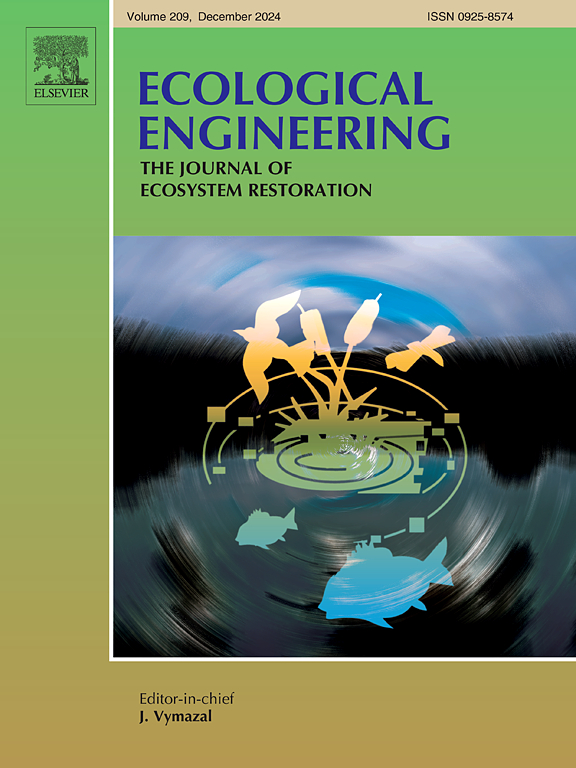
期刊介绍:
Ecological engineering has been defined as the design of ecosystems for the mutual benefit of humans and nature. The journal is meant for ecologists who, because of their research interests or occupation, are involved in designing, monitoring, or restoring ecosystems, and can serve as a bridge between ecologists and engineers.
Specific topics covered in the journal include: habitat reconstruction; ecotechnology; synthetic ecology; bioengineering; restoration ecology; ecology conservation; ecosystem rehabilitation; stream and river restoration; reclamation ecology; non-renewable resource conservation. Descriptions of specific applications of ecological engineering are acceptable only when situated within context of adding novelty to current research and emphasizing ecosystem restoration. We do not accept purely descriptive reports on ecosystem structures (such as vegetation surveys), purely physical assessment of materials that can be used for ecological restoration, small-model studies carried out in the laboratory or greenhouse with artificial (waste)water or crop studies, or case studies on conventional wastewater treatment and eutrophication that do not offer an ecosystem restoration approach within the paper.




 京公网安备 11010802042870号
京ICP备2023020795号-1
京公网安备 11010802042870号
京ICP备2023020795号-1

 分享
分享
 求助内容:
求助内容: 应助结果提醒方式:
 扫码关注我们
