{"title":"优化可见光下掺钒WO3光催化完全消除水环境中残留抗生素的研究","authors":"Thanh-Dong Pham , Nguyen Thi Hanh , Nguyen Viet Khoa , Nguyen Van Noi , Nguyen Thi Dieu Cam , Ha Minh Ngoc , Phuong Thao , Hoang Thu Trang , Nguyen Thuy Huong","doi":"10.1016/j.jphotochem.2024.116243","DOIUrl":null,"url":null,"abstract":"<div><div>The study successfully doped vanadium into the WO<sub>3</sub> lattice to enhance its activity for the effective photocatalytic degradation of tetracycline, a pollutant known to induce various adverse effects on environmental and ecological systems due to its excessive use and discharge. The results demonstrated that vanadium doping effectively reduced band gap energy and enhanced electron-hole separation efficiency of WO<sub>3</sub>. Under visible light, V-WO<sub>3</sub> generated a large number of electron-hole pairs for tetracycline degradation. The study further revealed that the optimal vanadium doping content to maximize the degradation efficiency of WO<sub>3</sub> was 3 wt% (V/W). Exceeding this doping content led to the formation of V<sub>2</sub>O<sub>5</sub> on the WO<sub>3</sub> surface. The V<sub>2</sub>O<sub>5</sub> occupied active sites and/or acted as centers for the recombination of generated electron-hole pairs, thereby reducing the photocatalytic performance of WO<sub>3</sub>. Additionally, the study identified that the optimal pH for tetracycline degradation using 3 V-WO<sub>3</sub> was 6. The 3 V-WO<sub>3</sub> demonstrated high photocatalytic efficiency, achieving complete mineralization of tetracycline. Finally, the study confirmed that 3 V-WO<sub>3</sub> exhibited excellent stability during photocatalysis and could be effectively recovered after use.</div></div>","PeriodicalId":16782,"journal":{"name":"Journal of Photochemistry and Photobiology A-chemistry","volume":"462 ","pages":"Article 116243"},"PeriodicalIF":4.4000,"publicationDate":"2025-05-01","publicationTypes":"Journal Article","fieldsOfStudy":null,"isOpenAccess":false,"openAccessPdf":"","citationCount":"0","resultStr":"{\"title\":\"Optimization of photocatalysis using vanadium doped WO3 under visible light to completely eliminate residual antibiotics in aqueous environment\",\"authors\":\"Thanh-Dong Pham , Nguyen Thi Hanh , Nguyen Viet Khoa , Nguyen Van Noi , Nguyen Thi Dieu Cam , Ha Minh Ngoc , Phuong Thao , Hoang Thu Trang , Nguyen Thuy Huong\",\"doi\":\"10.1016/j.jphotochem.2024.116243\",\"DOIUrl\":null,\"url\":null,\"abstract\":\"<div><div>The study successfully doped vanadium into the WO<sub>3</sub> lattice to enhance its activity for the effective photocatalytic degradation of tetracycline, a pollutant known to induce various adverse effects on environmental and ecological systems due to its excessive use and discharge. The results demonstrated that vanadium doping effectively reduced band gap energy and enhanced electron-hole separation efficiency of WO<sub>3</sub>. Under visible light, V-WO<sub>3</sub> generated a large number of electron-hole pairs for tetracycline degradation. The study further revealed that the optimal vanadium doping content to maximize the degradation efficiency of WO<sub>3</sub> was 3 wt% (V/W). Exceeding this doping content led to the formation of V<sub>2</sub>O<sub>5</sub> on the WO<sub>3</sub> surface. The V<sub>2</sub>O<sub>5</sub> occupied active sites and/or acted as centers for the recombination of generated electron-hole pairs, thereby reducing the photocatalytic performance of WO<sub>3</sub>. Additionally, the study identified that the optimal pH for tetracycline degradation using 3 V-WO<sub>3</sub> was 6. The 3 V-WO<sub>3</sub> demonstrated high photocatalytic efficiency, achieving complete mineralization of tetracycline. Finally, the study confirmed that 3 V-WO<sub>3</sub> exhibited excellent stability during photocatalysis and could be effectively recovered after use.</div></div>\",\"PeriodicalId\":16782,\"journal\":{\"name\":\"Journal of Photochemistry and Photobiology A-chemistry\",\"volume\":\"462 \",\"pages\":\"Article 116243\"},\"PeriodicalIF\":4.4000,\"publicationDate\":\"2025-05-01\",\"publicationTypes\":\"Journal Article\",\"fieldsOfStudy\":null,\"isOpenAccess\":false,\"openAccessPdf\":\"\",\"citationCount\":\"0\",\"resultStr\":null,\"platform\":\"Semanticscholar\",\"paperid\":null,\"PeriodicalName\":\"Journal of Photochemistry and Photobiology A-chemistry\",\"FirstCategoryId\":\"92\",\"ListUrlMain\":\"https://www.sciencedirect.com/science/article/pii/S1010603024007871\",\"RegionNum\":3,\"RegionCategory\":\"化学\",\"ArticlePicture\":[],\"TitleCN\":null,\"AbstractTextCN\":null,\"PMCID\":null,\"EPubDate\":\"2024/12/26 0:00:00\",\"PubModel\":\"Epub\",\"JCR\":\"Q2\",\"JCRName\":\"CHEMISTRY, PHYSICAL\",\"Score\":null,\"Total\":0}","platform":"Semanticscholar","paperid":null,"PeriodicalName":"Journal of Photochemistry and Photobiology A-chemistry","FirstCategoryId":"92","ListUrlMain":"https://www.sciencedirect.com/science/article/pii/S1010603024007871","RegionNum":3,"RegionCategory":"化学","ArticlePicture":[],"TitleCN":null,"AbstractTextCN":null,"PMCID":null,"EPubDate":"2024/12/26 0:00:00","PubModel":"Epub","JCR":"Q2","JCRName":"CHEMISTRY, PHYSICAL","Score":null,"Total":0}
Optimization of photocatalysis using vanadium doped WO3 under visible light to completely eliminate residual antibiotics in aqueous environment
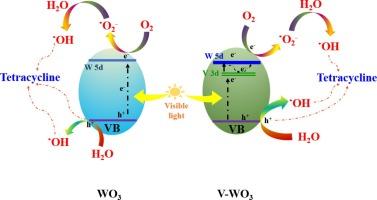
The study successfully doped vanadium into the WO3 lattice to enhance its activity for the effective photocatalytic degradation of tetracycline, a pollutant known to induce various adverse effects on environmental and ecological systems due to its excessive use and discharge. The results demonstrated that vanadium doping effectively reduced band gap energy and enhanced electron-hole separation efficiency of WO3. Under visible light, V-WO3 generated a large number of electron-hole pairs for tetracycline degradation. The study further revealed that the optimal vanadium doping content to maximize the degradation efficiency of WO3 was 3 wt% (V/W). Exceeding this doping content led to the formation of V2O5 on the WO3 surface. The V2O5 occupied active sites and/or acted as centers for the recombination of generated electron-hole pairs, thereby reducing the photocatalytic performance of WO3. Additionally, the study identified that the optimal pH for tetracycline degradation using 3 V-WO3 was 6. The 3 V-WO3 demonstrated high photocatalytic efficiency, achieving complete mineralization of tetracycline. Finally, the study confirmed that 3 V-WO3 exhibited excellent stability during photocatalysis and could be effectively recovered after use.
期刊介绍:
JPPA publishes the results of fundamental studies on all aspects of chemical phenomena induced by interactions between light and molecules/matter of all kinds.
All systems capable of being described at the molecular or integrated multimolecular level are appropriate for the journal. This includes all molecular chemical species as well as biomolecular, supramolecular, polymer and other macromolecular systems, as well as solid state photochemistry. In addition, the journal publishes studies of semiconductor and other photoactive organic and inorganic materials, photocatalysis (organic, inorganic, supramolecular and superconductor).
The scope includes condensed and gas phase photochemistry, as well as synchrotron radiation chemistry. A broad range of processes and techniques in photochemistry are covered such as light induced energy, electron and proton transfer; nonlinear photochemical behavior; mechanistic investigation of photochemical reactions and identification of the products of photochemical reactions; quantum yield determinations and measurements of rate constants for primary and secondary photochemical processes; steady-state and time-resolved emission, ultrafast spectroscopic methods, single molecule spectroscopy, time resolved X-ray diffraction, luminescence microscopy, and scattering spectroscopy applied to photochemistry. Papers in emerging and applied areas such as luminescent sensors, electroluminescence, solar energy conversion, atmospheric photochemistry, environmental remediation, and related photocatalytic chemistry are also welcome.




 京公网安备 11010802042870号
京ICP备2023020795号-1
京公网安备 11010802042870号
京ICP备2023020795号-1

 分享
分享
 求助内容:
求助内容: 应助结果提醒方式:
 扫码关注我们
