Hao Qi , Yingdong Qu , Chenghao Liu , Haokai Wu , Rongde Li , Guanglong Li
{"title":"超声振动对不同尺度TiC增强Al0.4CoCrFe2Ni2高熵合金组织和力学性能的影响","authors":"Hao Qi , Yingdong Qu , Chenghao Liu , Haokai Wu , Rongde Li , Guanglong Li","doi":"10.1016/j.msea.2025.147808","DOIUrl":null,"url":null,"abstract":"<div><div>Strength of casting high entropy alloys (HEAs) improved by the introduction of ceramic particle. However, the strengthening process of alloys were hindered by the problem of particle agglomeration seriously. In this paper, the ultrasonic vibration (UV) treatment process was introduced to improve the dispersion of ceramic particles. Al<sub>0.4</sub>CoCrFe<sub>2</sub>Ni<sub>2</sub> HEAs contain different particle sizes TiC were successfully prepared. Morphology of TiC (μm) change from long straight rod to network structure with UV treatment, and the average dendrite spacing decreases. TiC (nm) particles were dispersed uniformly and agglomeration decreased remarkably. The mean free path (<span><math><mrow><mover><mi>L</mi><mo>‾</mo></mover></mrow></math></span>) of dislocation motion is increased greatly. Additionally, a new substructure region formed by introducing ceramic phase TiC. Dislocation density increased around substructure region after UV, the energy and driving force provided by UV for the overturning of substructure region to sub-grains. Ultimate tensile strength of UV-Al<sub>0.4</sub>-TiC (nm) alloy reaches 572 MPa under the action of the second phase, Hall-Petch strengthening and other mechanisms, and the fracture elongation as high as 49.6 %. Compared with the non-ultrasonic alloy, the yield strength is increased by 10 %, and elongation after fracture is increased by 41.3 %. Compared with Al<sub>0.4</sub> matrix alloy, the yield strength is increased by 92.8 %. Therefore, the influence of UV assisted treatment on particle reinforced alloys with different sizes was analyzed in this paper. UV assisted treatment proved to provide an effective method to solve the agglomeration of reinforced particles and offer a novel pathway to design cast HEAs with an exceptional amalgamation of strength and ductility.</div></div>","PeriodicalId":385,"journal":{"name":"Materials Science and Engineering: A","volume":"924 ","pages":"Article 147808"},"PeriodicalIF":7.0000,"publicationDate":"2025-02-01","publicationTypes":"Journal Article","fieldsOfStudy":null,"isOpenAccess":false,"openAccessPdf":"","citationCount":"0","resultStr":"{\"title\":\"Effect of ultrasonic vibration on microstructure and mechanical properties of Al0.4CoCrFe2Ni2 high entropy alloys reinforced by TiC with different scale\",\"authors\":\"Hao Qi , Yingdong Qu , Chenghao Liu , Haokai Wu , Rongde Li , Guanglong Li\",\"doi\":\"10.1016/j.msea.2025.147808\",\"DOIUrl\":null,\"url\":null,\"abstract\":\"<div><div>Strength of casting high entropy alloys (HEAs) improved by the introduction of ceramic particle. However, the strengthening process of alloys were hindered by the problem of particle agglomeration seriously. In this paper, the ultrasonic vibration (UV) treatment process was introduced to improve the dispersion of ceramic particles. Al<sub>0.4</sub>CoCrFe<sub>2</sub>Ni<sub>2</sub> HEAs contain different particle sizes TiC were successfully prepared. Morphology of TiC (μm) change from long straight rod to network structure with UV treatment, and the average dendrite spacing decreases. TiC (nm) particles were dispersed uniformly and agglomeration decreased remarkably. The mean free path (<span><math><mrow><mover><mi>L</mi><mo>‾</mo></mover></mrow></math></span>) of dislocation motion is increased greatly. Additionally, a new substructure region formed by introducing ceramic phase TiC. Dislocation density increased around substructure region after UV, the energy and driving force provided by UV for the overturning of substructure region to sub-grains. Ultimate tensile strength of UV-Al<sub>0.4</sub>-TiC (nm) alloy reaches 572 MPa under the action of the second phase, Hall-Petch strengthening and other mechanisms, and the fracture elongation as high as 49.6 %. Compared with the non-ultrasonic alloy, the yield strength is increased by 10 %, and elongation after fracture is increased by 41.3 %. Compared with Al<sub>0.4</sub> matrix alloy, the yield strength is increased by 92.8 %. Therefore, the influence of UV assisted treatment on particle reinforced alloys with different sizes was analyzed in this paper. UV assisted treatment proved to provide an effective method to solve the agglomeration of reinforced particles and offer a novel pathway to design cast HEAs with an exceptional amalgamation of strength and ductility.</div></div>\",\"PeriodicalId\":385,\"journal\":{\"name\":\"Materials Science and Engineering: A\",\"volume\":\"924 \",\"pages\":\"Article 147808\"},\"PeriodicalIF\":7.0000,\"publicationDate\":\"2025-02-01\",\"publicationTypes\":\"Journal Article\",\"fieldsOfStudy\":null,\"isOpenAccess\":false,\"openAccessPdf\":\"\",\"citationCount\":\"0\",\"resultStr\":null,\"platform\":\"Semanticscholar\",\"paperid\":null,\"PeriodicalName\":\"Materials Science and Engineering: A\",\"FirstCategoryId\":\"5\",\"ListUrlMain\":\"https://www.sciencedirect.com/science/article/pii/S0921509325000267\",\"RegionNum\":2,\"RegionCategory\":\"材料科学\",\"ArticlePicture\":[],\"TitleCN\":null,\"AbstractTextCN\":null,\"PMCID\":null,\"EPubDate\":\"2025/1/6 0:00:00\",\"PubModel\":\"Epub\",\"JCR\":\"Q1\",\"JCRName\":\"MATERIALS SCIENCE, MULTIDISCIPLINARY\",\"Score\":null,\"Total\":0}","platform":"Semanticscholar","paperid":null,"PeriodicalName":"Materials Science and Engineering: A","FirstCategoryId":"5","ListUrlMain":"https://www.sciencedirect.com/science/article/pii/S0921509325000267","RegionNum":2,"RegionCategory":"材料科学","ArticlePicture":[],"TitleCN":null,"AbstractTextCN":null,"PMCID":null,"EPubDate":"2025/1/6 0:00:00","PubModel":"Epub","JCR":"Q1","JCRName":"MATERIALS SCIENCE, MULTIDISCIPLINARY","Score":null,"Total":0}
Effect of ultrasonic vibration on microstructure and mechanical properties of Al0.4CoCrFe2Ni2 high entropy alloys reinforced by TiC with different scale
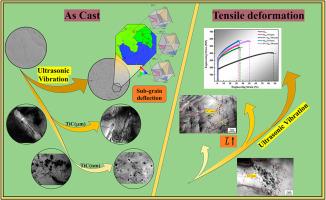
Strength of casting high entropy alloys (HEAs) improved by the introduction of ceramic particle. However, the strengthening process of alloys were hindered by the problem of particle agglomeration seriously. In this paper, the ultrasonic vibration (UV) treatment process was introduced to improve the dispersion of ceramic particles. Al0.4CoCrFe2Ni2 HEAs contain different particle sizes TiC were successfully prepared. Morphology of TiC (μm) change from long straight rod to network structure with UV treatment, and the average dendrite spacing decreases. TiC (nm) particles were dispersed uniformly and agglomeration decreased remarkably. The mean free path () of dislocation motion is increased greatly. Additionally, a new substructure region formed by introducing ceramic phase TiC. Dislocation density increased around substructure region after UV, the energy and driving force provided by UV for the overturning of substructure region to sub-grains. Ultimate tensile strength of UV-Al0.4-TiC (nm) alloy reaches 572 MPa under the action of the second phase, Hall-Petch strengthening and other mechanisms, and the fracture elongation as high as 49.6 %. Compared with the non-ultrasonic alloy, the yield strength is increased by 10 %, and elongation after fracture is increased by 41.3 %. Compared with Al0.4 matrix alloy, the yield strength is increased by 92.8 %. Therefore, the influence of UV assisted treatment on particle reinforced alloys with different sizes was analyzed in this paper. UV assisted treatment proved to provide an effective method to solve the agglomeration of reinforced particles and offer a novel pathway to design cast HEAs with an exceptional amalgamation of strength and ductility.
期刊介绍:
Materials Science and Engineering A provides an international medium for the publication of theoretical and experimental studies related to the load-bearing capacity of materials as influenced by their basic properties, processing history, microstructure and operating environment. Appropriate submissions to Materials Science and Engineering A should include scientific and/or engineering factors which affect the microstructure - strength relationships of materials and report the changes to mechanical behavior.




 京公网安备 11010802042870号
京ICP备2023020795号-1
京公网安备 11010802042870号
京ICP备2023020795号-1

 分享
分享
 求助内容:
求助内容: 应助结果提醒方式:
 扫码关注我们
