Bowen Huang , Renjuan Wang , Wenbin Hu , Hui Xu , Qi Chen , Tiansheng Liu , Yimeng Fan , Yun Kong
{"title":"MOF-808 (Zr-MOF)高效吸附苯氧乙酸农药的制备及性能研究","authors":"Bowen Huang , Renjuan Wang , Wenbin Hu , Hui Xu , Qi Chen , Tiansheng Liu , Yimeng Fan , Yun Kong","doi":"10.1016/j.jiec.2024.08.032","DOIUrl":null,"url":null,"abstract":"<div><div>The organic herbicides of chlorophenoxyacetic acids, including 2,4-dichlorophenoxyacetic acid (2,4-D) and 2-methyl-4-chlorophenoxyacetic acid (MCPA), have posed serious threats to aquatic ecosystems and human health due to extensive use, high solubility and degradation-resistant. In this study, the efficient adsorbent (MOF-808) was synthesized through solvothermal synthesis method and further evaluated for the adsorption performances of 2,4-D and MCPA. Results showed that MOF-808 exhibited the Type I nitrogen adsorption–desorption isotherm with a specific surface area of 2,155 m<sup>2</sup>·g<sup>−1</sup>, pore volume of 0.59 cm<sup>3</sup>·g<sup>−1</sup> and pore size of 1.41 nm. It was suggested that the pseudo-second-order and Langmuir model were much better to illustrate the adsorption performances of MOF-808 for both 2,4-D and MCPA, and the maximum adsorption capacities of 793 and 775 mg·g<sup>−1</sup> were achieved, respectively; besides, the adsorption processes were spontaneous and primarily driven by chemical adsorption with contributions from physical-chemical adsorption. Additionally, the adsorption capacities for 2,4-D and MCPA were decreased with the increasing of pH and cations concentrations; the optimal pH was 3.0 for 2,4-D and 4.0 for MCPA, and the effects of four cations on pesticides adsorption followed the order of Ca<sup>2+</sup> > Mg<sup>2+</sup> > Na<sup>+</sup> > K<sup>+</sup>. Reuse experiments demonstrated that MOF-808 could retain a high removal rate of 95.9 % (2,4-D) and 95.8 % (MCPA) at the fifth cycle. The spectral analysis revealed that the adsorption mechanisms of 2,4-D and MCPA by MOF-808 involved electrostatic interactions, π-π interactions, hydrogen bonding, and complexation. In conclusion, the well-defined physicochemical properties and outstanding adsorption performance of the synthesized MOF-808 may provide a potential application for the removal of chlorophenoxyacetic acid herbicides from real wastewater.</div></div>","PeriodicalId":363,"journal":{"name":"Journal of Industrial and Engineering Chemistry","volume":"143 ","pages":"Pages 293-302"},"PeriodicalIF":7.1000,"publicationDate":"2025-03-25","publicationTypes":"Journal Article","fieldsOfStudy":null,"isOpenAccess":false,"openAccessPdf":"","citationCount":"0","resultStr":"{\"title\":\"Preparation and performance of MOF-808 (Zr-MOF) for the efficient adsorption of phenoxyacetic acid pesticides\",\"authors\":\"Bowen Huang , Renjuan Wang , Wenbin Hu , Hui Xu , Qi Chen , Tiansheng Liu , Yimeng Fan , Yun Kong\",\"doi\":\"10.1016/j.jiec.2024.08.032\",\"DOIUrl\":null,\"url\":null,\"abstract\":\"<div><div>The organic herbicides of chlorophenoxyacetic acids, including 2,4-dichlorophenoxyacetic acid (2,4-D) and 2-methyl-4-chlorophenoxyacetic acid (MCPA), have posed serious threats to aquatic ecosystems and human health due to extensive use, high solubility and degradation-resistant. In this study, the efficient adsorbent (MOF-808) was synthesized through solvothermal synthesis method and further evaluated for the adsorption performances of 2,4-D and MCPA. Results showed that MOF-808 exhibited the Type I nitrogen adsorption–desorption isotherm with a specific surface area of 2,155 m<sup>2</sup>·g<sup>−1</sup>, pore volume of 0.59 cm<sup>3</sup>·g<sup>−1</sup> and pore size of 1.41 nm. It was suggested that the pseudo-second-order and Langmuir model were much better to illustrate the adsorption performances of MOF-808 for both 2,4-D and MCPA, and the maximum adsorption capacities of 793 and 775 mg·g<sup>−1</sup> were achieved, respectively; besides, the adsorption processes were spontaneous and primarily driven by chemical adsorption with contributions from physical-chemical adsorption. Additionally, the adsorption capacities for 2,4-D and MCPA were decreased with the increasing of pH and cations concentrations; the optimal pH was 3.0 for 2,4-D and 4.0 for MCPA, and the effects of four cations on pesticides adsorption followed the order of Ca<sup>2+</sup> > Mg<sup>2+</sup> > Na<sup>+</sup> > K<sup>+</sup>. Reuse experiments demonstrated that MOF-808 could retain a high removal rate of 95.9 % (2,4-D) and 95.8 % (MCPA) at the fifth cycle. The spectral analysis revealed that the adsorption mechanisms of 2,4-D and MCPA by MOF-808 involved electrostatic interactions, π-π interactions, hydrogen bonding, and complexation. In conclusion, the well-defined physicochemical properties and outstanding adsorption performance of the synthesized MOF-808 may provide a potential application for the removal of chlorophenoxyacetic acid herbicides from real wastewater.</div></div>\",\"PeriodicalId\":363,\"journal\":{\"name\":\"Journal of Industrial and Engineering Chemistry\",\"volume\":\"143 \",\"pages\":\"Pages 293-302\"},\"PeriodicalIF\":7.1000,\"publicationDate\":\"2025-03-25\",\"publicationTypes\":\"Journal Article\",\"fieldsOfStudy\":null,\"isOpenAccess\":false,\"openAccessPdf\":\"\",\"citationCount\":\"0\",\"resultStr\":null,\"platform\":\"Semanticscholar\",\"paperid\":null,\"PeriodicalName\":\"Journal of Industrial and Engineering Chemistry\",\"FirstCategoryId\":\"5\",\"ListUrlMain\":\"https://www.sciencedirect.com/science/article/pii/S1226086X24005513\",\"RegionNum\":3,\"RegionCategory\":\"工程技术\",\"ArticlePicture\":[],\"TitleCN\":null,\"AbstractTextCN\":null,\"PMCID\":null,\"EPubDate\":\"2024/8/31 0:00:00\",\"PubModel\":\"Epub\",\"JCR\":\"Q1\",\"JCRName\":\"CHEMISTRY, MULTIDISCIPLINARY\",\"Score\":null,\"Total\":0}","platform":"Semanticscholar","paperid":null,"PeriodicalName":"Journal of Industrial and Engineering Chemistry","FirstCategoryId":"5","ListUrlMain":"https://www.sciencedirect.com/science/article/pii/S1226086X24005513","RegionNum":3,"RegionCategory":"工程技术","ArticlePicture":[],"TitleCN":null,"AbstractTextCN":null,"PMCID":null,"EPubDate":"2024/8/31 0:00:00","PubModel":"Epub","JCR":"Q1","JCRName":"CHEMISTRY, MULTIDISCIPLINARY","Score":null,"Total":0}
Preparation and performance of MOF-808 (Zr-MOF) for the efficient adsorption of phenoxyacetic acid pesticides
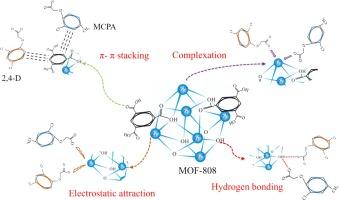
The organic herbicides of chlorophenoxyacetic acids, including 2,4-dichlorophenoxyacetic acid (2,4-D) and 2-methyl-4-chlorophenoxyacetic acid (MCPA), have posed serious threats to aquatic ecosystems and human health due to extensive use, high solubility and degradation-resistant. In this study, the efficient adsorbent (MOF-808) was synthesized through solvothermal synthesis method and further evaluated for the adsorption performances of 2,4-D and MCPA. Results showed that MOF-808 exhibited the Type I nitrogen adsorption–desorption isotherm with a specific surface area of 2,155 m2·g−1, pore volume of 0.59 cm3·g−1 and pore size of 1.41 nm. It was suggested that the pseudo-second-order and Langmuir model were much better to illustrate the adsorption performances of MOF-808 for both 2,4-D and MCPA, and the maximum adsorption capacities of 793 and 775 mg·g−1 were achieved, respectively; besides, the adsorption processes were spontaneous and primarily driven by chemical adsorption with contributions from physical-chemical adsorption. Additionally, the adsorption capacities for 2,4-D and MCPA were decreased with the increasing of pH and cations concentrations; the optimal pH was 3.0 for 2,4-D and 4.0 for MCPA, and the effects of four cations on pesticides adsorption followed the order of Ca2+ > Mg2+ > Na+ > K+. Reuse experiments demonstrated that MOF-808 could retain a high removal rate of 95.9 % (2,4-D) and 95.8 % (MCPA) at the fifth cycle. The spectral analysis revealed that the adsorption mechanisms of 2,4-D and MCPA by MOF-808 involved electrostatic interactions, π-π interactions, hydrogen bonding, and complexation. In conclusion, the well-defined physicochemical properties and outstanding adsorption performance of the synthesized MOF-808 may provide a potential application for the removal of chlorophenoxyacetic acid herbicides from real wastewater.
期刊介绍:
Journal of Industrial and Engineering Chemistry is published monthly in English by the Korean Society of Industrial and Engineering Chemistry. JIEC brings together multidisciplinary interests in one journal and is to disseminate information on all aspects of research and development in industrial and engineering chemistry. Contributions in the form of research articles, short communications, notes and reviews are considered for publication. The editors welcome original contributions that have not been and are not to be published elsewhere. Instruction to authors and a manuscript submissions form are printed at the end of each issue. Bulk reprints of individual articles can be ordered. This publication is partially supported by Korea Research Foundation and the Korean Federation of Science and Technology Societies.




 京公网安备 11010802042870号
京ICP备2023020795号-1
京公网安备 11010802042870号
京ICP备2023020795号-1

 分享
分享
 求助内容:
求助内容: 应助结果提醒方式:
 扫码关注我们
