Guoyu Yang , Shuo Cheng , Xuming Yao , Yuan Tian , Qi Zhao , Junzhen Chen , Yujun Li , Jianjun Jiang
{"title":"模拟森林垂直结构的高性能双面电磁干扰屏蔽仿生多功能复合材料","authors":"Guoyu Yang , Shuo Cheng , Xuming Yao , Yuan Tian , Qi Zhao , Junzhen Chen , Yujun Li , Jianjun Jiang","doi":"10.1016/j.compositesb.2025.112167","DOIUrl":null,"url":null,"abstract":"<div><div>Inspired by the vertical structure of forests, a Ti<sub>3</sub>C<sub>2</sub>T<sub><em>x</em></sub> MXene–short carbon fiber/carbonyl iron/polyurethane composite with a typical “forest-ground” heterogeneous structure was developed. These biomimetic composites comprised a hybrid foam with parallel bramble-like porous microstructures and an MXene film with a layered microstructure. The asymmetric electrical conductivity, provided by the “forest-ground” heterostructure, imparts distinct composite Janus-faced electromagnetic interference (EMI) shielding properties. In the X-band, the composite demonstrated an average total EMI shielding effectiveness (SE<sub>T</sub>) of 55.1 dB, which highlights its superior EMI shielding performance. When the electromagnetic (EM) waves were incident from the hybrid foam, the shielding mechanism was absorption-dominated, with a reflection-shielding effectiveness (SE<sub>R</sub>) of 2.6 dB and a reflection coefficient of 0.45, which corresponds to just 45 % of the incident waves being reflected. This performance is attributed to the synergistic “loss-reflection-loss” effect, multiple scattering, and diverse EM dissipation mechanisms within the hybrid foam. In contrast, when the EM waves were incident from the MXene film, the composite exhibited a reflection-dominated EMI shielding performance, with an SE<sub>R</sub> of 10.6 dB and a reflection coefficient of 0.9, reflecting 90 % of the incident waves. Furthermore, the composite exhibited outstanding mechanical properties with a compressive strength of 2.04 MPa and an elastic modulus of 4.14 MPa. It also demonstrated excellent thermal insulation performance (0.490 W m<sup>−1</sup>K<sup>−1</sup>) and hydrophobicity. This study highlights an effective strategy for creating unique multifunctional Janus-faced EMI shielding materials, expanding their potential for application in complex environments, such as at high-temperatures, beyond the conventional EMI shielding materials.</div></div>","PeriodicalId":10660,"journal":{"name":"Composites Part B: Engineering","volume":"294 ","pages":"Article 112167"},"PeriodicalIF":14.2000,"publicationDate":"2025-04-01","publicationTypes":"Journal Article","fieldsOfStudy":null,"isOpenAccess":false,"openAccessPdf":"","citationCount":"0","resultStr":"{\"title\":\"Biomimetic multifunctional composites mimicking the vertical structure of forest for high-performance Janus-faced electromagnetic interference shielding\",\"authors\":\"Guoyu Yang , Shuo Cheng , Xuming Yao , Yuan Tian , Qi Zhao , Junzhen Chen , Yujun Li , Jianjun Jiang\",\"doi\":\"10.1016/j.compositesb.2025.112167\",\"DOIUrl\":null,\"url\":null,\"abstract\":\"<div><div>Inspired by the vertical structure of forests, a Ti<sub>3</sub>C<sub>2</sub>T<sub><em>x</em></sub> MXene–short carbon fiber/carbonyl iron/polyurethane composite with a typical “forest-ground” heterogeneous structure was developed. These biomimetic composites comprised a hybrid foam with parallel bramble-like porous microstructures and an MXene film with a layered microstructure. The asymmetric electrical conductivity, provided by the “forest-ground” heterostructure, imparts distinct composite Janus-faced electromagnetic interference (EMI) shielding properties. In the X-band, the composite demonstrated an average total EMI shielding effectiveness (SE<sub>T</sub>) of 55.1 dB, which highlights its superior EMI shielding performance. When the electromagnetic (EM) waves were incident from the hybrid foam, the shielding mechanism was absorption-dominated, with a reflection-shielding effectiveness (SE<sub>R</sub>) of 2.6 dB and a reflection coefficient of 0.45, which corresponds to just 45 % of the incident waves being reflected. This performance is attributed to the synergistic “loss-reflection-loss” effect, multiple scattering, and diverse EM dissipation mechanisms within the hybrid foam. In contrast, when the EM waves were incident from the MXene film, the composite exhibited a reflection-dominated EMI shielding performance, with an SE<sub>R</sub> of 10.6 dB and a reflection coefficient of 0.9, reflecting 90 % of the incident waves. Furthermore, the composite exhibited outstanding mechanical properties with a compressive strength of 2.04 MPa and an elastic modulus of 4.14 MPa. It also demonstrated excellent thermal insulation performance (0.490 W m<sup>−1</sup>K<sup>−1</sup>) and hydrophobicity. This study highlights an effective strategy for creating unique multifunctional Janus-faced EMI shielding materials, expanding their potential for application in complex environments, such as at high-temperatures, beyond the conventional EMI shielding materials.</div></div>\",\"PeriodicalId\":10660,\"journal\":{\"name\":\"Composites Part B: Engineering\",\"volume\":\"294 \",\"pages\":\"Article 112167\"},\"PeriodicalIF\":14.2000,\"publicationDate\":\"2025-04-01\",\"publicationTypes\":\"Journal Article\",\"fieldsOfStudy\":null,\"isOpenAccess\":false,\"openAccessPdf\":\"\",\"citationCount\":\"0\",\"resultStr\":null,\"platform\":\"Semanticscholar\",\"paperid\":null,\"PeriodicalName\":\"Composites Part B: Engineering\",\"FirstCategoryId\":\"5\",\"ListUrlMain\":\"https://www.sciencedirect.com/science/article/pii/S1359836825000575\",\"RegionNum\":1,\"RegionCategory\":\"材料科学\",\"ArticlePicture\":[],\"TitleCN\":null,\"AbstractTextCN\":null,\"PMCID\":null,\"EPubDate\":\"2025/1/27 0:00:00\",\"PubModel\":\"Epub\",\"JCR\":\"Q1\",\"JCRName\":\"ENGINEERING, MULTIDISCIPLINARY\",\"Score\":null,\"Total\":0}","platform":"Semanticscholar","paperid":null,"PeriodicalName":"Composites Part B: Engineering","FirstCategoryId":"5","ListUrlMain":"https://www.sciencedirect.com/science/article/pii/S1359836825000575","RegionNum":1,"RegionCategory":"材料科学","ArticlePicture":[],"TitleCN":null,"AbstractTextCN":null,"PMCID":null,"EPubDate":"2025/1/27 0:00:00","PubModel":"Epub","JCR":"Q1","JCRName":"ENGINEERING, MULTIDISCIPLINARY","Score":null,"Total":0}
引用次数: 0
摘要
受森林垂直结构的启发,开发了具有典型“森林-地面”异质结构的Ti3C2Tx mxen -短碳纤维/羰基铁/聚氨酯复合材料。这些仿生复合材料包括具有平行荆棘状多孔微结构的混合泡沫和具有层状微结构的MXene薄膜。由“森林地面”异质结构提供的不对称导电性赋予了独特的复合双面电磁干扰(EMI)屏蔽性能。在x波段,该复合材料的平均总EMI屏蔽效能(SET)为55.1 dB,突出了其优越的EMI屏蔽性能。当电磁波从混合泡沫中入射时,屏蔽机制以吸收为主,反射屏蔽效率为2.6 dB,反射系数为0.45,对应于只有45%的入射波被反射。这种性能归因于混合泡沫内的协同“损耗-反射-损耗”效应、多重散射和多种电磁耗散机制。相比之下,当电磁波从MXene薄膜入射时,复合材料表现出以反射为主的EMI屏蔽性能,SER为10.6 dB,反射系数为0.9,反射了90%的入射波。复合材料具有优异的力学性能,抗压强度为2.04 MPa,弹性模量为4.14 MPa。它还具有优异的保温性能(0.490 W m−1K−1)和疏水性。这项研究强调了一种创造独特多功能双面电磁干扰屏蔽材料的有效策略,扩大了它们在复杂环境(如高温)中的应用潜力,超越了传统的电磁干扰屏蔽材料。
Biomimetic multifunctional composites mimicking the vertical structure of forest for high-performance Janus-faced electromagnetic interference shielding
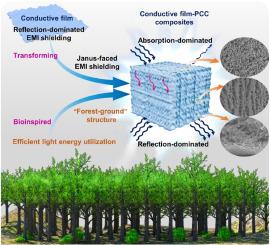
Inspired by the vertical structure of forests, a Ti3C2Tx MXene–short carbon fiber/carbonyl iron/polyurethane composite with a typical “forest-ground” heterogeneous structure was developed. These biomimetic composites comprised a hybrid foam with parallel bramble-like porous microstructures and an MXene film with a layered microstructure. The asymmetric electrical conductivity, provided by the “forest-ground” heterostructure, imparts distinct composite Janus-faced electromagnetic interference (EMI) shielding properties. In the X-band, the composite demonstrated an average total EMI shielding effectiveness (SET) of 55.1 dB, which highlights its superior EMI shielding performance. When the electromagnetic (EM) waves were incident from the hybrid foam, the shielding mechanism was absorption-dominated, with a reflection-shielding effectiveness (SER) of 2.6 dB and a reflection coefficient of 0.45, which corresponds to just 45 % of the incident waves being reflected. This performance is attributed to the synergistic “loss-reflection-loss” effect, multiple scattering, and diverse EM dissipation mechanisms within the hybrid foam. In contrast, when the EM waves were incident from the MXene film, the composite exhibited a reflection-dominated EMI shielding performance, with an SER of 10.6 dB and a reflection coefficient of 0.9, reflecting 90 % of the incident waves. Furthermore, the composite exhibited outstanding mechanical properties with a compressive strength of 2.04 MPa and an elastic modulus of 4.14 MPa. It also demonstrated excellent thermal insulation performance (0.490 W m−1K−1) and hydrophobicity. This study highlights an effective strategy for creating unique multifunctional Janus-faced EMI shielding materials, expanding their potential for application in complex environments, such as at high-temperatures, beyond the conventional EMI shielding materials.
期刊介绍:
Composites Part B: Engineering is a journal that publishes impactful research of high quality on composite materials. This research is supported by fundamental mechanics and materials science and engineering approaches. The targeted research can cover a wide range of length scales, ranging from nano to micro and meso, and even to the full product and structure level. The journal specifically focuses on engineering applications that involve high performance composites. These applications can range from low volume and high cost to high volume and low cost composite development.
The main goal of the journal is to provide a platform for the prompt publication of original and high quality research. The emphasis is on design, development, modeling, validation, and manufacturing of engineering details and concepts. The journal welcomes both basic research papers and proposals for review articles. Authors are encouraged to address challenges across various application areas. These areas include, but are not limited to, aerospace, automotive, and other surface transportation. The journal also covers energy-related applications, with a focus on renewable energy. Other application areas include infrastructure, off-shore and maritime projects, health care technology, and recreational products.




 京公网安备 11010802042870号
京ICP备2023020795号-1
京公网安备 11010802042870号
京ICP备2023020795号-1

 分享
分享
 求助内容:
求助内容: 应助结果提醒方式:
 扫码关注我们
