Mingming Yu , Mujaheed Halliru Saad , Xiangyu Lin , Fuhao Dong , Xu Fan , Xu Xu , He Liu , Zhanqian Song
{"title":"协同的多个氢键和可逆结晶效应使超坚韧、自愈和可回收的纤维素增强弹性体成为可能","authors":"Mingming Yu , Mujaheed Halliru Saad , Xiangyu Lin , Fuhao Dong , Xu Fan , Xu Xu , He Liu , Zhanqian Song","doi":"10.1016/j.compscitech.2024.111014","DOIUrl":null,"url":null,"abstract":"<div><div>Incorporating dynamic covalent bonds into polyurethane (PU) elastomers contributes to exceptional self-healing and recyclable properties. However, further applications are seriously limited due to unsatisfying mechanical characteristics. Herein, a self-healing and ultra-robust nanocomposite elastomer is presented here that consists of polyurethane matrix and cellulose nanocrystals through the synergistic gradient hydrogen bonds and strain-induced reversible crystallization effect. Multiple dynamic hydrogen bonds formed between cellulose nanocrystals (CNC) and polyurethane (PHHD) together with the strain-induced reversible crystallized physical network facilitate excellent mechanical properties while maintaining favorable self-healing ability. The introduction of cellulose nanocrystals significantly enhanced the binding energy of the nanocomposite polyurethane elastomer system, exhibiting an increase of 204.32 kJ/mol. Consequently, nanocomposite elastomers display a remarkable tensile strength (up to 50.1 MPa), ultra-high toughness (441.6 MJ/m<sup>3</sup>), and excellent fracture energy (214.5 kJ/m<sup>2</sup>) Furthermore, the result found that the introduction of cellulose nanocrystals can reduce the reaction activation energy and obtain nanocomposite elastomers with highly efficient self-healing (93.9 %). The innovative approach is expected to facilitate the development of high-strength, tough, and exceptional self-healing elastomers in academia and industry.</div></div>","PeriodicalId":283,"journal":{"name":"Composites Science and Technology","volume":"261 ","pages":"Article 111014"},"PeriodicalIF":9.8000,"publicationDate":"2025-03-01","publicationTypes":"Journal Article","fieldsOfStudy":null,"isOpenAccess":false,"openAccessPdf":"","citationCount":"0","resultStr":"{\"title\":\"Synergistic multiple hydrogen bonds and reversible crystallization effect enable ultra-tough, self-healing, and recyclable cellulose-enhanced elastomer\",\"authors\":\"Mingming Yu , Mujaheed Halliru Saad , Xiangyu Lin , Fuhao Dong , Xu Fan , Xu Xu , He Liu , Zhanqian Song\",\"doi\":\"10.1016/j.compscitech.2024.111014\",\"DOIUrl\":null,\"url\":null,\"abstract\":\"<div><div>Incorporating dynamic covalent bonds into polyurethane (PU) elastomers contributes to exceptional self-healing and recyclable properties. However, further applications are seriously limited due to unsatisfying mechanical characteristics. Herein, a self-healing and ultra-robust nanocomposite elastomer is presented here that consists of polyurethane matrix and cellulose nanocrystals through the synergistic gradient hydrogen bonds and strain-induced reversible crystallization effect. Multiple dynamic hydrogen bonds formed between cellulose nanocrystals (CNC) and polyurethane (PHHD) together with the strain-induced reversible crystallized physical network facilitate excellent mechanical properties while maintaining favorable self-healing ability. The introduction of cellulose nanocrystals significantly enhanced the binding energy of the nanocomposite polyurethane elastomer system, exhibiting an increase of 204.32 kJ/mol. Consequently, nanocomposite elastomers display a remarkable tensile strength (up to 50.1 MPa), ultra-high toughness (441.6 MJ/m<sup>3</sup>), and excellent fracture energy (214.5 kJ/m<sup>2</sup>) Furthermore, the result found that the introduction of cellulose nanocrystals can reduce the reaction activation energy and obtain nanocomposite elastomers with highly efficient self-healing (93.9 %). The innovative approach is expected to facilitate the development of high-strength, tough, and exceptional self-healing elastomers in academia and industry.</div></div>\",\"PeriodicalId\":283,\"journal\":{\"name\":\"Composites Science and Technology\",\"volume\":\"261 \",\"pages\":\"Article 111014\"},\"PeriodicalIF\":9.8000,\"publicationDate\":\"2025-03-01\",\"publicationTypes\":\"Journal Article\",\"fieldsOfStudy\":null,\"isOpenAccess\":false,\"openAccessPdf\":\"\",\"citationCount\":\"0\",\"resultStr\":null,\"platform\":\"Semanticscholar\",\"paperid\":null,\"PeriodicalName\":\"Composites Science and Technology\",\"FirstCategoryId\":\"88\",\"ListUrlMain\":\"https://www.sciencedirect.com/science/article/pii/S0266353824005852\",\"RegionNum\":1,\"RegionCategory\":\"材料科学\",\"ArticlePicture\":[],\"TitleCN\":null,\"AbstractTextCN\":null,\"PMCID\":null,\"EPubDate\":\"2024/12/15 0:00:00\",\"PubModel\":\"Epub\",\"JCR\":\"Q1\",\"JCRName\":\"MATERIALS SCIENCE, COMPOSITES\",\"Score\":null,\"Total\":0}","platform":"Semanticscholar","paperid":null,"PeriodicalName":"Composites Science and Technology","FirstCategoryId":"88","ListUrlMain":"https://www.sciencedirect.com/science/article/pii/S0266353824005852","RegionNum":1,"RegionCategory":"材料科学","ArticlePicture":[],"TitleCN":null,"AbstractTextCN":null,"PMCID":null,"EPubDate":"2024/12/15 0:00:00","PubModel":"Epub","JCR":"Q1","JCRName":"MATERIALS SCIENCE, COMPOSITES","Score":null,"Total":0}
Synergistic multiple hydrogen bonds and reversible crystallization effect enable ultra-tough, self-healing, and recyclable cellulose-enhanced elastomer
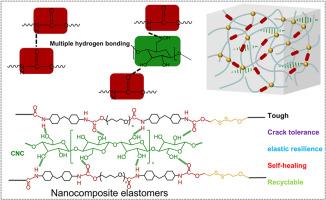
Incorporating dynamic covalent bonds into polyurethane (PU) elastomers contributes to exceptional self-healing and recyclable properties. However, further applications are seriously limited due to unsatisfying mechanical characteristics. Herein, a self-healing and ultra-robust nanocomposite elastomer is presented here that consists of polyurethane matrix and cellulose nanocrystals through the synergistic gradient hydrogen bonds and strain-induced reversible crystallization effect. Multiple dynamic hydrogen bonds formed between cellulose nanocrystals (CNC) and polyurethane (PHHD) together with the strain-induced reversible crystallized physical network facilitate excellent mechanical properties while maintaining favorable self-healing ability. The introduction of cellulose nanocrystals significantly enhanced the binding energy of the nanocomposite polyurethane elastomer system, exhibiting an increase of 204.32 kJ/mol. Consequently, nanocomposite elastomers display a remarkable tensile strength (up to 50.1 MPa), ultra-high toughness (441.6 MJ/m3), and excellent fracture energy (214.5 kJ/m2) Furthermore, the result found that the introduction of cellulose nanocrystals can reduce the reaction activation energy and obtain nanocomposite elastomers with highly efficient self-healing (93.9 %). The innovative approach is expected to facilitate the development of high-strength, tough, and exceptional self-healing elastomers in academia and industry.
期刊介绍:
Composites Science and Technology publishes refereed original articles on the fundamental and applied science of engineering composites. The focus of this journal is on polymeric matrix composites with reinforcements/fillers ranging from nano- to macro-scale. CSTE encourages manuscripts reporting unique, innovative contributions to the physics, chemistry, materials science and applied mechanics aspects of advanced composites.
Besides traditional fiber reinforced composites, novel composites with significant potential for engineering applications are encouraged.




 京公网安备 11010802042870号
京ICP备2023020795号-1
京公网安备 11010802042870号
京ICP备2023020795号-1

 分享
分享
 求助内容:
求助内容: 应助结果提醒方式:
 扫码关注我们
